
NEW
Font size
 Worksheets
Half-Life
Total questions: 10
Worksheet time: 11mins
Radioactive carbon-14 is often useful in determining the absolute age of geologic samples because radioactive isotopes
decay at a regular rate
become less stable during decay
remain unchanged over time
stabilize after four half-lives
What percentage of rubidium-87 atoms will be left after four half lives?
25.0%
12.5%
6.25%
3.125%
Radioactive decay of 40K atoms in an igneous rock has resulted in a ratio of 25 percent 40K atoms to 75 percent. 40Ar and 40Ca atoms. How many years old is this rock?
0.3 x 10^9 years
1.3 x 10^9 years
2.6 x 10^9 years
3.9 x 10^9 years

The solid black sections of the bars on the graph represent the percentages of
carbon-14 from the original sample that has not decayed
lead-206 decay product resulting from the radioactive decay
nitrogen-14 decay product resulting from the radioactive decay
uranium-238 from the original sample that has not decayed
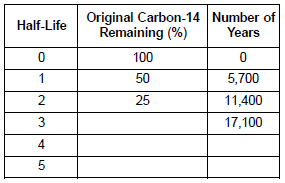
After 22,800 years, approximately what percentage of the original carbon-14 remains?
15%
12.5%
6.25%
3.125%
Which radioactive element is used to determine the absolute age of late Pleistocene animal remains?
rubidium-87
uranium-238
potassium-40
carbon-14
How much of an 800-gram sample of potassium-40 will remain after 3.9 × 10^9 years of radioactive decay?
50 grams
100 grams
200 grams
400 grams

Which diagram best represents the percentage of this radioactive isotope sample that will remain after 2 half-lives?


A sample of wood that originally contained 100 grams of carbon-14 now contains only 25 grams of carbon-14. Approximately how many years ago was this sample part of a living tree?
2,850 years
5,700 years
11,400 years
17,100 years
A bone sample contains only 1/4 of its original radioactive C14 content. How old is the bone sample?
1 C14 half-life
2 C14 half-lives
3 C14 half-lives
4 C14 half-lives

