wayground logo

Free Printable Worksheets

NEW

Font size

S
M
L
XL
Worksheets

Tectonics GW1

Total questions: 28

Worksheet time: 18mins

Name
Class
Date
1.
The physical layer of Earth made of solid rock and soil is called the ___________. 
a)
mesosphere
b)
lithosphere
c)
asthenosphere
d)
mantle
2.
The type of plate boundary where two plates come together is a .....
a)
Convergent Boundary
b)
Divergent Boundary
c)
Transform Boundary
d)
Plate Boundary
3.
Which of the following causes Earth's tectonic plates to move?
a)
Energy from the Sun
b)
Magnetic Pole Reversal
c)
Convection currents in the mantle
d)
Faults in Mountain Ranges
4.
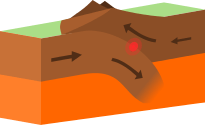
What type of plate boundary is this?
a)
Plate
b)
Divergent
c)
Convergent
d)
Transform
5.
What type of event will occur at this boundary?
a)
Earthquake
b)
Volcano Eruption
c)
Tornado
d)
Mountain Building
6.
A divergent boundary occurs when plates ....
a)
Pull apart
b)
Come together
c)
Slide past each other
d)
subducting
7.
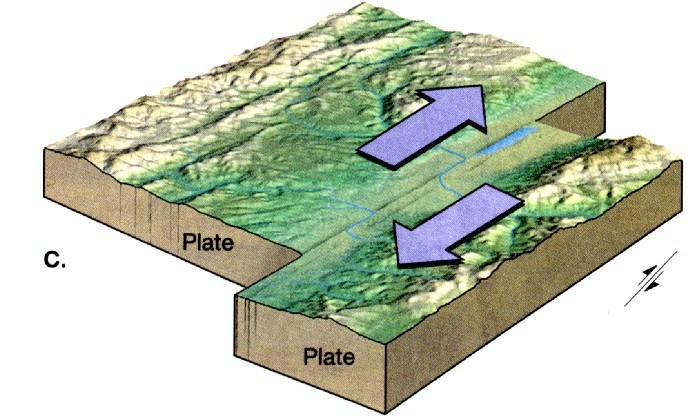
What type of plate boundary is this?
a)
Transform
b)
Convergent
c)
Divergent
d)
Plate
8.

Oceanic Trenches are formed by _______ plate boundaries

a)

Convergent

b)

Transform

c)

Convergent and divergent

d)

Divergent

9.

Islands can form from magma which is pushed up at a __________ plate boundary

a)

Divergent

b)

Convergent

c)

Transform

10.
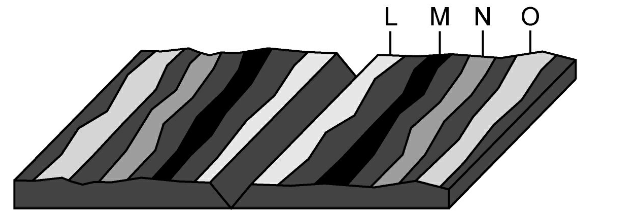
Where would the oldest rock be found?
a)
L
b)
M
c)
N
d)
O
11.
Mountains are created when....
a)
Two continental plates collide
b)
Two oceanic plates pull apart
c)
An Oceanic plate subducts under a Continental Plate
d)
Two continental plates pull apart
12.
How is it possible for new crust to be formed without increasing the surface area of the Earth?
a)
Crust is destroyed at the same time it is created
b)
New crust is underwater where it sinks
c)
New crust breaks more easily than old crust
13.
The Great Rift Valley in Africa and the Mid-Ocean Ridge were all created by this boundary
a)
Divergent
b)
Convergent
c)
Reform
d)
Transform
14.
What are the two types of crust
a)
continental and oceanic
b)
ocean and upper
c)
lower and upper
d)
pizza and subway
15.

Transform boundaries are most likely to produce what phenomenon?

a)

volcanic eruption

b)

deep sea typhoon

c)

underwater eruption

d)

earthquakes

16.
When an oceanic plate and a continental plate collide, which one will subduct?
a)
oceanic
b)
continental
c)
neither
17.

This landform can occur at a divergent plate boundary.

a)

ocean trench

b)

mid-oceanic ridge

c)

tall mountains

d)

transform fault

18.
A subduction zone is formed...
a)
when one tectonic plate sinks below another
b)
at every type of convergent plate boundary
c)
at every type of divergent plate boundary
d)
at transform boundaries
19.
The process by which molten material adds new oceanic crust to the ocean floor is called ___________.
a)
Divergent boundary
b)
Sea-floor spreading
c)
Convergent boundary
d)
Renovating 
20.

A _________ is a valley that forms where two continental plates move apart.

a)

Fissure

b)

Rift valley

c)

Sea-floor spreading

d)

Fault

21.
The Himalayan mountains have some of the highest peaks like Mt. Everest, on which type of convergent boundary are they located?
a)
Oceanic/Continental
b)
Oceanic/Oceanic
c)
Continental/Continental
d)
None of the above
22.
What type of rock makes most of the oceanic crust
a)
Sedimentary
b)
Basalt
c)
Metamorphic
d)
Limestone
23.
The San Andréa fault in California is one example of a...  
a)
Divergent boundary
b)
Convergent boundary
c)
Transform boundary
d)
All of the above
24.

What two mechanisms do scientists think help tectonic plates move?

a)

Convection currents and slab pull force

b)

Slab pull force and convention currents

c)

Slab pull and reaction forces

d)

Gravitational and Rotational pull

e)

Convention currents and gravity

25.

What is the correct order (starting from the surface) of Earth’s layers?

a)

crust, outer core, inner core, mantle

b)

mantle, outer core, inner core, crust

c)

crust, mantle, outer core, inner core

d)

outer core, inner core, crust, mantle

26.

Scientists think that convection currents flow in Earth’s

a)

continents.

b)

mantle.

c)

lithosphere.

d)

inner core.

27.
This layer of Earth is the thickest part
a)
crust
b)
outer core
c)
mantle
d)
inner core
28.
What is Pangaea?
a)
the name of a German scientist
b)
the name of the super-continent that existed millions of years ago
c)
another name for continental drift
d)
the name of an ancient fossil