
Font size
 Worksheets
World History: World War I
Total questions: 106
Worksheet time: 1hrs 24mins
The partial outline below describes what important historical developments?
I. ____________________
A. Growing nationalism in Europe
B. Growing militarism in Europe
C. The creation of secret alliances
The colonization of Africa and Asia
The rise of democracy
The causes of communism
The causes of WWI
Why were the Balkans referred to as the "Powder Keg of Europe" in the period prior to World War I?
Because of the large deposits of saltpeter and sulfur in the region
Because of the manufacturing ability of the nations in the region
Because of the nationalistic rivalries that existed in the region
Because of the vast stockpiles of weapons in the region
How did the Triple Entente and the Triple Alliance contribute to the start of World War I?
By issuing threats against nations in the Western Hemisphere
By increasing tensions between the nations of Europe through complicated alliances
By refusing to allow Germany and France to become members
By ignoring aggressive actions by the Japanese in Korea
The assassination of Archduke Franz Ferdinand was the immediate cause of which conflict?
World War I
The Franco-Prussian War
World War II
The Russo-Japanese War
Which of the following best explains why the growth of European alliances during the early twentieth century contributed to the onset of a vast conflict?
Progress achieved by allies in weapons development led to an arms race.
The sense of security among allies distracted them from emerging threats.
Suspicions of disloyalty among allies caused international tensions to rise.
The responsibilities of allies drew them into taking sides in regional fights.
In which country did the rise of nationalism lead most directly to events causing the outbreak of World War I?
Serbia
Russia
France
Germany
Which of the following best describes warfare during World War I?
Naval battles between ships fighting over trade routes
Quick attacks with coordinated aircraft, artillery, and infantry
Guerrilla combatants attacking from behind trees and in cities
Soldiers digging in trenches and coming out over the top to attack
Using its industrial might to prepare for World War I, Germany was ____________ (Complete this sentence using the best possible answer below)
unable to prevent workers from striking
able to produce weapons at maximum capacity, matching the industrial might of rival England
unable to produce enough supplies to remain in the war
able to produce enough submarines to sink the British fleet
Which of the following were most helpful in ending the stalemate of trench warfare during World War I? (Think, which of these options successfully overcame trench warfare by breaking through enemy troop formations)
Airplanes and U-boats
Tanks and airplanes
Hand grenades and U-boats
Mines and hand grenades
Which of the following had the most influence on the United States' decision to enter World War I?
The entry of the Ottoman Empire
The capture of Paris by the Germans
Unrestricted submarine warfare by the Germans leading to the sinking of the U.S.S. Lusitania
Mexico's insinuation that it would ally itself with Germany
Which statement about the technology developed during World War I is correct?
The new technology led to fewer refugees being displaced from their homes during the conflict.
The new technology created deadlier weapons which led to increased military casualties in battles fought during the conflict.
The new technology led to smaller nations joining large empires following the conflict.
The new technology led to a reduced focus on transportation improvements following the conflict.
Read the excerpt below and answer the question that follows.
"To keep out the chill night winds the men had spread their shelter halves over the foxholes which had been dug into the side of the bank. When the enemy’s barrage opened it was directed particularly at this spot, where he believed the infantry was lying in readiness to go over. It was not surprising, then, that the entire vicinity was thoroughly bombarded. In quick succession the shells struck, many of them so near that they blew men to pieces less than ten feet from us and peppered our shelter halves with stones and lumps of mud, leaving many of them perforated like sieves."
— William L. Langer, Gas and Flame in World War I, Knopf/Borzoi
Which characteristic of warfare associated with World War I is described in the excerpt?
Trench warfare
Air Warfare
Submarine warfare
Armored warfare
Which factor contributed most to the beginning of World War I? (Think, which cause of WWI turned a regional conflict into a international conflict)
communist ideology
economic depression
secret alliances
territorial disputes
Which countries were members of the Triple Alliance, later known as the Central Powers? Pick all below options that apply.
Great Britain
France
Russia
Austria-Hungary
Ottoman Empire
Which nations were members of the Triple Entente, later know as the Allies? Select all below options that apply.
Germany
Italy
Great Britain
Austria-Hungary
Russia
All of the following are regarded as primary causes of World War I except___________
alliances.
nationalism.
militarism.
communism.
Imperialism.
Which statement best describes militarism?
establishing a classless society through government force
the policy of maintaining a large armed force for the aggressive pursuit of national interests
the policy of requiring citizens to serve during a country crisis
restricting the activities of the army when maintaining public order
Germany’s entrance into World War I was based on a pre-arranged agreement with Austria-Hungary. This is an example of ___________ (Think, main causes for WWI)
a treaty.
a contract.
an ultimatum.
an alliance.
What was an immediate result of the assassination of Archduke Franz Ferdinand in 1914?
Germany signed a peace treaty
Great Britain formed an alliance with Belgium
Russia’s monarch was overthrown
Austria-Hungary declared war on Serbia after delivering an unworkable ultimatum
Which event in World War I indicated the Schlieffen Plan had failed?
Great Britain was unable to gain control of the Dardanelles.
Germany was unable to defeat France quickly at the outset of war in 1914.
Austria-Hungary was unable to suppress nationalist rebels.
Russia was unable to suppress a communist revolution.

What was the "New Deal" of the 1930s?
a government program that gave free land to homesteaders
a government program that helped women get the vote
a government program that spread civil rights throughout the country
a government program designed to help people during the depression

Which army did he volunteer for?
French
German
American
British

Where was Hitler born?
Germany
Poland
Berlin
Austria
Why did Hitler hate Jews?
There is no reason
He does not like their culture.
He thinks they are mean.
He believes they caused Germany to lose WW1.
What is the year he got in office?
1927
1933
1945
1914
What does Mein Kampf translate to?
Hooray for Germany
My Story
Your Faith
My Struggle
Did Mussolini ever believe in Socialism?
Yes
No

Who were the 'Blackshirts'?
Retired WWII veterans
Unemployed Tradesman
People who believed in Communism
Retired WWI veterans
In what month and year was the 'March on Rome'?
Oct, 1921
Oct, 1922
Sept, 1921
Sept, 1922

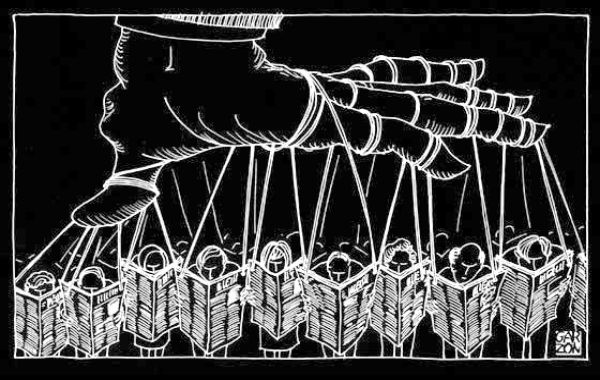
What type of picture is this and who was it aimed at?
Election Poster / Peasant Farmers
Propaganda / Industrialist
Propaganda / Peasant Farmers
Which of the following is an effect Hitler’s reign had on Germany during the 1930’s?
Unemployment became a much bigger problem in Germany
Hitler made Germany smaller in hopes to strengthen the economy
Hitler built up the German army, and unemployment decreased dramatically
What is the best definition of Fascism?
An extreme form of nationalistic militarism
An ideology that guaranteed basic rights for all citizens
An ideology that got rid of social classes

Why were the Italians unhappy with the Treaty of Versailles?
They lost Land
They did not get what they felt they were promised by the Allies.
They did not get participate in the Treaty negotiations.
They allies demilitarized the Italo-Austrian border.


A major goal of Joseph Stalin’s five-year plan was to...
encourage communist revolutions in the
colonies of the European powers
transform the Soviet Union into an
industrial power
expand the Soviet Union’s borders to
include warm-water ports
reduce the amount of foreign aid coming
from the Western Hemisphere
Totalitarian countries are characterized by
free and open discussions of ideas
a multiparty system with several
candidates for each office
government control of newspapers, radio
and television
government protection of people’s civil
liberties
-Collectivization
-Five-year plan
-Restrictions on the press
-Purges of Communist Party
Which title best completes these headlines?
Saddam Hussein and the Persian Gulf
War
Sun Yat-sen and the Defeat
of the Manchu Dynasty
Joseph Stalin and the Rise of a
Totalitarian State
Jawaharlal Nehru and the Modern
Industrial State of India
Which condition was a result of Joseph Stalin’s
command economy?
Peasants were encouraged to sell surplus
grain for personal profit.
The production of consumer goods
increased
National revenue increased allowing for
greater individual spending
The government controlled agriculture
through collective farms
In the Soviet Union, Joseph Stalin governed by
means of secret police, censorship, and purges.
This type of government is called
democracy
limited monarchy
theocracy
totalitarian
What was one reason that totalitarian dictatorships gained power in Europe between World War I and World War II?
Famine and AIDS spread throughout Europe.
Trade was banned between western and eastern Europe.
Governments failed to meet the needs of the people.
Monarchies were reinstated in many nations
A totalitarian society is one in which
religious beliefs are supported by the government
the state is considered a servant of the citizens
the government controls most aspects of life
citizens have say over the government

