
 Worksheets
Unit 4 and 5 Review
Total questions: 126
Worksheet time: 7hrs 43mins
Name
Class
Date
1.
We can use SOH-CAH-TOA for...
a)
Any triangle ever
b)
Non-right triangles only
c)
Right Triangles only
d)
Never
2.
The ratio in a right triangle of adjacent to hypotenuse is _____
a)
sine
b)
cosine
c)
tangent
d)
inverse cosine
3.
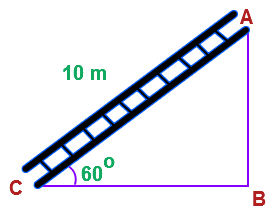
Find side AB?
a)
20 m
b)
5 m
c)
11.54 m
d)
8.66 m
4.
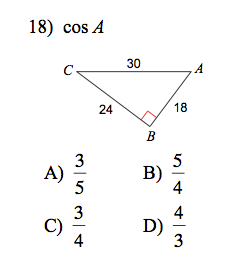
Choose the correct ratio.
a)
A
b)
B
c)
C
d)
D
5.
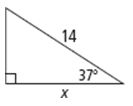
Choose the correct ratio.
a)
sin(37)=x/14
b)
cos(37)=x/14
c)
tan(37)=x/14
d)
sin(37)=14/x
6.

Find the length of side w.
a)
21.4 cm
b)
18.0 cm
c)
36.5 cm
d)
43.6 cm
7.
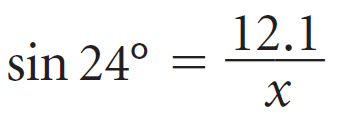
Solve for x.
a)
24.20
b)
4.92
c)
290.4
d)
29.75
8.
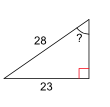
Find the measure of the indicated angle (?) round to the nearest tenth.
a)
9.4
b)
55.2
c)
20.15
d)
19.4
9.
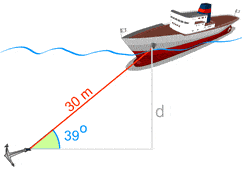
Solve for the misssing distance
a)
18.9
b)
19.5
c)
47
d)
27.5
10.
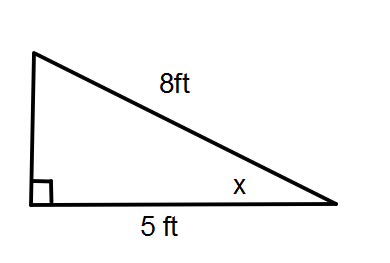
Which scenario describes the picture shown?
a)
A 5 foot ramp is 8 feet away from a building. What is the angle that the ramp makes with the ground?
b)
A 5 foot ramp leans against an 8 foot structure. What is the angle that the ramp makes with the ground?
c)
An 8 foot ramp leans
against a building 5 feet away. What angle does the ramp make with the ground?
against a building 5 feet away. What angle does the ramp make with the ground?
d)
A 5 foot man is 8 feet away from a building. What is the angle of elevation?
11.

Solve for x.
a)
10
b)
11.3
c)
12.0
d)
15.0
12.

Solve for the missing angle
a)
32°
b)
44°
c)
61°
d)
50°
13.
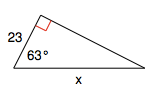
Solve for x.
a)
50.7
b)
50.1
c)
60.7
d)
61.0
14.
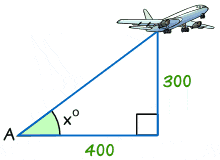
Solve for the missing angle.
a)
50.5 degrees
b)
12.7 degrees
c)
36.9 degrees
d)
72.2 degrees
15.

Solve for x.
a)
30°
b)
45°
c)
60°
d)
90°
16.

Angles a and e are what type of angles?
a)
Vertical Angles
b)
Corresponding Angles
c)
Alternate Interior Angles
d)
Alternate Exterior Angles
17.

Angles e and d are what type of angles?
a)
Vertical Angles
b)
Corresponding Angles
c)
Alternate Interior Angles
d)
Alternate Exterior Angles
18.

Fill in the missing proofs.
a)
Transitive Property, SAS(Side-Angle-Side)
b)
Reflexive Property, SAS(Side-Angle-Side)
c)
Reflexive Property, Vertical Angles Thm.
d)
Transitive Property, SSS(Side-Side-Side)
19.

a)
Transitive Property, SAS(Side-Angle-Side)
b)
Reflexive Property, SAS(Side-Angle-Side)
c)
Transitive Property, SSS(Side-Side-Side)
d)
Reflexive Property, SSS(Side-Side-Side)
20.

What is the "statement" for step 3 of the proof?
a)
∡EDA≅∡DCB
b)
∡AED≅∡BEC
c)
DE=CE
d)
∡AED≅∡CED
21.

What is the "reason" for step 4 of the proof?
a)
proof
b)
AAS
≅ Thrm
≅ Thrm
c)
ASA
≅ Thrm
≅ Thrm
d)
SAS
≅ Thrm
≅ Thrm
22.

What is the "statement" for step 2 of the proof?
a)
∆BAC≅∆DAC
b)
BC=DC
c)
∡B≅∡D
d)
∡BAC≅∡DAC
23.

What is the "reason" for step 4 of the proof?
a)
SAS
≅ theorem
≅ theorem
b)
ASA
≅ theorem
≅ theorem
c)
SSA
≅ theorem
≅ theorem
d)
CPTCT
theorem
theorem
24.

What is the "reason" for step 5 of the proof?
a)
Vertical Angle Theorem
b)
proof
c)
def. of angle bisector
d)
CPCTC Theorem
25.

What is the "statement" for step 3 of the proof?
a)
AD=DA
b)
AD=AD
c)
HD=ND
d)
HD=DN
26.

What is the "statement" for step 2 of the proof?
a)
AD=AD
b)
AD=DA
c)
HD=DN
d)
HD=ND
27.

Determine if the triangles are congruent, if "yes" state the theorem.
a)
yes, SAS
b)
not congruent
c)
yes, ASA
d)
yes, AAS
28.

Determine if the triangles are congruent, if "yes" state the theorem.
a)
not congruent
b)
yes, SSS
c)
yes, SAS
d)
yes, ASA
29.

Determine if the triangles are congruent, if "yes" state the theorem.
a)
yes, AAS
b)
yes, SAS
c)
yes, ASA
d)
not congruent
30.

What is the "statement" for step 2 of the proof?
a)
∡JHI≅∡JKL
b)
JL=JI
c)
∡H≅∡K
d)
HI=KL
31.

What is the "reason" for step 3 of the proof?
a)
Proof
b)
Def. of Midpoint
c)
Reflexive Property
d)
Vertical angle Theorem
32.

What is the "statement" for step 3 of the proof?
a)
∡JKL≅∡JHI
b)
JI=JL
c)
∡KJL≅∡HJI
d)
∡JLK≅∡JIH
33.

What is the "reason" for step 5 of the proof?
a)
Angle Bisector Theorem
b)
Reflexive property
c)
CPCTC Theorem
d)
Proof
34.

What is the "statement" for step 3 of the proof?
a)
HA=HA
b)
HA=AH
c)
MA=AM
d)
MA=MA
35.

What is the "statement" for step 4 of the proof?
a)
∡MAH≅∡THA
b)
∆MHA≅∆THA
c)
HM=AT
d)
∆MAH≅∆THA
36.

What is the "statement" for step 5 of the proof?
a)
HM=AT
b)
HM=TA
c)
∆MAH≅∆THA
d)
∡MAH≅∡THA
37.

What would be the correct "given" statements for this diagram?
a)
T is the midpoint of segment BG and
∡B≅∡G
∡B≅∡G
b)
∡B≅∡G and ∡A≅∡W
c)
T is the midpoint of segment BG and ∡A≅∡W
d)
T is the midpoint of segment AW and ∡A≅∡W
38.

What would be the correct "given" statements for this diagram?
a)
∡A≅∡C, and segment DB is the angle bisector of ∡CDA
b)
BD=BD, and DB=DB
c)
∡A≅∡C, and segment DB is the angle bisector of ∡CBA
d)
∡B≅∡D, segment DB is the angle bisector of ∡DCA.
39.
Which of the following is not a valid reason to prove congruent triangles?
a)
SSA
b)
AAS
c)
SAS
d)
SSS
40.

Determine if the triangles are congruent, if "yes" state the theorem.
a)
not congruent
b)
yes, SSS
c)
yes, ASA
d)
yes, SAS
41.

Determine if the triangles are congruent, if "yes" state the theorem.
a)
yes, ASA
b)
yes, AAS
c)
not congruent
d)
yes, SAS
42.

Name the property of equality or congruence that justifies going from the first statement to the second statement.
a)
Reflexive Property of Equality
b)
Symmetric Property of Equality
c)
Symmetric Property of Congruence
d)
Reflexive Property of Congruence
43.

Name the property of equality or congruence that justifies going from the first statement to the second statement.
a)
Associative Property
b)
Commutative Property
c)
Distributive Property
d)
Combine Like Terms
44.

Name the property of equality or congruence that justifies going from the first statement to the second statement.
a)
Reflexive Property of Congruence
b)
Symmetric Property of Congruence
c)
Distributive Property
d)
Transitive Property of Congruence
45.

Name the property of equality or congruence that justifies going from the first statement to the second statement.
a)
Reflexive Property of Congruence
b)
Symmetric Property of Congruence
c)
Distributive Property
d)
Transitive Property of Congruence
46.
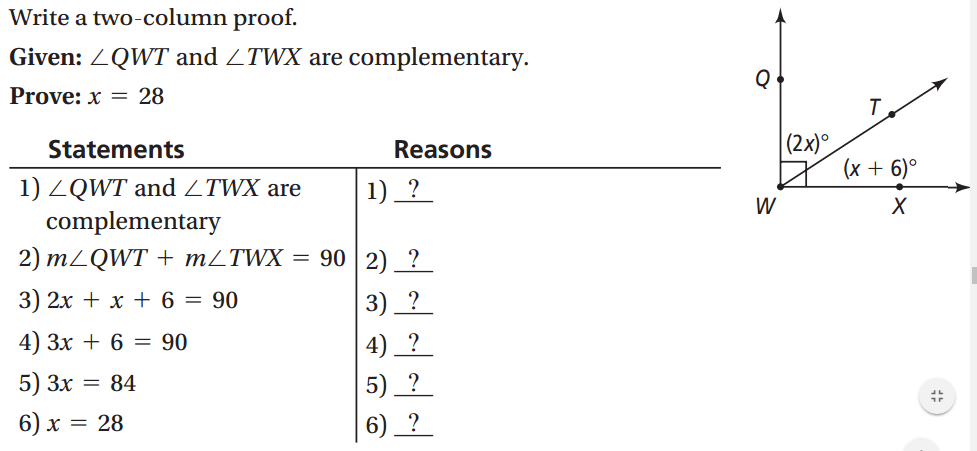
What is the REASON for Statement #1?
a)
Given
b)
Definition of Complementary Angles
c)
Substitution Property
d)
Reflexive Property of Congruence
47.
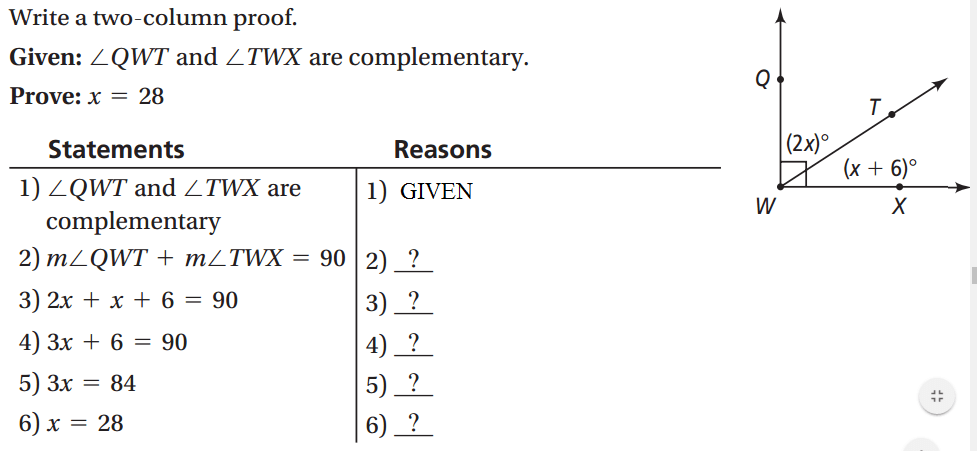
What is the REASON for Statement #2?
a)
Given
b)
Definition of Complementary Angles
c)
Substitution Property
d)
Reflexive Property of Congruence
48.
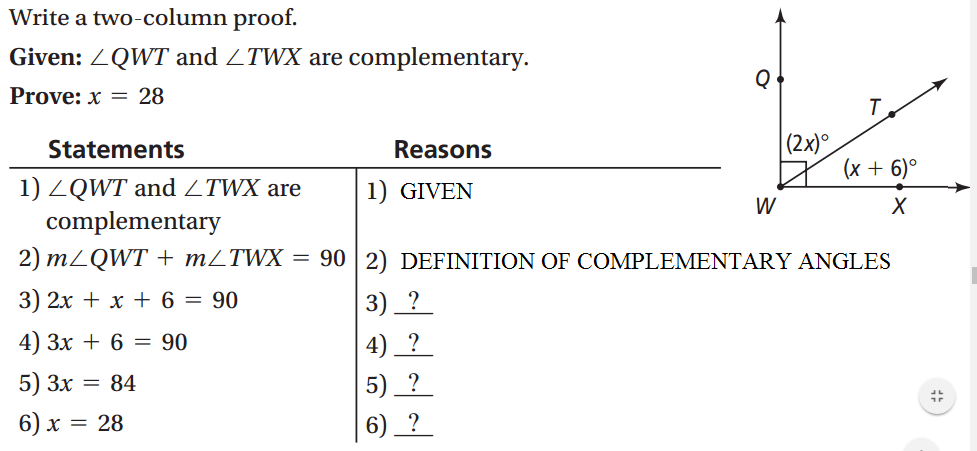
What is the REASON for Statement #3?
a)
Given
b)
Definition of Complementary Angles
c)
Substitution Property
d)
Reflexive Property of Congruence
49.
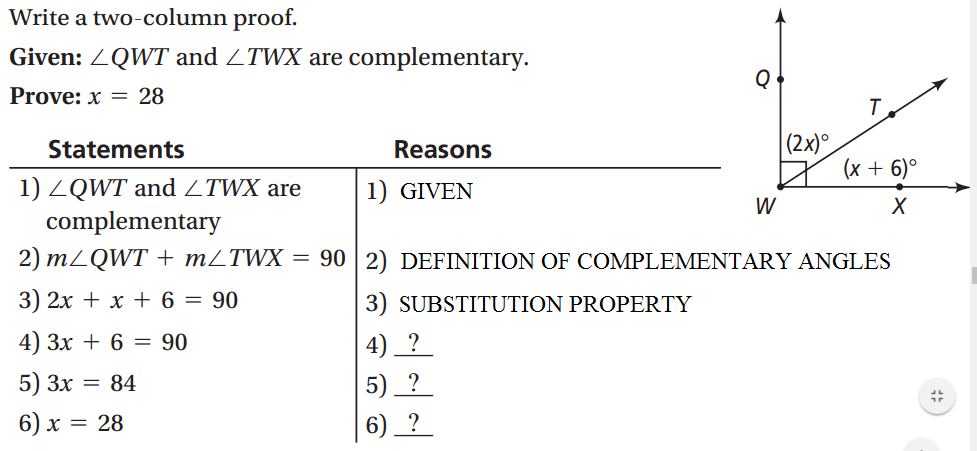
What is the REASON for Statement #4?
a)
Substitution Property
b)
Distributive Property
c)
Transitive Property
d)
Combine Like Terms
50.
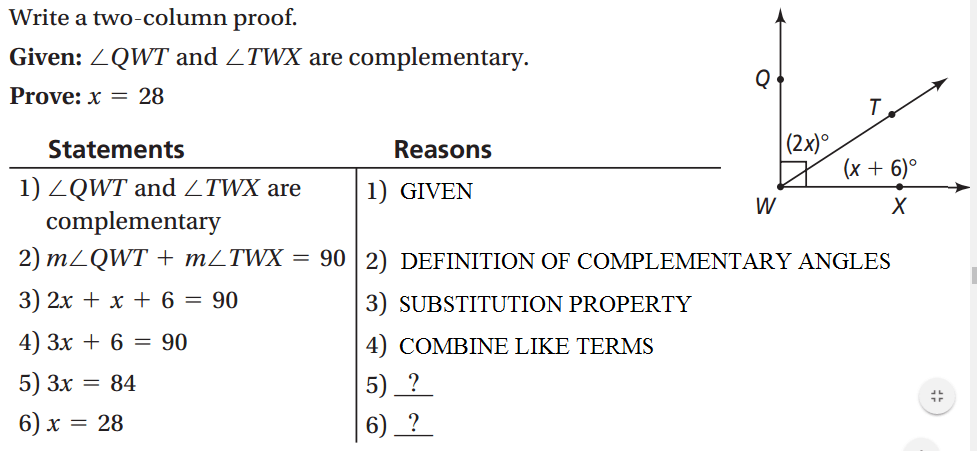
What is the REASON for Statement #5?
a)
Addition Property of Equality
b)
Subtraction Property of Equality
c)
Multiplication Property of Equality
d)
Division Property of Equality
51.
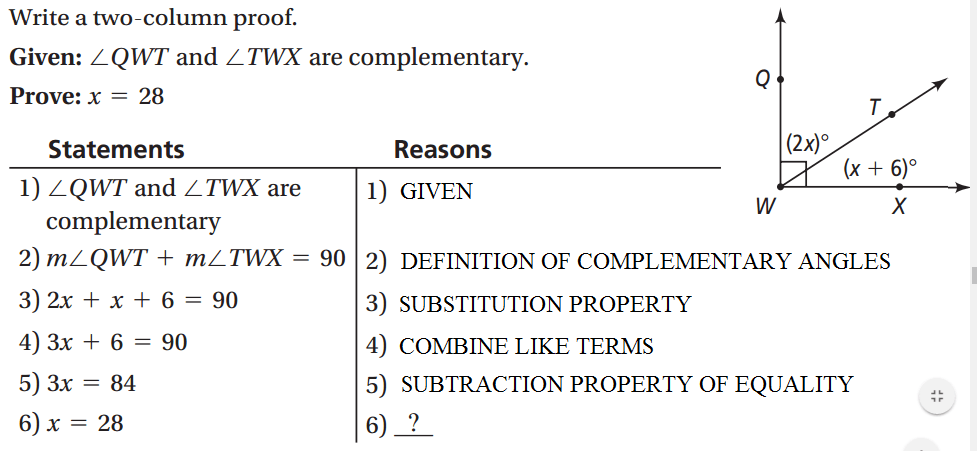
What is the REASON for Statement #6?
a)
Addition Property of Equality
b)
Subtraction Property of Equality
c)
Multiplication Property of Equality
d)
Division Property of Equality
52.
Which is true about parallelograms?
a)
Opposite sides are congruent
b)
Diagonals are congruent
c)
Consecutive angles are congruent
d)
The interior angles add to 180 degrees
53.
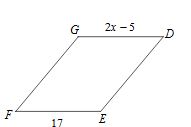
The figure is a parallelogram.
Solve for x.
Solve for x.
a)
1
b)
11
c)
7
d)
6
54.
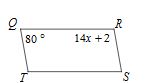
The figure is a parallelogram.
Solve for x.
Solve for x.
a)
7
b)
2
c)
0
d)
4
55.

What is the value of x?
a)
132
b)
66
c)
114
d)
48
56.
______ parallelograms are quadrilaterals.
a)
All
b)
Some
c)
No
57.

Which quadrilateral has 4 right angles, 2 sets of parallel sides, and all of its' sides are the same length?
a)
Triangle
b)
Rhombus
c)
Rectangle
d)
Square
58.
______ squares are rectangles.
a)
All
b)
Some
c)
No
59.
The diagonals of a rectangle are
a)
parallel
b)
congruent
c)
perpendicular
d)
not congruent
60.
In a parallelogram, consecutive angles are __________.
a)
congruent
b)
supplementary
c)
corresponding
d)
parallel
61.
In a parallelogram, diagonals __________.
a)
are perpendicular
b)
bisect each other
c)
are congruent
d)
are parallel
62.
Which quadrilateral has opposite sides parallel?
a)
Rectangle
b)
Rhombus
c)
Square
d)
All of these do
63.
In a rhombus, all four sides are ___________.
a)
congruent
b)
parallel
c)
perpendicular
d)
unequal
64.

Figure A is a...
a)
Rectangle
b)
Square
c)
Rhombus
65.

Figure B is a...
a)
Rectangle
b)
Square
c)
Rhombus
66.
A parallelogram that is both a rhombus and a rectangle is called a __________.
a)
Quadrilateral
b)
Parallelogram
c)
Trapezoid
d)
Square
67.

If ABCD is a parallelogram, what is the length of BD?
a)
10
b)
11
c)
7
d)
5
68.

LMNO is a parallelogram
solve for X
solve for X
a)
19
b)
20
c)
33
d)
53
69.
What does it mean if diagonals are perpendicular (⊥)?
a)
They bisect the vertex
b)
Where they intersect is a 90˚ angle
c)
They are equal
d)
They never intersect
70.

What are the values of x, y, and z?
a)
x=145, y=145,z=145
b)
x=145, y=35, z=35
c)
x=35,y=145, z=35
d)
x=35, y=35, z=145
71.

Question #1
a)
The difference between the m
∠C and the m
∠A is 90°.
b)
∠A is complementary to
∠C.
c)
∠A and
∠C are congruent.
d)
The sum of the m
∠A and the m
∠C is 270
°.
72.
Sally is solving a problem in which angles measuring 6x° and (10 + 11x)° are supplementary. What is the value of x?
a)
x = 11
b)
x = 8
c)
x = 10
d)
x = 9
73.

Question #2
a)
Definition of complementary angles
b)
Definition of adjacent angles
c)
Definition of supplementary angles
d)
Definition of right angle
74.

Question #4
a)
j°
b)
(180-j)°
c)
(90-j)°
d)
(2j)°
75.

Question #5
a)
∠AOB
b)
∠AOE
c)
∠COA
d)
∠COD
76.

Question #6
a)
m∠COA = 40
b)
∠COA and
∠DOA are adjacent angles
c)
m
∠DOA = 130
d)
∠BOC and
∠BOD are adjacent angles
77.
The supplement of an angle is 65 °. What is the measure of the angle?
a)
25°
b)
15°
c)
115°
d)
35°
78.

Question #8
a)
∠16 and
∠2
b)
∠9 and
∠16
c)
∠12 and
∠13
d)
∠5 and
∠6
79.

Question #9
a)
Corresponding Angles
b)
Same-Side Interior Angles
c)
Alternate Interior Angles
d)
Alternate Exterior Angles
80.

Question #10
a)
65°
b)
115°
c)
55°
d)
125°
81.

Question #11
a)
30°
b)
74°
c)
76°
d)
65°
82.

Question #12
a)
x = 25
b)
x = 35
c)
No Solution
d)
Infinite Solutions
83.

Question #13
a)
x = 25
b)
x = 35
c)
x = 30
d)
x = 20
84.

Question #14
a)
x = 20, y = 10
b)
x = 30, y = 5
c)
x = 20, y = 5
d)
x = 30, y = 10
85.
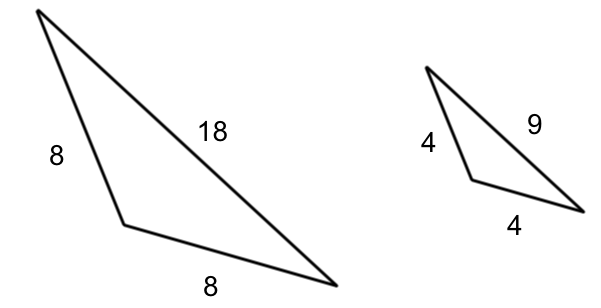
The triangles are similar by...
a)
SAS
b)
AA
c)
ASA
d)
SSS
86.

The triangles are similar by...
a)
SAS
b)
AA
c)
ASA
d)
SSS
87.

The triangles are similar by...
a)
SAS
b)
AAS
c)
ASA
d)
SSS
88.
Are these triangles similar?
Angles in Triangle 1: 40⁰,60⁰, and 80⁰
Angles in Triangle 2: 40⁰,50⁰, and 90⁰
Angles in Triangle 1: 40⁰,60⁰, and 80⁰
Angles in Triangle 2: 40⁰,50⁰, and 90⁰
a)
Yes
b)
No
c)
There is not enough information to decide.
89.
Are these triangles similar?
Known angles in Triangle 1: 40⁰,60⁰
Known angles in Triangle 2: 60⁰,40⁰
Known angles in Triangle 1: 40⁰,60⁰
Known angles in Triangle 2: 60⁰,40⁰
a)
Yes
b)
No
c)
There is not enough information to decide.
90.
Are these triangles similar?
Known angles in Triangle 1: 40⁰,60⁰
Known angles in Triangle 2: 80⁰,40⁰
Known angles in Triangle 1: 40⁰,60⁰
Known angles in Triangle 2: 80⁰,40⁰
a)
Yes
b)
No
c)
There is not enough information to decide.
91.

If the triangles are similar, state how.
a)
SSS
b)
SAS
c)
AA
d)
Not similar
92.

If the triangles are similar, state how.
a)
SSS
b)
SAS
c)
AA
d)
Not similar.
93.

Determine whether the triangles are similar or not. If so, state how they are similar.
a)
Yes, by AA Similarity
b)
Yes, by SAS Similarity
c)
Yes, by SSS Similarity
d)
No, not similar
94.

Determine whether the triangles are similar or not. If so, state how they are similar.
a)
Yes, by AA Similarity
b)
Yes, by SAS Similarity
c)
Yes, by SSS Similarity
d)
No, not similar
95.

The triangles are similar by...
a)
SAS
b)
AA
c)
ASA
d)
SSS
96.

The triangles are similar by...
a)
SAS
b)
AA
c)
ASA
d)
SSS
97.

Why are the triangles similar?
a)
AA
b)
SAS
c)
SSS
d)
AAS
98.

What is the similarity statement for the triangle pair?
a)
ΔXYZ~ΔNEW
b)
ΔXZY~ΔNWE
c)
ΔZYX~ΔENW
d)
ΔYZX~ΔNWE
99.

Determine whether the triangles are similar.
a)
SSS
b)
AA
c)
SAS
d)
not similar
100.

a)
A
b)
B
c)
C
d)
D
101.

How are these triangles similar?
a)
A
b)
B
c)
C
d)
D
102.

Why are the triangles similar?
a)
AA
b)
SAS
c)
SSS
d)
AAS
103.
If two figures are similar their angles are______.
a)
proportional
b)
congruent
c)
supplementary
d)
complementary
104.
If two figures are similar, the corresponding sides are ______________.
a)
equal
b)
congruent
c)
proportional
d)
none of these
105.

To find the height of a very tall pine tree, you place a mirror on the ground and stand where you can see the top of the pine tree. How tall is the tree?
a)
144 feet
b)
72 feet
c)
36 feet
106.

What is the height of the Tree?
a)
20
b)
15
c)
30
d)
10
107.

Find AE
a)
12.5
b)
18
c)
11.75
d)
13
108.

A tree is 12 feet tall and casts a shadow 9 feet long. A building nearby casts a shadow that measures 21 feet. How tall is the building? (Draw a picture, set up a proportion)
a)
16 feet
b)
21 feet
c)
24 feet
d)
28 feet
109.

Find the value of x.
a)
90/13
b)
56/3
c)
21/8
d)
96/7
110.

Find the height of the tree.
a)
8 ft
b)
12 ft
c)
13 ft
d)
15 ft
111.

Use the information in the diagram to determine the height of the tree.
a)
80 feet
b)
320 feet
c)
40 feet
d)
160 feet
112.

If the triangles are similar, find x
a)
90
b)
60
c)
30
d)
15
113.
Simplify:
(10+ 15i)-(48 - 30i)
(10+ 15i)-(48 - 30i)
a)
58 - 45i
b)
58 - 15i
c)
-38 - 15i
d)
-38 + 45i
114.
Simplify:
(7 + 2i)(9 - 6i)
(7 + 2i)(9 - 6i)
a)
75-24i
b)
63 - 24i - 12i2
c)
51 - 24i
d)
58 + 60i
115.

a)
10
b)
-10
c)
10i
d)
-10i
116.
What does i2 = ?
a)
-1
b)
√-1
c)
1
d)
-√1
117.
Simplify
√-25
√-25
a)
-5i
b)
5
c)
5i
d)
-5
118.
Simplify:
3√-81
3√-81
a)
-27
b)
3i√3
c)
27i
d)
9i
119.
Simplify:
√-108
√-108
a)
3i√6
b)
3i√20
c)
6i√3
d)
20i√3
120.
Simplify -4√-63
a)
3i√7
b)
-12i√7
c)
-12√7
d)
36√7
121.
Simplify
2i - 7i + 10
2i - 7i + 10
a)
-5i+10
b)
5i
c)
9i+10
d)
5i+10
122.
Simplify
3i - (4 + 7i)
3i - (4 + 7i)
a)
-4 + 10i
b)
21 - 12i
c)
4 - 10i
d)
-4 - 4i
123.
Find the sum.
(5-2i) + (-7+8i)
(5-2i) + (-7+8i)
a)
-2+6i
b)
12+6i
c)
-35-16i2
d)
-35 -16i
124.
Multiply
(2i)(3i)
(2i)(3i)
a)
5i
b)
-5
c)
6i
d)
-6
125.
Multiply
(3i)(-2+4i)
(3i)(-2+4i)
a)
-6+12i
b)
-12-6i
c)
-2+7i
d)
12+6i
126.
Multiply:
(4 – 3i)(7 + 2i)
(4 – 3i)(7 + 2i)
a)
A. 22 - 13i
b)
B. 28 - 19i
c)
C. 34 - 13i
d)
D. -34 - 29i
100 %

