wayground logo

Free Printable Worksheets

Font size

S
M
L
XL
Worksheets

Check for Understanding: Classification

Total questions: 25

Worksheet time: 19mins

Name
Class
Date
1.
What is the science of organizing, classifying and naming living things?
a)
taxonomy
b)
taxadermy
c)
taxicab
d)
toxicology
2.
In a properly written scientific name, which part is lowercase?
a)
species
b)
genus
c)
phylum
d)
family
3.
In the 8 levels of classification which level is the broadest category? 
a)
Kingdom
b)
Family
c)
Species
d)
Domain
4.
Who organized living things based on shared characteristics and created a system for assigning scientific names?
a)
Carolus Linnaeus
b)
Robert Hooke
c)
Anton van Leeuwenhoek
d)
James Watson
5.
Which organism is MOST closely related to the common chimpanzee?
a)
grey wolf
b)
human
c)
monarch butterfly
d)
tiger snake
6.
What are the 8 levels of classification of living things from most general to most specific?
a)
domain, kingdom, phylum, class, order, family, genus, species
b)
domain, kingdom, class, phylum, order, family, genius, species
c)
domain, kingdom, family, class, order, family, genus, species
d)
domain, king, phillip, class, order, family, genus, species
7.

A series of descriptions arranged in pairs that lead the user to the identification of an unknown organism is called a ......

a)

Dichotomous key

b)

Cladogram

c)

Classifier

d)

Grouper

8.
The scientific name for an organism is made from the:
a)
class and family name
b)
genus and species name
c)
domain and kingdom name
d)
kingdom and phylum name
9.
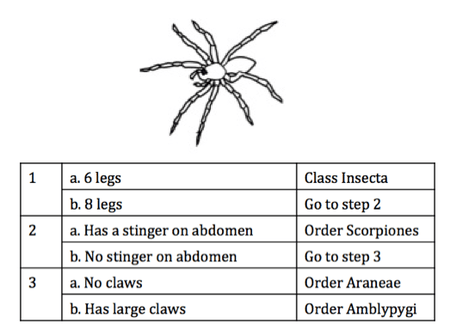
An illustration and a dichotomous key are given. What is the correct classification for this organism?
a)
Class Insecta
b)
Order Amblygygi
c)
Order Araneae
d)
Order Scorpiones
10.
A table of arachnid and insect characteristics is shown. Which characteristic could be used to distinguish between
arachnids and insects?
a)
Jointed legs
b)
Body segments
c)
Presence of eyes
d)
Presence of antennae
11.

What are the three Domains?

a)

Kingdom, Phylum, and Class

b)

Bacteria, Archaea and Eukarya

c)

Bacteria, Virus, and Eukarya

d)

Genus, Species, and Common

12.

What is the broadest level of classification?

a)

Kingdom

b)

Genus

c)

Domain

d)

Species

13.

What factors help to classify organisms?

a)

Genetics

b)

Names

c)

Characteristics

d)

Favorite Foods

14.

Members of this kingdom are multicellular and autotrophic...

a)

Plantae

b)

Fungi

c)

Protista

d)

Animalia

15.

Members of this kingdom live in unusual conditions such as deep ocean trenches or volcanoes...

a)

Bacteria

b)

Fungi

c)

Protista

d)

Archaebacteria

16.

Molds, yeast, and mushroom belong to kingdom:

a)

Eubacteria

b)

Protista

c)

Archaebacteria

d)

Fungi

17.

Tool used by a taxonomist to identify an unknown organism is a:

a)

dichotomous key

b)

scientific name

c)

binomial nomenclature

d)

binomial key

18.

The correct way to write the scientific name for a red maple tree is....

a)

ACER RUBRUM

b)

acer rubrum

c)

Red maple

d)

Acer rubrum

19.

How do you properly write a scientific name?

a)

Capitalize the genus and species and underline both

b)

Capitalize the genus, lowercase the species and underline both

c)

Lowercase both and underline both

20.

Identify leaf F

a)

Cydonia

b)

Magnolia

c)

Aesculus

d)

Fraxinus

e)

Ilex

21.

Based on the dichotomous key, which bird is Certhidea? (Slender = thin; stout= round)

a)

Bird W

b)

Bird X

c)

Bird Y

d)

Bird Z

22.

Identify the plant shown

a)

A

b)

B

c)

C

d)

D

23.

What class of vertebrates does organism T belong to?

a)

Amphibians

b)

Birds

c)

Fish

d)

Mammals

24.
a)

A

b)

B

c)

C

d)

D

25.
a)

A

b)

B

c)

C

d)

D