
 Worksheets
Module 5 Topic 1: Angles & Triangles
Total questions: 70
Worksheet time: 1hrs 11mins
Name
Class
Date
1.
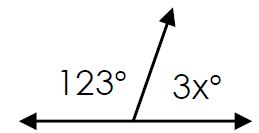
Find the value of x.
a)
15
b)
16
c)
18
d)
19
2.
What is an example of a pair of complementary angles?
a)
13° and 45°
b)
10° and 170°
c)
81° and 9°
d)
90° and 3°
3.

What kind of angles are shown?
a)
complementary
b)
supplementary
c)
adjacent
d)
corresponding
4.
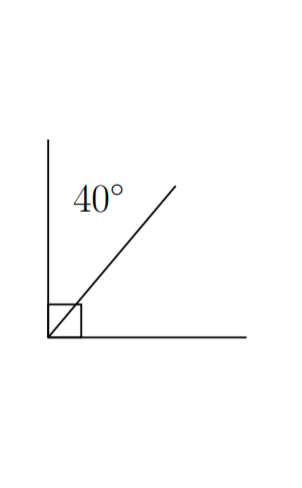
Find the missing angle.
a)
60°
b)
70°
c)
50°
d)
140
5.
What are complementary angles?
a)
Angles that add up to 180°
b)
Angles that add up to 90°
c)
Angles that are equal to each other
d)
Angles that are opposite of each other when lines intersect.
6.
What are supplementary angles?
a)
Angles that add up to 180°
b)
Angles that add up to 90°
c)
Angles that are equal to each other
d)
Angles that are opposite of each other when lines intersect
7.
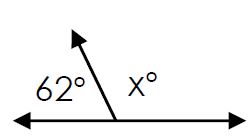
a)
x = 118
b)
x = 108
c)
x = 28
d)
x = 58
8.

Solve for x
a)
20
b)
25
c)
120
d)
180
9.

Solve for x
a)
5
b)
90
c)
25
d)
10
10.

complementary, supplementary, or neither?
a)
Complementary
b)
Supplementary
c)
Neither
11.

Find the supplement of the angle
a)
160
b)
20
c)
-70
d)
180
12.
What are vertical angles?
a)
Angles that are adjacent to each other
b)
Angles that add up to 180°
c)
Angles that are opposite of each other when lines intersect
d)
Angles that add up to 90°
13.
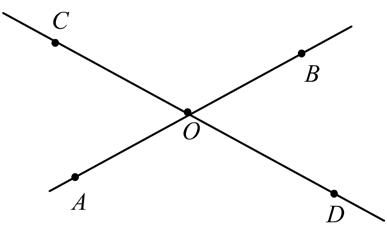
Which are pairs of vertical angles?
a)
∠COB & ∠COA
b)
∠AOD & ∠AOC
c)
∠COB & ∠AOD
d)
∠BOD & ∠AOD
14.
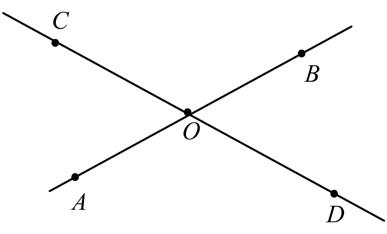
Which are pairs of adjacent angles?
a)
∠COB & ∠DOA
b)
∠AOD & ∠AOC
c)
∠COB & ∠AOD
d)
∠BOD & ∠AOC
15.

If the measure of ∠2 is 83°, what is the measure of ∠3?
a)
7°
b)
17°
c)
83°
d)
97°
16.

If ∠COB is 124°, then what is ∠BOD? How are they related?
a)
56°, they are adjacent
b)
90°, they are right angles
c)
124°, they are vertical
17.
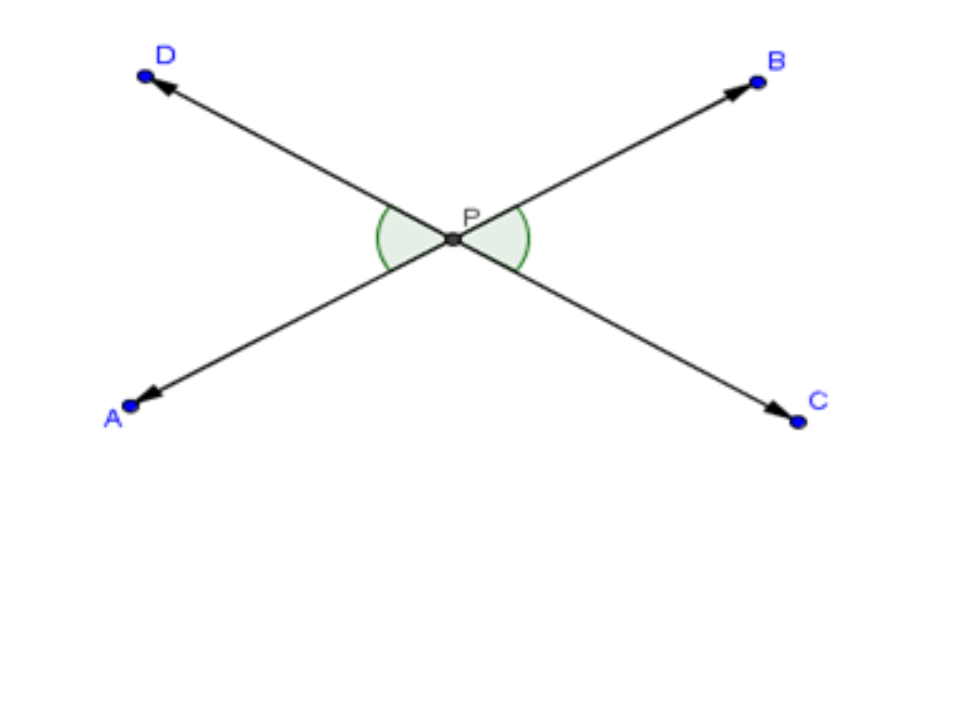
What angle pair is pictured?
a)
Alternate Interior Angles
b)
Supplementary Angles
c)
Vertical Angles
d)
Corresponding Angles
18.

Find the missing angle. Find x.
a)
15o
b)
50o
c)
130o
d)
165o
19.
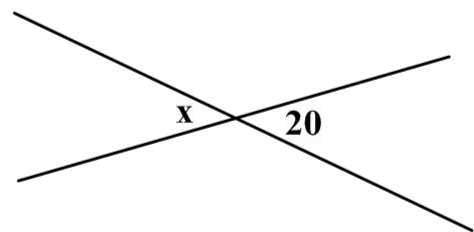
Find the missing angle. Find x.
a)
20o
b)
70o
c)
160o
d)
180o
20.

Find the missing angle. Find x.
a)
15o
b)
50o
c)
130o
d)
165o
21.

Find the missing angle. Find x.
a)
20o
b)
70o
c)
160o
d)
180o
22.
Vertical angles are always
a)
acute
b)
total 180 degrees
c)
congruent (equal measures)
d)
adjacent angles
23.

If m∠1 = 30°, then m∠3 =
a)
30°
b)
60°
c)
150°
d)
undetermined
24.
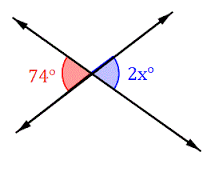
What is the value of x?
a)
37
b)
72
c)
108
d)
18
25.

Find the value of x.
a)
14
b)
60
c)
35
d)
180
26.
What is the complement angle to 30°?
a)
60°
b)
30°
c)
150°
d)
230˚
27.
What is the supplement angle to 42°?
a)
48°
b)
138°
c)
100°
d)
Not possible
28.

How are these angles related?
a)
Vertrical
b)
Complementary
c)
Adjacent
d)
Supplementary
29.

If the measure of ∠2 is 83°, what is the measure of ∠3?
a)
7°
b)
17°
c)
83°
d)
97°
30.

Tell whether the angles are complementary or supplementary. Then find the value of x.
a)
Complementary; x=25
b)
Complementary; x=5
c)
Supplementary; x=25
d)
Supplementary; x=5
31.
Vertical angles are always
a)
acute
b)
total 180 degrees
c)
congruent (equal measures)
d)
adjacent angles
32.

What is the value of x?
a)
60
b)
26
c)
14
d)
10
33.

This is what kind of angle?
a)
right
b)
acute
c)
obtuse
d)
straight
34.

This is what kind of angle?
a)
obtuse
b)
right
c)
straight
d)
acute
35.
How many degrees is a straight angle?
a)
90
b)
360
c)
180
d)
145
36.
Angles are measured using a ______.
a)
compass
b)
protractor
c)
ruler
d)
prospector
37.

∠1 and ∠3 can best be described as -
a)
complementary angles
b)
supplementary angles
c)
vertical angles
d)
adjacent angles
38.

Which of these angles is NOT congruent to angle 5?
a)
Angle 6
b)
Angle 8
c)
Angle 1
d)
Angle 4
39.

What is this tool called and what is it used for?
a)
A ruler used to measure lines.
b)
A protractor used to measure lines.
c)
A ruler used to measure angles.
d)
A protractor used to measure angles.
40.

What is the measure of the angle shown in the picture?
a)
0 degrees
b)
45 degrees
c)
90 degrees
d)
180 degrees
41.

What is the measure of the angle shown in the picture?
a)
30 degrees
b)
35 degrees
c)
140 degrees
d)
145 degrees
42.

What is the measure of the angle shown in the picture?
a)
20 degrees
b)
27 degrees
c)
30 degrees
d)
153 degrees
43.

How many degrees are in a circle?
a)
45 degrees
b)
90 degrees
c)
180 degrees
d)
360 degrees
44.

What is the measure of 〈FOE?
a)
10 degrees
b)
20 degrees
c)
30 degrees
d)
40 degrees
45.

What is the measure and type of the angle shown in the picture?
a)
53 degrees; acute
b)
53 degrees; obtuse
c)
127 degrees; acute
d)
127 degrees; obtuse
46.

What is the measure of the angle shown in the picture?
a)
30 degrees
b)
35 degrees
c)
150 degrees
d)
155 degrees
47.
What is an obtuse angle?
a)
An angle that measures more than 90 degrees, but less than degrees 180 degrees.
b)
An angle that measures less than 90 degrees.
c)
An angle that measures 90 degrees.
d)
An angle that measures 180 degrees.
48.
What is a right angle?
a)
An a angle that measures more than 90 degrees.
b)
An angle that measures less than 90 degrees.
c)
An angle that measures exactly 90 degrees.
d)
An angle that measures 180 degrees.
49.
What is a straight angle?
a)
An angle that measures more than 90 degrees.
b)
An angle that measures less than 90 degrees.
c)
An angle that measures exactly 90 degrees.
d)
An angle that measures exactly 180 degrees.
50.

What is the measure of the following angle?
a)
21 degrees.
b)
34 degrees.
c)
70 degrees.
d)
172 degrees.
51.

What is the measure of the following angle?
a)
56 degrees.
b)
180 degrees.
c)
142 degrees.
d)
97 degrees.
52.

What is the measure of the following angle?
a)
78 degrees.
b)
11 degrees.
c)
190 degrees.
d)
58 degrees.
53.

What is the measure of the following angle?
a)
11 degrees.
b)
40 degrees.
c)
67 degrees.
d)
168 degrees.
54.

What is the measure of the angle?
a)
110 degrees.
b)
140 degrees.
c)
150 degrees.
d)
170 degrees.
55.

Which angle type is pictured?
a)
Acute
b)
Right
c)
Obtuse
d)
Straight
56.
Which of the following sets of side lengths could produce a triangle. SELECT ALL THAT APPLY.
a)
4, 4, 4
b)
5, 5, 10
c)
3, 6, 9
d)
5, 7, 11
e)
13, 5, 6
57.

Will these three sides form a triangle?
a)
yes
b)
no
58.

Will these line segments form a triangle?
a)
yes
b)
no
59.
Which set of side lengths will form a triangle?
a)
3, 6, 12
b)
7, 7, 14
c)
9, 9, 9
d)
13, 6, 7
60.
Given are the lengths of two sides of a triangle. Find the range of lengths for the third side. 7 ft, 13 ft
a)
more than 6 but less than 20
b)
more than 20 but less than 6
c)
less than 6 but more than 20
61.
Given are the lengths of two sides of a triangle. Find the range of lengths for the third side. 7 mm, 4 mm
a)
more than 3 but less than 11
b)
more than 11 but less than 3
c)
less than 3 but more than 11
62.

Will these side lengths form a triangle?
a)
yes
b)
no
63.
Determine if it is possible to form a triangle with the given side lengths. 15 in., 12 in., 2 in.
a)
yes
b)
no
64.
Determine if it is possible to form a triangle with the given side lengths. 7 yd, 8 yd, 9 yd
a)
yes
b)
no
65.
How many degrees make up a triangle?
a)
45
b)
90
c)
60
d)
180
66.
side lengths of 4,4,4 form a triangle
a)
True
b)
False
67.
Equilateral triangles have sides that are all equal?
a)
False
b)
True
68.
If the longest side of the triangle was 10. Then the two shorter sides must have a sum of ....?
a)
9
b)
10
c)
11
d)
8
69.
What symbol has to be in the inequality to make the side lengths form a triangle?
a)
less than
b)
equal sign
c)
greater than or equal to
d)
greater than
70.
If the given side lengths of a triangle are 16 and 10 which can NOT be the third side?
a)
25
b)
22
c)
27
d)
21
100 %

