wayground logo

Free Printable Worksheets

NEW

Font size

S
M
L
XL
Worksheets

Africa History Review

Total questions: 65

Worksheet time: 44mins

Name
Class
Date
1.
Which was a part of early European plans for Africa?
a)
Establishing trade routes
b)
Spreading Islam
c)
Setting up democracies
d)
Preventing deforestation
2.
What was the MAIN reason European countries colonized Africa?
a)
They wanted to spread Christianity.
b)
They were looking for trade routes.
c)
The continent would provide large amounts of land.
d)
They needed the natural resources.
3.
The belief that acquiring colonies for raw materials will create a stronger country is called ____.
a)
apartheid
b)
imperialism
c)
nationalism
d)
communism
4.
What happened during the Berlin Conference?
a)
Europeans decided how to divide up Africa.
b)
Africans decided how to divide up Africa.
c)
Africans mapped out routes for the slave trade.
d)
Germany staked claim to most of Africa.
5.
When African people helped European officials rule a colony it was called ____.
a)
Direct rule
b)
Monarchy
c)
Apartheid
d)
Indirect rule
6.
Pride in one's country is known as ____.
a)
apartheid
b)
imperialism
c)
nationalism
d)
communism
7.
When did many African groups begin to challenge European colonial rule?
a)
Before WWI
b)
Just after WWI
c)
Just before WWII
d)
After WWII
8.
Why did many of the boundaries of the new African states created after WWII cause problems?
a)
They caused the countries to be too small.
b)
They grouped enemies and split tribes.
c)
They did not cause any problems.
d)
They caused the countries to be too large.
9.
Which organization was formed to work for equality in the country of South Africa?
a)
United Nations
b)
African National Congress
c)
Pan-African Congress
d)
African Union
10.
What was wrong with Kenya's government after independence?
a)
It was controlled by one party.
b)
It was influenced by the Europeans.
c)
It was ruled by a king.
d)
There was nothing wrong with it.
11.
The main goal of the Pan-African movement was to get Africans to ____.
a)
end apartheid in South Africa
b)
unify Africans to work together
c)
remove F.W. de Klerk from office
d)
remove all Europeans from Africa
12.
What was apartheid?
a)
segregation of races in Kenya
b)
integrated democracy in Kenya 
c)
segregation of races in South Africa
d)
integrated democracy in South Africa
13.
What role did F.W. de Klerk play in the apartheid laws?
a)
He was responsible for starting them.
b)
He was responsible for ending them.
c)
He was responsible for extending them into other nations.
d)
He was responsible for ensuring they continued.
14.
To which political party did Nelson Mandela belong?
a)
African Union
b)
National Party
c)
Kenyan African National Union
d)
African National Congress
15.
Which of the following was NOT a reason for European Colonization?
a)
Fur trade
b)
Spread Christianity
c)
Religious freedom
d)
Economic reasons
16.
The trade route that delivered slaves to the Americas was called?
a)
The Triangular Trade
b)
The Atlantic Trade
c)
The Square Trade
d)
The Pacific Trade
17.
What country did South Africa gain its independence from?
a)
Great Britain
b)
France
c)
Germany
d)
Portugal
18.
Under the rule of apartheid, which of the following could a black person do?
a)
work as a laborer
b)
marry a white person
c)
go to college
d)
protest against the government
19.
What was a homeland?
a)
urban ghettos blacks were forced to live in
b)
urban ghettos coloureds were forced to live in
c)
a rural area blacks were forced to live on
d)
a rural area coloureds were forced to live on
20.
Even with the end of apartheid, what was a major problem that remained?
a)
laws that treated whites better than blacks
b)
income inequality between blacks and whites
c)
an unfair tax system
d)
blacks being forced to live in homelands
21.
Which of these would be a benefit of being a white South African during apartheid?
a)
being able to vote
b)
carrying a passbook
c)
living in a homeland
d)
poor healthcare
22.
Which of these would a black South African had to have done during apatheid?
a)
carry a passbook
b)
see a doctor
c)
vote for government officials
d)
attend a white school
23.
Who was the first black president of South Africa?
a)
F.W. de Klerk
b)
Nelson Mandela
c)
Jomo Kenyatta
d)
Kwame Nkrumah
24.
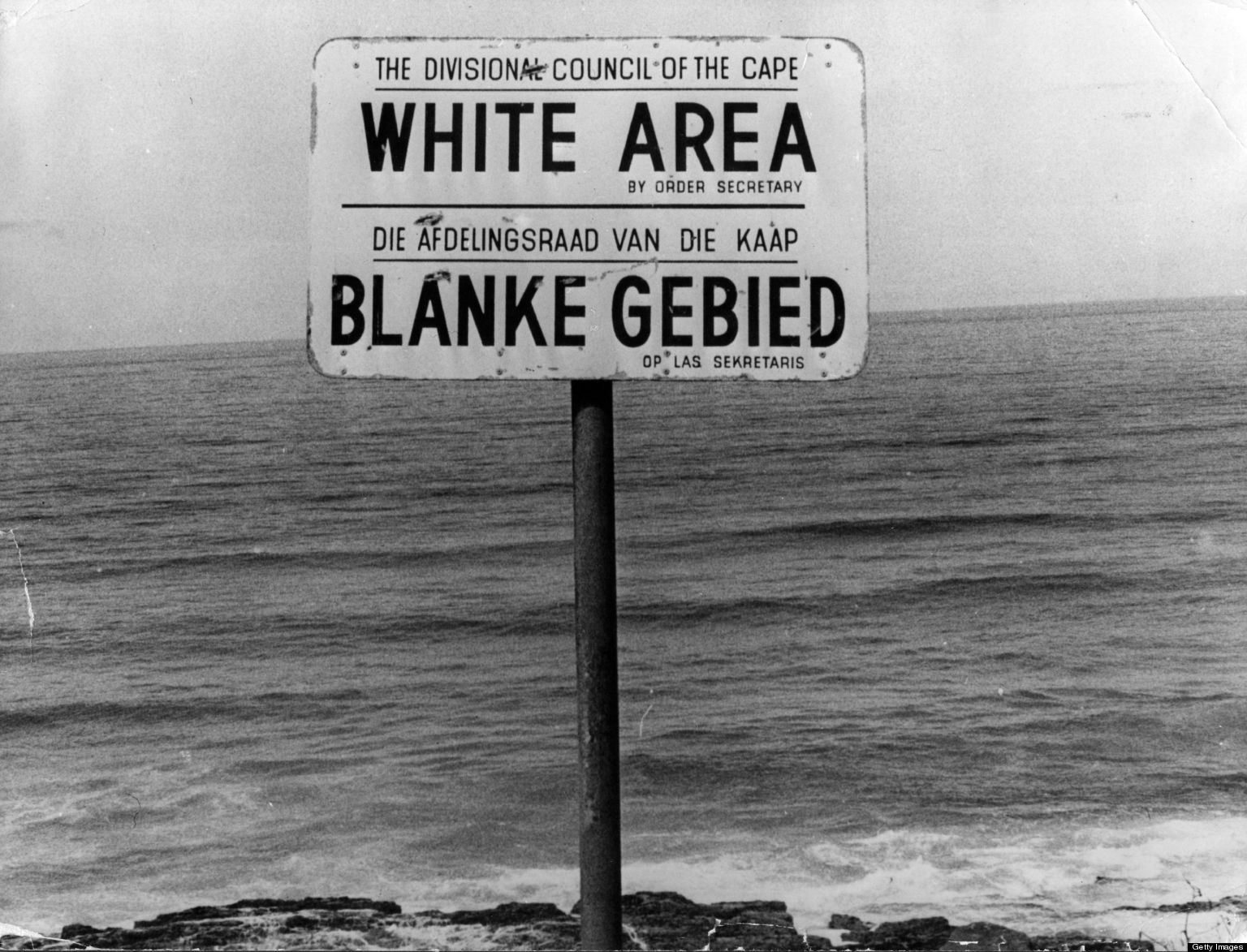
In what African country would you likely have seen this sign during 1975? (Click text to reveal the picture)
a)
Nambia
b)
Egypt
c)
United States
d)
South Africa
25.
Apartheid is an Afrikaans word meaning? 
a)
A state of being apart
b)
Separate but equal
c)
Equality for all
d)
Racism
26.
What was the significance of Nelson Mandela's election to office in South Africa? 
a)
he became the first black president
b)
he released political prisoners
c)
he united the Zulu and Ashanti people to win the election
d)
he won the election with the support of the British
27.
What was Nelson Mandela's attitude towards the people who supported apartheid laws in South Africa? 
a)
he believed they should be punished for their actions
b)
he wanted to unite all races in South Africa
c)
he wanted to turn over those leaders to the nsUnited Natio
d)
he forced those leaders out of the country
28.
What did Deklerk and Nelson Mandela share together?
a)
Mandela's release
b)
Nobel Peace Prize
c)
Mandela being elected as President
d)
Mandela's new marriage
29.
What consequence did Mandela face for his actions?
a)
He was given a prison sentence but didn't have to serve it.
b)
He was tried, found guilty, and sentenced to hang.
c)
He was exiled to the United States.
d)
He was imprisoned for 27 years.
30.
African nationalism served to:
a)
Unite all African countries as one big country
b)
Unite Africans against colonial rule
31.

A major factor in the development of 20th–century nationalist movements throughout Africa was a common

a)

language throughout most of Africa

b)

goal to end European rule in Africa

c)

ethnic bond among the people of

sub-Saharan Africa

d)

religion throughout most of Africa

32.

What year did Kenya gain independence?

a)

1963

b)

1965

c)

1956

d)

1936

33.

Which country's independence movement involved the Mau Mau uprising?

a)

Kenya

b)

Nigeria

c)

South Africa

d)

South Africa & Nigeria

34.

Who was a staunch supporter of Pan Africanism who eventually became Kenya's president?

a)

Nnamdi Azikiwe

b)

Joseph Kenyatta

c)

Marcus Garvey

d)

Martin Luther King

35.

Which country received independence peacefully and more quickly but immediately after had a civil war btw the Muslim north and Christian south?

a)

Kenya

b)

Nigeria

c)

Neither

d)

Both

36.
When a country controls the lands of another to gain from their resources...
a)
imperialism/colonialism
b)
segregation
c)
enclave
d)
partition
37.
How did the Europeans “partition” Africa?
a)
At the Berlin Conference in 1884 the European countries divided Africa for natural resources.
b)
At the Paris Conference in 1886 the European countries divided Africa for natural resources.
c)
European countries just showed up with their military and took over.
d)
Europe never took anything from Africa.
38.
This country wanted to have independence so they “fought with words” (using political negotiations, not violent ones) against Britain so that they could be free from them.
a)
Nigeria
b)
Kenya
c)
Both 
d)
Neither
39.
This country had a VIOLENT split from British rule.
a)
Nigeria
b)
Kenya
c)
Both 
d)
Neither
40.
This was achieved by most African nations due to the negative economic impact of WWII and the pressure of Pan-Africanism. What was it?
a)
African independence
b)
European Rebuilding
c)
African National Congress
d)
European Partitioning
41.
The boundaries created by the Europeans were this to the Africans as they had no real meaning. What's the best word?
a)
artificial
b)
apartheid
c)
continuity
d)
discrimination
42.
Nigeria and Kenya were former colonies of this once mighty nation?
a)
Great Britain
b)
France
c)
Spain
d)
Belgium
43.
Through European Partitioning, _________ ___________ were divided and this led to political instability (civil wars).
a)
ethnic groups
b)
political groups
c)
career groups
d)
social groups
44.
This is a war in a country involving two or more groups. What is it called?
a)
civil war
b)
guerilla warfare
c)
call of duty
d)
mortal combat
45.
How was apartheid eventually abolished?
a)
The international community excluded South Africans from important events such as the Olympics.
b)
Many countries began economic sanctions against South Africa.
c)
F. W. De Klerk released many ANC members from prison and began to repeal apartheid legislation.
d)
All of the above answers are correct and you should slowly read them all.
46.
What did Nigerian and Kenyan independence movements have in common?
a)
violent rebellion
b)
peaceful protest
c)
nationalist movements
d)
french revolution
47.

Which religions are the most widely practiced in modern Africa?

a)

Christianity and Judaism

b)

Buddhism and Hinduism

c)

Judaism and Buddhism

d)

Islam and Christianity

48.

Which of these items is a central religious artifact for the Ashanti people?

a)

the Holy Grail

b)

The Golden Stool

c)

The immortal dove

d)

the Golden spear

49.

Arabs in Africa live primarily in what region?

a)

North Africa

b)

South Africa

c)

Central Africa

d)

Savannas

50.

Which of the following is not one of the main ethnic groups living in Africa?

a)

Arabs

b)

Ashanti

c)

Bantu

d)

Muslims

51.

Islam is the main religion practiced by what two ethnic groups?

a)

Arabs and Bantu

b)

Arabs and Swahili

c)

Swahili and Zulu

d)

Bantu and Ashanti

52.

Most Swahili practice what religion?

a)

Judaism

b)

Hinduism

c)

Islam

d)

Christianity

53.

What do you call the belief that natural physical entities, including animals, plants, and features of the earth, have a spiritual essence (souls)?

a)

Shintoism

b)

Animism

c)

Confucianism

d)

Islam

54.

Which best describes the religious beliefs of the Bantu people?

a)

Christianity

b)

Islam

c)

Christianity, Islam, and traditional African beliefs

d)

Animism

55.

Which ethnic group would primarily be found at the number 1 (blue)?

a)

Bantu

b)

Arab

c)

Ashanti

d)

Swahili

56.

What ethnic group is found at 4 (green)?

a)

Ashanti

b)

Arab

c)

Swahili

d)

Bantu

57.

Which ethnic group is found at 3 (purple)?

a)

Ashanti

b)

Arabs

c)

Bantu

d)

Swahili

58.

What ethnic group is found at 2 (yellow)?

a)

Bantu

b)

Arabs

c)

Swahili

d)

Ashanti

59.

Which of the below ethnic groups has the largest population?

a)

Arabs

b)

Bantu

c)

Ashanti

d)

Swahili

60.

What is primary language of the Ashanti?

a)

Twi

b)

English

c)

French

d)

Bantu

61.

What language do most Arabs speak?

a)

Asante

b)

Arabic

c)

English

d)

African

62.

Which ethnic group has over 650 dialects and languages spoken?

a)

Bantu

b)

Arab

c)

Ashanti

d)

Twi

63.

What ethnic group is found in Ghana and the Ivory Coast?

a)

Ashanti

b)

Bantu

c)

Arab

d)

Swahili

64.

Which ethnic group is found on the east coast of Africa in Kenya and Tanzania?

a)

Arab

b)

Ashanti

c)

Bantu

d)

Swahili

65.

The golden stool represents ____________ to the Ashanti?

a)

the throne of the king

b)

the new democracy

c)

The unity and power of the Ashanti

d)

The alliance with the Bantu