wayground logo

Free Printable Worksheets

NEW

Font size

S
M
L
XL
Worksheets

Wave unit review

Total questions: 34

Worksheet time: 27mins

Name
Class
Date
1.
Which electromagnetic waves have the highest frequencies and the shortest wavelengths?
a)
microwaves
b)
visible light
c)
gamma rays
2.
For waves in any medium, as the wavelength decreases, what happens to the frequency?
a)
It also decrease
b)
It stays the same
c)
It increases
3.
A wave with a large wavelength will have a ______ frequency and _____ energy
a)
high, low
b)
high, high
c)
low, high
d)
low, low
4.
Which has the SHORTEST wavelength and, therefore, the highest frequency/most energy
a)
Radio waves
b)
Ultraviolet Rays
c)
Gamma Rays
d)
X-rays
5.
How are electromagnetic waves different from other waves? 
a)
They have very short wavelengths 
b)
They transmit energy instead of matter 
c)
They can travel through empty space
d)
They can change direction by reflection 
6.
The distance between two crests or two troughs of a wave is called:
a)
frequency
b)
amplitud
c)
wavelength
d)
hertz
7.
The height of the wave from the rest position is known as the _____________.
a)
amplitude
b)
crest
c)
trough
d)
wavelength
8.

The highest point on a wave is:

a)

the crest

b)

the trough

c)

the top

d)

the coast

9.
Which wave has a greater frequency?
a)
A
b)
B
10.

All waves carry ________ as they travel from one place to another.

a)

matter

b)

space

c)

energy

d)

water

11.
What kind of wave is pictured below?
a)
compressional wave
b)
transverse wave
c)
sound wave
d)
mechanical wave
12.
If there is no wave, the particles would be at the _____________________.
a)
wavelength
b)
resting point
c)
trough
d)
beach
13.
What part is represented by the blue lines?
a)
Crest
b)
Resting Point
c)
Wavelength
d)
Amplitude
14.
What kind of wave is pictured?
a)
Transverse
b)
Longitudinal
c)
surface
d)
none of the above
15.
What is the name of this phenomena ? 
a)
refraction 
b)
reflection 
c)
diffraction 
d)
interference 
16.
Which pattern shows effect of diffraction ?
a)
A
b)
B
c)
C
d)
D
17.

What behavior of light is shown?

a)

Absorption

b)

Transmission

c)

Diffraction

d)

Refraction

e)

Reflection

18.
a)

Absorption

b)

Transmission

c)

Diffraction

d)

Refraction

e)

Reflection

19.

What behavior is shown?

a)

Absorption

b)

Transmission

c)

Diffraction

d)

Refraction

e)

Reflection

20.

How will the net wave look when both crests meet at point B

a)

Larger

b)

Smaller

c)

No change will occur.

21.

Interaction of two waves that meet.

a)

Constructive Interference

b)

Destructive Interference

c)

Resonance

d)

Interference

22.

Interaction of two waves that results in a wave with larger amplitude.

a)

Constructive Interference

b)

Destructive Inteference

c)

Resonance

d)

Standing Wave

23.
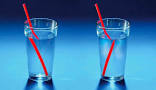
Swimming pools and the ocean look shallower than they really are due to:
a)
reflection 
b)
dispersion
c)
refraction
d)
total internal reflection
24.
What is this called?
a)
refraction
b)
reflection
c)
reconstroction
d)
retraction
25.
According to the Law of reflection, a light ray striking a mirror
a)
continues moving through the mirror in the same direction
b)
moves into the mirror at a slightly different angle
c)
bounces off the mirror toward the direction it came from
d)
bounces off the mirror at the same angle it hits.
26.
All waves carry
a)
energy
b)
light 
c)
matter
d)
particles
27.
Why would a wave change direction?
a)
Because it kept traveling through the same medium
b)
Because it went from one medium to another
c)
the amplitude was too large
d)
the frequency was too small
28.
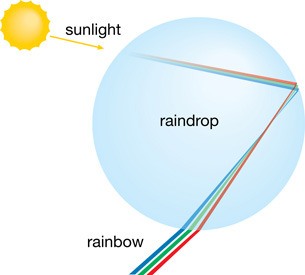
Light bending as it passes through a rain drop is an example of...
a)
Refraction
b)
Reflection
29.
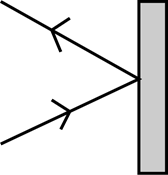
The illustration shows a light ray striking an object.
In the illustration, the light ray striking the object is-
a)
absorbed
b)
stopped
c)
reflected
d)
refracted
30.

If the angle of reflection is 300 what is the angle of incidence?

a)

40o

b)

50o

c)

30 o

d)

60o

31.

how does diffraction work

a)

it goes through water and air

b)

is a beam of light stopping at a wall

c)

it bounces off of light

d)

is the bending of light as it passes around the edge of an object

32.
This image is representing what wave interaction?
a)
Refraction
b)
Diffraction
c)
Reflection
d)
Interference
33.

The waves with the longest wavelengths in the electromagnetic spectrum are

a)

Infrared rays.

b)

radio waves

c)

gamma rays

d)

X-rays

34.
Which section of the spectrum is the ONLY one we can see?
a)
X-rays
b)
Visible Light
c)
Gamma Rays
d)
Ultraviolet Rays