wayground logo

Free Printable Worksheets

Font size

S
M
L
XL
Worksheets

REVIEWER 4B

Total questions: 40

Worksheet time: 39mins

Name
Class
Date
1.
Jelly-like material that makes up most of the cell
a)
cytoskeleton
b)
cytoplasm
c)
cyclops
d)
cytoliquid
2.
What is the nucleus?
a)
a thin layer that encloses the cell
b)
controls all life processes; "brains"
c)
holds cell together
d)
gatekeeper for cell
3.
Ribosomes make....
a)
coffee
b)
lunch
c)
protein
d)
other cells
4.

Plant cells contain what organelle that animal cells do not?

a)

Chloroplast

b)

nucleus

c)

ER

d)

mitochondria

5.
_________ ship and package materials
a)
Golgi bodies
b)
Mitochondria
c)
Rough endoplasmic reticulum
d)
Smooth endoplasmic reticulim
6.
What is the tube-like network that enables cell to transport material where it is needed?
a)
endoplasmic reticulum (ER)
b)
vacuole
c)
organelle
d)
nucleus
7.
This part of the cell breaks down and eliminates waste.
a)
Lysosomes
b)
Mitochondria
c)
Ribosomes
d)
Endoplasmic Reticulum
8.
This part of the cell keeps all the organelles in their place.
a)
Cell Membrane
b)
Cell Wall
c)
Nucleus
d)
Cytoplasm
9.
Which of the following is the correct equation for PHOTOSYNTHESIS?
a)
carbon dioxide + water --> oxygen + glucose
b)
carbon dioxide + glucose + water --> oxygen 
c)
oxygen + water --> carbon dioxide + glucose
d)
glucose+ oxygen ---> water + carbon dioxide 
10.
The fluid like substance found inside the chloroplast is called
a)
Cytoplasm
b)
Stroma
c)
Thykloids
d)
Cell Wall
11.
__________ is a stack of thylakoids
a)
Granum
b)
Stomata
c)
Stroma
d)
Chloroplast
12.
This is the female part of the flower; the top is sticky to catch pollen.
a)
stigma
b)
pistil
c)
stamen
d)
anther
13.
This is the male part of the flower; it makes pollen.
a)
filament
b)
ovary
c)
sepal
d)
stamen
14.

What is the process by which an organism produces offspring?

a)

Reproduction

b)

Specialization

c)

Genetics

d)

Adaptation

15.

In plant reproduction, fertilization occurs when the male and female sex cells form ______________.

a)

a sprout

b)

a seed

c)

a petal

d)

a clone

16.

Organisms have certain behaviors and features that increase their odds to reproduce and pass on their _____________ to offspring.

a)

Structures

b)

Behaviors

c)

Thoughts

d)

Genetic information

17.

Wind, water, animal fur, & prickly burrs can all facilitate what process?

a)

asexual reproduction

b)

seed dispersal

c)

behavior

d)

adaptations

18.

Most vertebrates and most invertebrates reproduce _______________.

a)

sexually

b)

asexually

c)

internally

d)

externally

19.

____________ reproduction requires only one parent organism.

a)

sexual

b)

asexual

c)

external

d)

internal

20.

Sponges reproduce asexually by breaking off from a parent in a process called _________.

a)

internal

b)

fragmentation

c)

budding

d)

external

21.

Fertilization that takes place inside the female organism's body is ___________.

a)

internal fertilization

b)

gestation period

c)

external fertilization

d)

asexual reproduction

22.

Which cnidarian body form looks like an open umbrella?

a)

medusa

b)

larva

c)

polyp

d)

offspring

23.

An immature form of an animal that looks different from the adult is called ___________________.

a)

polyp

b)

larva

c)

medusa

d)

cnidarian

24.
Which is NOT true of asexual reproduction?
a)
genetic variety is increased
b)
there is only one parent
c)
budding and binary fission are examples
d)
may be an advantage in stable environments
25.
A type of asexual reproduction where a body part breaks off and the regenerates is:
a)
binary fission
b)
gemmulation
c)
multiple fission
d)
fragmentation
26.
Genetically identical offspring of asexual reproduction are known as:
a)
germ cells
b)
twins
c)
clones
d)
gametes
27.
An asexual method of reproduction used by single celled organisms is:
a)
gemmulation
b)
budding
c)
fragmentation
d)
binary fission
28.
Having both male and female sex organs in a single individual is known as being:
a)
aseual
b)
parthenogenic
c)
dioecious
d)
hermaphroditic
29.
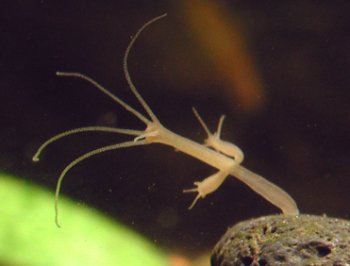
This is when a new organism grows by cell division on the body of its parent. The bud, or offspring is identical to the parent. The bud, when large enough, can break off of the parent and live on its own.  Examples of this include yeast, hydra and potatoes.
 
a)
Regeneration
b)
Vegetative propagation
c)
Fission
d)
Budding
30.
Which of the following is an example of positive feedback to indirectly maintain homeostasis?
a)
the chemical reactions involved in blood clotting
b)
your blood vessels dilate and you begin to sweat in response to elevated body temperature
c)
your blood vessels constrict and you begin to shiver in response to low body temperature
d)
your coach compliments you on your performance in practice
31.
When you get cut, your skin cells release hormones that signal platelets to come and stop the bleeding. Platelets then release more hormones that signal even more platelets to help stop bleeding. The hormone signals continue until the cut is closed.
a)
Positive Feedback Response
b)
Negative Feedback Loop 
32.
What is mean by homeostasis?
a)
Controls and coordinates body activities through chemical 
b)
controls and coordinates body activities through electrical impulses
c)
For maintenance of a steady state in the internal environment
d)
remove metabolic waste products from the cel
33.
Which of the system below not involved in body temperature?
a)
Nervous system
b)
endocrine system
c)
Excretory system
d)
muscular system
34.
Which sentence is TRUE?
a)
Acquired traits are passed from parents to offspring
b)
Inherited traits are passed from parents to offspring
c)
Behaviors are never inherited
d)
Behaviors are always inherited 
35.
A mother dog and her puppy both have curly fur. Which best explains this?
a)
in dogs, curly fur is more common than straight fur
b)
in dogs, curly fur is an acquired trait
c)
the mother dog acquired curly fur and passed on that trait to her puppy
d)
the mother dog inherited curly fur and passed on that trait to her puppy
36.

In which ways can genetic engineering can improve crops

a)

Make them pest or drought resistant

b)

Make them more nutritious

c)

Make them larger

d)

All answers are correct

37.
Biotech foods look and taste the same as traditional foods and crops. The only difference is that biotech food has
a)
fewer calories.
b)
the addition of specific minerals.
c)
genes with traits that improve something about the plant.
d)
a better chance of surviving a frost during the growing season.
38.
What is plant biotechnology?
a)
Adding chemicals to foods to preserve them.
b)
Making synthetic foods using artificial, man-made proteins.
c)
Inserting a gene or genes with beneficial traits into a plant cell.
d)
Taking immature plants and adding steroids to make them grow bigger and stronger.
39.

An argument in favor of food biotechnology is that it

a)

provides foods that cure viral diseases.

b)

provides more food to feed a growing population.

c)

provides a cash crop for low income nations.

d)

biotech foods are not controversial

40.

What is a GMO?

a)

An organism that has had its DNA modified by humans

b)

An organism missing a chromosome

c)

Epigenetics

d)

A genetically identical organism