wayground logo

Free Printable Worksheets

Font size

S
M
L
XL
Worksheets

Social Studies Review

Total questions: 74

Worksheet time: 40mins
Name
Class
Date
1.
What is another name for British soldiers?
a)
Redcoats
b)
Patriots
c)
Minutemen
d)
Continental Soldiers
2.
What did we call colonists who did NOT want independence from England?
a)
Minutemen
b)
Traitors
c)
Militia
d)
Loyalists
3.
"No ________ without representation"
a)
voting
b)
taxation
c)
rights
d)
liberty poles
4.
What was the purpose of the Boston Tea Party?
a)
to punish merchants for selling imported tea.
b)
to see who could throw a barrel further.
c)
to frame the Native Americans.
d)
to protest taxes
5.
Who were the Minutemen?
a)
Patriots who were ready to fight at a minutes notice
b)
British soldiers who were ready to fight at a minutes notice
c)
Sons of Liberty who were ready to fight at a minutes notice
d)
Hessians who were ready to fight at a minutes notice
6.
Which side had more resources and training at the beginning of the war?
a)
British
b)
Colonists
7.
Who won the American Revolution?
a)
The British
b)
The American Colonists
8.
Who fired "the shot heard round the world?"
a)
the British
b)
the minutemen
c)
it is a mystery!
9.
How many people died at the Boston Massacre?
a)
2
b)
6
c)
3
d)
5
10.
What country joined the colonists to help them win the war?
a)
Germany
b)
France
c)
Netherlands
d)
Africa
11.
Where were the first armed conflicts of the American Revolution?
a)
Yorktown
b)
Saratoga
c)
Lexington and Concord
d)
Bunker Hill
12.
What was the name of the British king during the American Revolution?
a)
Charles III
b)
George III
c)
William III
d)
James III
13.
This American victory was the turning point in the war.
a)
Saratoga
b)
Yorktown
c)
Bunker Hill
d)
Lexington and Concord
14.
Who was the major author of the Declaration of Independence?
a)
Benjamin Franklin
b)
John Adams
c)
Thomas Jefferson
d)
Patrick Henry
15.
Surrounded by French and Continental armies, a large British army surrendered here.
a)
Saratoga
b)
Yorktown
c)
Bunker Hill
d)
Lexington and Concord
16.
This member of the Continental Congress helped gain French support for American independence.
a)
Thomas Jefferson
b)
Benjamin Franklin
c)
Patrick Henry
d)
John Adams
17.
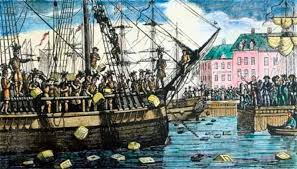
What event is depicted in this image?
a)
Boston Massacre
b)
Boston Tea Party
c)
Battle of Bunker Hill
d)
Lexington and Concord
18.
This patriot made a daring ride to warn colonists that British soldiers were approaching.
a)
Patrick Henry
b)
Paul Revere
c)
Phillis Wheatley
d)
Samuel Adams
19.
Samuel Adams and Paul Revere led members of the Sons of Liberty in this protest against taxes.
a)
First Continental Congress
b)
Boston Massacre
c)
Boston Tea Party
d)
Stamp Act Congress
20.
This enslaved person wrote poems and plays supporting American independence.
a)
Harriet Tubman
b)
Benjamin Banneker
c)
Paul Revere
d)
Phillis Wheatley
21.
Of the following events, which happened first? 
a)
Saratoga
b)
Yorktown
c)
Declaration of Independence
d)
Treaty of Paris of 1783
22.
Of the following events, which happened last?
a)
First Continental Congress
b)
Boston Massacre
c)
Boston Tea Party
d)
Stamp Act
23.
What five things make up a region?
a)
People, climate, culture, landmarks, Orlando
b)
Climate, vegetation, natural resources, culture, and landmarks
c)
Landmarks, mountains, streams, valleys, Air
d)
Landmarks, States, Cities, Counties, Presidents
24.
What does NOT make up culture?
a)
celebrations
b)
music
c)
food
d)
Disney World
25.
What's a type of Physical Feature?
a)
Mountains
b)
Volcanoes
c)
Streams
d)
All of these
26.
What makes up Human Features
a)
Culture
b)
Economics
c)
Government
d)
All of these
27.
Florida is in which region?
a)
Northeast
b)
Midwest
c)
West
d)
Southeast
28.
A region has features that make it different from other areas.  Landforms, water and plants are all part of museums in the region.
a)
false
b)
true
29.
Climate is ...
a)
the type of weather an area has over a long period of time.
b)
the type of weather in one day.
c)
the people who live there.
30.
A tropical climate is ....
a)
always wet.
b)
in every region.
c)
is fun to play in.
d)
temperate, which means it is not too hot or too cold.
31.
Regions have _________________, which are important places or objects.  Landmarks can be natural or man-made.
a)
mountains
b)
streams
c)
landmarks
32.
The southeast Region has ____________.
a)
Rain Forest
b)
Disney World
c)
Mountains
33.
The Northeast Region has ______________.
a)
The Appalachian Mountains
b)
Beaches
c)
The desert
d)
Yellowstone National Park
34.
The Midwest Region includes __________________.
a)
The Desert and Beaches
b)
The Grand Canyon
c)
Mount Rushmore and the Gateway Arch.
d)
The Everglades
35.
The Southwest Region is mostly __________.
a)
Mountains
b)
Beaches
c)
Swampy
d)
Desert
36.
The West Region has ______________.
a)
Yellowstone National Park
b)
The Grand Canyon
c)
The Everglades
d)
The Appalachian Mountains
37.
Name the five Regions!
a)
West, Southwest, Midwest, Southeast, Northeast
b)
West, North, South, East
c)
North Pole and South Pole
d)
Northeast, Southeast, Midwest, Southwest
38.
I believed I could read Asia by traveling west across the Atlantic Ocean in 1492.  I asked the king and queen of Spain to pay for my journey.
a)
Cabot
b)
de Leon
c)
Columbus
d)
Cortes
39.
_________________ claimed the eastern shores of Canada for England.
a)
John Cabot
b)
Juan Ponce de Leon
c)
Vasco Nunez Balboa
d)
Jacques Cartier
40.
What was the main accomplishment of exploration?
a)
The discovery of new lands
b)
Riches and valuable gold
c)
Natural resources like large forest and fish
d)
Learning to grow crops from Native Americans
41.
Christopher Columbus thought he had reached India, but he had really landed in______.
a)
Florida
b)
Canada
c)
the Bahamas
d)
Hudson Bay
42.
Which European country sponsored Christopher Columbus' voyages?
a)
England
b)
Mexico
c)
France
d)
Spain
43.
What was the purpose of Columbus' expeditions?
a)
To find a shorter route to Asia by sailing west
b)
To claim land in Canada
c)
To explore the Hudson Bay
d)
None of the above
44.
What was an outcome of John Cabot's attempt to find the Northwest Passage?
a)
He discovered fishing in Canada  was extremely good and fishing companies moved there.
b)
He discovered Florida.
c)
He learned to grow corn from the natives.
d)
None of the above
45.
_______________ was kicked off his boat by his crew and was never heard from again.
a)
John Cabot
b)
Juan Ponce de Leon
c)
Henry Hudson
d)
Jacques Cartier
46.
Ponce de Leon was the first European explorer to 
a)
claim land for France int he Western Hemisphere.
b)
Set foot on what is now the United States
c)
Start a colony for England in North America.
d)
Sail across the Atlantic Ocean.
47.
This explorer was looking for a way to go west from Europe to find Asia.  Instead he discovered a famous river and explored the area around NYC.  Who is it?
a)
Amerigo Vespucci
b)
Ferdinand Magellan
c)
Christopher Columbus
d)
Henry Hudson
48.
Which of the folowing is an obstacle faced by the early explorers?
a)
bad weather
b)
no maps
c)
ran out of supplies
d)
all of the above
49.
Cabot and Hudson both sailed for which European Country?
a)
France
b)
Porugal
c)
England
d)
Spain
50.
Who is Christopher Columbus? 
a)
Explorer who found the Indies.
b)
Explorer who found the Americas.
c)
Explorer who sailed to Asia. 
d)
Explorer who sailed to the Indies. 
51.

The highest law in the United States is the:

a)

Bill of Rights

b)

Declaration of Independence

c)

Amendment Scroll

d)

Constitution

52.

Our three branches of government are:

a)

Legislative, Independent, Judicial

b)

Judicial, Executive, Legislative

c)

Local, State, Federal

d)

Tall, Grande, Venti

53.

What type of government do we have in the United States?

a)

Monarchy

b)

Democracy

c)

Socialist

d)

Communist

54.

What does "suffrage" mean?

a)

To vote

b)

To approve

c)

To select

d)

To change

55.

The first ten amendments of the Constitution are called the:

a)

Declaration of Independence

b)

Bill of Rights

c)

Revolution Regime

d)

Constitutional Amendments

56.

The Bill of Rights gives people the right to be sent to jail for 20 years for stealing a notebook from CVS.

a)

YES

b)

NO

57.

The Bill of Rights gives people the right to gather peacefully to protest the government.

a)

YES

b)

NO

58.

The Bill of Rights gives people the right to refuse to celebrate Christmas if it is against your religion.

a)

YES

b)

NO

59.

In charge of the court system

a)

Judicial

b)

Legislative

c)

Executive

60.

The Bills of Rights gives people the right to own a gun.

a)

YES

b)

NO

61.

Responsible for writing and passing laws

a)

Judicial

b)

Legislative

c)

Executive

62.

Can declare war

a)

Judicial

b)

Legislative

c)

Executive

63.

Includes the President

a)

Judicial

b)

Legislative

c)

Executive

64.

Represents the citizens of the U.S. with elected officials

a)

Judicial

b)

Legislative

c)

Executive

65.

Includes the Senate and House of Representatives

a)

Judicial

b)

Legislative

c)

Executive

66.

Is able to balance the power of the other branches

a)

Judicial

b)

Legislative

c)

Executive

67.

Makes sure laws are carried out (enforces)

a)

Judicial

b)

Legislative

c)

Executive

68.
Which word means more than enough?
a)
Surplus
b)
Pueblo
c)
Shaman
d)
Ceremony
69.
Which word means a long period without water
a)
Drought
b)
Powwow
c)
Potlatch
d)
Shaman
70.
Which word means land set aside for Native Americans
a)
Reservaton
b)
Pueblo
c)
Travois
d)
Mesa
71.
Why did the northwest region live in plank houses?
a)
They lived in forests where there were many trees.
b)
They lived in the desert.
c)
They stole wood from other indians.
d)
They actually lived in tipis.
72.
Why did the northwest region eat many fish?
a)
They lived near streams and rivers.
b)
They rode their horses to the Atlantic Ocean.
c)
They went fishing in Coligny.
d)
They northwest region did not eat fish
73.
Which region do you see in the picture? (Think of Never Eat Soggy Waffles!)
a)
Southwest
b)
Great Basin
c)
Plains
d)
Northwest
74.
Which of following is one way these Native Americans adapted to their environment?
a)
Trading for what they need
b)
They used irrigation so they would be able to farm in the Southwest
c)
They stored food in containers
d)
They traveled long distances for wood