
NEW
Font size
 Worksheets
Fossil Record and Changes over time
Total questions: 17
Worksheet time: 49mins

When did fossil A become extinct?
Layer 1
Layer 2
Layer 3
Layer 4

Do not rush, examine the diagram. How has life evolved starting with the oldest fossils?
Life started in the ocean and over time organism became to appear with no common ancestors. Fish evolved first, then reptiles, then mammals and finally birds.
Life started in the ocean then slowly evolved through natural selection to life on land. Fish evolved first, then reptiles, then mammals and finally birds.
Life started on land and over time humans began to evolve into fish, then reptiles, and birds.
Life started in the ocean as four-legged amphibians which then evolved to palm trees, then to dinosaurs, and eventually into humans.
Most geologists rejected Wegener's idea of Continental Drift because _________.
He used too many pieces of evidence to support the idea.
He wanted to know what Earth looked like millions of years ago, which is impossible.
He couldn't identify what would cause continents to move around.
They were afraid of the new idea.
Similarities in the Cat's leg, Dolphin's flipper, Bat's wing and our arms suggest...
that we have a common ancestor millions of years ago.
that all could fly at one time.
they can't be related because bats can't swim.
that cats love to swim.

This image shows that
These animals have no simliarities in their structures.
these different species may have evolved from a common ancestor.
These animals are from the same species.
These animals likely evolved from different ancestors due to their differences.

What do you call similar structures that related species have inherited from a common ancestor?
Natural Selection
Analogous Structure
Vestigial Structure
Homologous Structure
Which of these descriptions is an example of an unused body structure?
a bat’s wing that enables it to fly
the tiny leg bones found in snakes (even though snakes do not have legs)
the front legs of a dog that supports its weight as it walks and runs
the tentacles of an octopus that aid it in movement and catching prey
Snakes have tiny leg bones that are not used for movement. What does this most likely show?
Snakes are able to walk if the environment changes.
The ancestors of snakes probably had legs.
All the ancestors of snakes probably did not have legs.
Snakes have the same DNA as organisms that have no leg bones.
Who was Charles Darwin?
A naturalist who came up with the theory of evolution
A scientist who came up with the hypothesis of Continental Drift
A geologist who looked at rocks and fossils
A paleontologist who studied dinosaurs
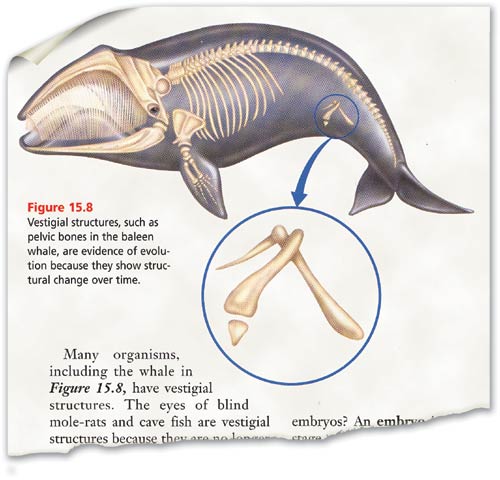
Whales do not have back legs, but they do have tiny leg and hip bones. Even though these leg and hip bones are not used by the whale, they must have been used by an ancestor of the whale. Thus, the leg and hip bones of the whale are referred to as
vestigial structures
extinct structures
homologous structures
An educated guess or testable prediction is a
theory
law
hypothesis
conclusion
Why did the population of peppered moths in England change from light to dark after London became more polluted?
Light moths were easy to see against darker trees and were eaten
Light moths were killed by smoke
The birds that ate the dark moths were killed by smoke
Dark moths were produced by the smoky air.


