Wayground logo

Free Printable Worksheets

Font size

S
M
L
XL
Worksheets

PHYSICS ACP REVIEW 2ND SEMESTER

Total questions: 55

Worksheet time: 1hrs 15mins

Name
Class
Date
1.
The momentum of an object depends upon the object's ___________&_____________.  
a)
size and shape
b)
mass and speed
c)
mass and veloctiy
d)
mass and energy
2.
The equation to calculate momentum is
a)
p=mv
b)
p=1/2mv2
c)
p=mgh
d)
p=mg
3.
Determine the momentum of 1000-kg car moving southward at 20 m/s......... 
a)
20000 N
b)
20000 Joules
c)
20000 Kg * m/s south
d)
10000 kg * m/s south
4.
A 9300 kg railroad car traveling at a velocity of 5 m/s strikes a second boxcar that weighs 5000 kg at rest. At what speed will the second boxcar move?
a)
18.6 m/s
b)
9.3 m/s
c)
7.5 m/s
d)
1.86 m/s
5.
The impulse is ______ the change in momentum
a)
Greater than
b)
Equal to
c)
less than
d)
always double
6.
When the speed of an object is doubled, its momentum
a)
remains unchanged in accord with the conservation of momentum.
b)
doubles
c)
quadruples
d)
decreases
7.
Which object listed below has the greatest momentum?
a)
A 0.05 kg object rolling at 0.2 m/s.
b)
A 0.15 kg object rolling at 2 m/s.
c)
A 0.15 kg object rolling at 1 m/s
d)
A 0.4 kg object rolling at 2 m/s.
8.
A boy kicks a football with a force of 20 N, the time the force acts for is 0.3 s.
Calculate the impulse on the ball.
a)
1 N.s
b)
6 N.s
c)
66 N.s 
d)
None of these
9.
The impulse-momentum theorem states that
a)
the impulse on an object is equal to the change in momentum it causes 
b)
the force on a moving object is equal to the magnitude of the impulse.
c)
the impulse on an object is greater than the change in momentum it causes 
d)
the impulse on an object is less than the change in momentum it causes
10.
What is the frequency of this wave?
a)
3 Hertz
b)
4 Hertz
c)
5 Hertz
d)
6 Hertz
11.
When wavelength increases, what happens to the frequency?
a)
it increases
b)
it decreases
c)
it stays the same
12.

You can't hear sounds in outer space because there is no

a)

medium

b)

light

c)

energy

d)

heat

13.
Which color has the highest frequency?
a)
blue
b)
yellow
c)
orange
d)
violet
14.
A student placed a pencil in a cup of water.  The pencil appears broken because light-
a)
always travels in a straight line
b)
bends when it passes through water
c)
makes the water in the glass evaporate
d)
reflects the pencil on the water's surface
15.
When a wave strikes and object and bounces off. (example echo)
a)
medium
b)
refraction
c)
reflection
d)
interference
16.
Which of the following represents refraction?
a)
A
b)
B
c)
C
d)
D
17.

The diagram shows a series of wave fronts approaching an opening in a barrier. Point P is located on the opposite side of the barrier. The wave fronts reach point P as a result of

a)

resonance

b)

refraction

c)

reflection

d)

diffraction

18.
A converging lens is also known as a ____ lens.
a)
convex
b)
concave
c)
double
d)
refracted
19.
When an object is placed between the focal point and the convex lens, the image produced is ___.
a)
real, reduced, and inverted
b)
real, enlarged, and inverted
c)
virtual, enlarged, and upright
d)
virtual, reduced, and upright
20.
When an object is placed on the focal point in front of a convex lens, the image produced is ___.
a)
real, reduced, and inverted
b)
real, enlarged, and inverted
c)
real, true, and inverted
d)
There is no image
21.
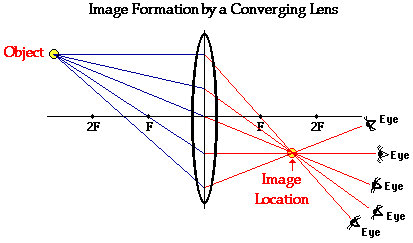
This image is.....
a)
inverted and smaller
b)
inverted and larger
c)
not inverted and smaller
d)
not inverted and larger
22.
What is the ray of light that strikes the surface.
a)
Incident ray
b)
reflected ray
c)
normal ray
d)
normal
23.
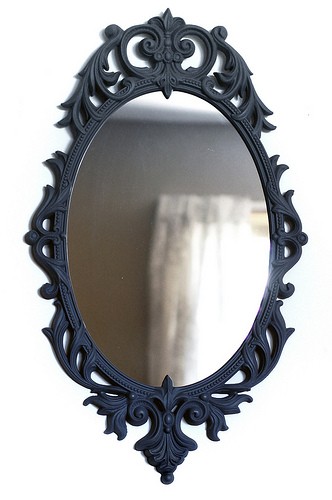
An image that you can see when you look into a mirror, but does not really exist is called which of the following?
a)
Real Image
b)
Fake Image
c)
Virtual Image
d)
Digital Image
24.
The picture shows an electrical circuit. This circuit is a series circuit because: 
a)
It has 3 light bulbs.
b)
The same current flows through all three light bulbs.
c)
It uses a single battery.
d)
The electrical current is divided between the three light bulbs.
25.

What is the total resistance (RT) across this circuit?

a)

3 kΩ

b)

10 kΩ

c)

13 kΩ

d)

18 kΩ

26.
As resistors are added in series to a circuit, the total resistance will...
a)
increase
b)
decrease
c)
stay the same
27.
As the resistance of a circuit increases, the current will...
a)
increase
b)
decrease
c)
stay the same
28.
What will happen if one light bulb is removed from this circuit?
a)
The other bulbs will go out.
b)
The other bulbs will stay on
c)
The other bulbs will get dimmer.
d)
The battery will become stronger.
29.

If lamp 1 is unscrewed from its holder, what will happen to lamp 2?

a)

It will get brighter

b)

It will stay the same brightness

c)

It will go out

d)

Nothing will happen

30.
What size resistor would produce a 3 Amp current flow with a 12 Volt battery
a)
1 Ohm
b)
3 Ohms
c)
4 Ohms
d)
12 Ohms
31.
What is current measured in?
a)
Ω (Ohms)
b)
V (Volts)
c)
A (Amps)
d)
W (Watts)
32.
What is Resistance?
a)
The flow of electrons
b)
Electric potential difference
c)
A battery
d)
The ability to reduce the flow of electrons
33.
Current times Resistance equals
 (I X R)
a)
Power
b)
Voltage
c)
Amperage
d)
Ohm
34.
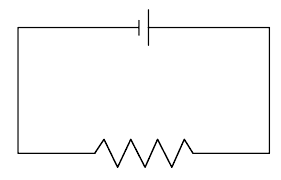
This circuit has a 24 volt battery and the resistor is 8 ohms. How many amps are running through the circuit?
a)
3 Amps
b)
192 Amps
c)
2 Amps
d)
4 Amps
35.

A particle of light is called a...

a)

Photoelectron

b)

Photon

c)

Proton

d)

Electron

36.

The only way to increase the number of photoelectrons emitted is by increasing the _________ of the light

a)

Intensity

b)

Wavelength

c)

Frequency

d)

Energy

37.

What color of light has the greatest energy per photon?

a)

Red

b)

Green

c)

Blue

d)

Violet

38.

Which of the following best describes the nature of light?

a)

Light is both a wave and a particle.

b)

Light is a wave.

c)

Light is a particle.

d)

Light is neither a wave nor a particle.

39.

How much energy is produced when 0.250 universal mass unit of matter is completely converted into energy?

a)

2.25 X 10^16 J

b)

2.34 X 10^15 J

c)

1.8 X 10^12 J

d)

1.14 X 10^-30

40.
Emission of light from an atom occurs when an electron
a)
drops from a higher to a lower energy level.
b)
   jumps from a lower to a higher energy level.   
c)
   moves within its atomic orbital.
d)
falls into the nucleus.
41.
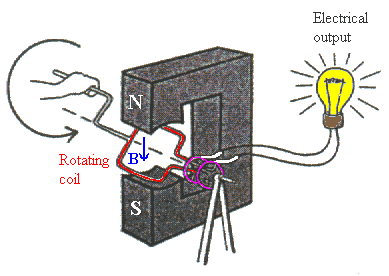
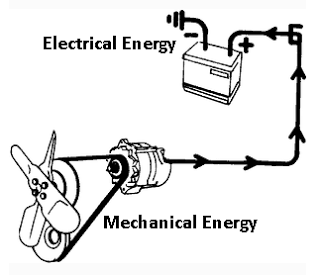
What is the transfer of electricity in a generator?
a)
Mechanical to Electrical 
b)
Physical to Potential 
c)
Electrical to Mechanical
d)
Yogurt to Light
42.
What is the transfer of electricity in a motor?
a)
chemical to mechanical 
b)
electrical to mechanical
c)
mechanical to electrical 
d)
physical to potential 
43.
Generators are devices that convert _____ energy into _____ energy.
a)
chemical; mechanical
b)
mechanical; electrical
c)
electrical; mechanical
d)
potential; kinetic
44.
Looking at the drawing. If you tried to move these 2 magnets closer together, what would you feel?
a)
Push Away
b)
Pull Closer together
c)
No Force
d)
Let the Force be with YOU
45.
The area around a magnet which is affected by its magnetism is the
a)
magnetic curtain
b)
magnetic gas
c)
sum of 5 + 3
d)
magnetic field
46.
If 2 objects collide and stick together, what will happen to their velocities?
a)
velocities will increase
b)
velocities will decrease
c)
velocities will stay the same
d)
none of the above
47.
When the speed of an object is doubled, its momentum
a)
remains unchanged in accord with the conservation of momentum.
b)
doubles
c)
quadruples
d)
decreases
48.
In this type of collision, objects tend to "stick" together.
a)
elastic
b)
inelastic 
c)
They "stick" together in both types of collisions
49.
A 10kg toy truck moves at 5m/s East. It collides and bounces off of a 5kg toy car moving 10 m/s moving west. Which equation would you use to solve for the final velocity of the car?
a)
m1v1i+m2v2i=m1v1f+m2v2f
b)
(m1+m2)vi=m1v1f+m2v2f 
c)
m1v1i+m2v2i=(m1+m2)vf
50.

Determine the momentum of 1,000-kg car moving northward at 20 m/s.

a)

20,000 N

b)

20,000 Joules

c)

20,000 Kg * m/s

d)

20,000 kg * m/s north

51.

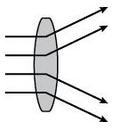
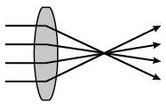
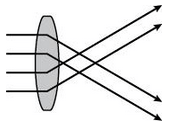
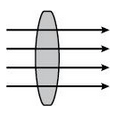
Which figure represents the path light takes through a converging lens?
a)
b)
c)
d)
52.
The splitting of a nucleus into smaller nuclei is
a)
fusion
b)
fission
c)
half-life
d)
gamma radiation
53.
How do nuclear power-plants work?
a)
Fusion
b)
Half-life
c)
Fission
d)
Fusion or fission
54.
This is an example of...
a)
Fission  reaction
b)
Fusion reaction
c)
Decomposition reaction
d)
Decay
55.
This is an example of ---
a)
Radioactive Decay
b)
Nuclear Fission
c)
Nuclear Fusion
d)
Fossil fuel reaction