
 Worksheets
Static Electricity Test
Total questions: 23
Worksheet time: 16mins
Name
Class
Date
1.
Static means...
a)
not moving
b)
moving slowly
c)
moving quicky
2.
One example of static electricity is...
a)
rain
b)
thunder
c)
lightning
3.

The smallest unit of an element is
a)
An electron
b)
A proton
c)
A neutron
d)
An atom
4.
If an object has the same number of positive and negative charges, its electrical charge is...
a)
positive
b)
negative
c)
neutral or no charge
d)
opposite
5.
What charge does a proton have?
a)
negative (-)
b)
positive (+)
c)
neutral or no charge (0)
6.
True or False
A negatively charged object has lost protons
A negatively charged object has lost protons
a)
True
b)
False
7.
Materials that tightly hold on to their electrons are considered
a)
Good conductors
b)
Good insulators
c)
Good anti-static agents
d)
Useful for storing charge
8.
Materials that easily loose or accept electrons are considered
a)
Good conductors
b)
Good insulators
c)
Good anti-static agents
d)
Good for storing charge
9.
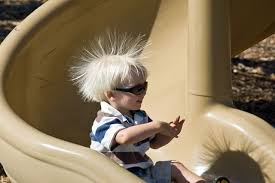
What method of static charging is shown in this picture
a)
Polarization
b)
Friction
c)
Induction
d)
Conduction
10.
Static electricity is:
a)
electricity flowing in a wire
b)
the buildup of electric charges on an object
c)
when protons move between objects
11.
Rubbing a balloon on hair is an example of static charge build up created by....
a)
conduction
b)
friction
c)
induction
d)
hairduction
12.

Why do lightning rods need to be grounded?
a)
They don't. The rod is enough to protect the home
b)
to create a path for the electricity to get to the ground
c)
to direct the electricity to the power grid of the house
d)
to deflect the electricity back into the cloud
13.
Ms Jo Jo rubbed two balloons with a piece of wool. What will happen when the balloons are brought near each other?
a)
The balloons will repel each other.
b)
The balloons will attract each other.
c)
The balloons will become positively (+) charged.
d)
The balloons will pop.
14.
What types of charges attract?
a)
Positive and Positive
b)
Positive and Neutral
c)
Negative and Neutral
d)
Positive and Negative
15.
If a substance has a higher number of electrons than protons on its surface, what type of charge does it have?
a)
A positive charge.
b)
A negative charge.
c)
A neutral charge
d)
No charge at all
16.
If you rub a glass rod with a piece of silk, the rod becomes positively charged. This means that
a)
friction destroyed electrons in the rod.
b)
the silk has become negatively charged.
c)
protons have moved to the rod.
d)
glass attracts more protons.
17.
If you bring a charged object near an electrically neutral surface without allowing the object to touch the surface, the charges in the surface are rearranged by
a)
friction.
b)
convection.
c)
induction.
d)
conduction.
18.
When electrons are transferred from one object to another, positive and negative charges are separated.
a)
true
b)
false
19.
Electrostatics is the study of electrical charges that can be collected and held in one place.
a)
true
b)
false
20.
An electron and a proton have the same amount of charge.
a)
true
b)
false
21.
According to the triboelectric series, paper and aluminum tend to __________.
a)
gain electrons
b)
lose electrons
c)
lose protons
d)
none of the above
22.
How does a Van der Graaf generator generate static electricity?
a)
By friction when the rubber belt spins inside the plastic tube.
b)
By induction when your hands are placed on the metal sphere.
c)
By conduction when the rubber belt comes in contact with the copper comb
d)
None of the above
23.
How can you prevent the Van der Graaf generator from shocking you?
a)
Keep your hands away from it when it is turned on.
b)
Keep your hands on it when it is turned on.
c)
Constantly touch someone else to discharge the electricity
d)
You can't keep it from shocking you.
100 %

