wayground logo

Free Printable Worksheets

Font size

S
M
L
XL
Worksheets

Functions (Mapping Diagram, Vertical Line Test, Graphing))

Total questions: 72

Worksheet time: 2hrs 55mins

Name
Class
Date
1.

Which equation represents y as a linear function of x?

a)

y=8x

b)

x=5

c)

y=4x2

d)

y=x3

2.

Which equations represents y as a linear function of x? Selection ALL that apply!

a)

y=x3

b)

y=9x

c)

x=5

d)

y=x

3.

Which equations represent nonlinear functions? Select all that apply.

a)

y= 3x-4

b)

y=9x2+7x

c)

y=x

d)

y=2x3

e)

2x2=y+4

4.

Is this function represented by the graph Linear or Nonlinear

a)

linear

b)

nonlinear

5.

Is the function represented by the graph linear or nonlinear

a)

linear

b)

nonlinear

6.

Is the function represented by the equation linear or nonlinear?

a)

linear

b)

nonlinear

7.

Is the function represented by the equation linear or nonlinear?

a)

linear

b)

nonlinear

8.

Which graph is linear?

a)

A

b)

B

c)

C

d)

D

9.

What type of graph makes a straight line and can be written as y=mx+b or y=mx?

a)

Nonlinear

b)

Linear

10.

Which of the following are nonlinear? SELECTION ALL THAT APPLY!

a)
b)
c)
d)
11.

Which of the following are linear? SELECTION ALL THAT APPLY!

a)
b)
c)
d)
12.
Is this function linear or nonlinear?
a)
Linear
b)
Nonlinear
13.
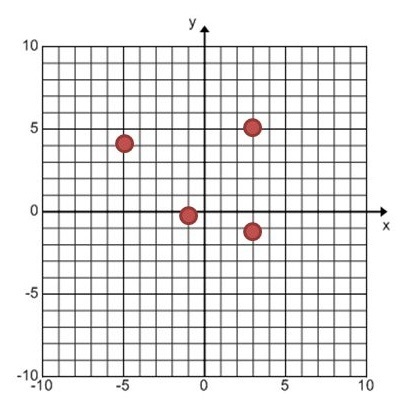
Is this  graph a function?
a)
Function
b)
Not a Function
14.
Is the graph pictured a linear or nonlinear function?
a)
Linear
b)
Nonlinear
15.
Is this graph a function or not a function? 
a)
Function
b)
Not a Function
16.
Is the equation linear or nonlinear?
a)
Linear
b)
Nonlinear
17.
Is the equation linear or nonlinear?
a)
Linear
b)
Nonlinear
18.

Is this function linear or nonlinear?

a)

linear

b)

nonlinear

19.
Does the graph represent a function?
a)
Yes, because the vertical line test shows there are no repeating input values
b)
No, because the vertical line test shows there are repeating input values
20.
Does this mapping diagram represent a function?
a)
No, because there are repeating input values
b)
Yes, because there are no repeating input values
21.

A relation where every input in matches with exactly one output is called a (a)   .

Choose from the below words
Relation
Linear
Exponential
Function
22.
Which graph does NOT pass the vertical line test?
a)
Graph 1
b)
Graph 2
c)
Graph 3
d)
Graph 4
23.
Is the relation a function? Why.
a)
Yes, because the x-value 11 has two y-values pair with it.
b)
Yes, because each x-value has only one y-value paired with it.
c)
No, because the x-value 11 has two y-values pair with it.
d)
No, because each x-value has only one y-value paired with it.
24.
Is this a function? Explain.
a)
Yes; it passes the horizontal line test.
b)
No; it is not a straight line.
c)
Yes; it passes the vertical line test.
d)
No; there is a line connecting the dots.
25.
a)
Function
b)
Not a Function
26.
a)
Function
b)
Not a Function
27.
a)
Function
b)
Not a Function
28.
a)
Function
b)
Not a Function
29.
Which set of values is a function?
a)
(9,5) (10,5) (9,-5) (10,-5)
b)
(3,4) (4,-3) (7,4) (3, 8)
c)
(6,-5) (7, -3) (8, -1) (9, 1)
d)
(2, -2) (5, 9) (5, -7) (1, 4)
30.
Is this graph a function or not a function? 
a)
Function
b)
Not a Function
31.

All of the x values or inputs are called (a)   .

Choose from the below words
Domain
Range
Relation
Function
32.
Is this graph a function or not a function? 
a)
Function 
b)
Not a Function
33.
What is the definition of function?
a)
Has inputs and outputs
b)
Every input has only ONE output
c)
Inputs have different outputs every time
d)
x-values and y-values
34.
A relation is
a)
A way of looking at things.
b)
Always a function
c)
A set of ordered pairs
d)
a set of numbers
35.
True or a false:  A relation is always a function
a)
TRUE
b)
FALSE
36.
What test do we use to see if a relation is a function?
a)
Horizontal Line Test
b)
The Line Test
c)
The Vertical Line Test
d)
Just look at it
37.
Is relation shown a function?
a)
YES
b)
NO
38.
Is the following a function?
a)
Yes
b)
No
39.
Is the mapping diagram an example of a function?
a)
Yes
b)
No
40.
Is the following mapping diagram an example of a function?
a)
Yes
b)
No
41.
Is the following mapping diagram an example of a function?
a)
Yes
b)
No
42.
Is the following graph an example of a function?
a)
Yes
b)
No
43.
Is the following graph an example of a function?
a)
Yes
b)
No
44.
Is the following graph an example of a function?
a)
Yes
b)
No
45.
Is the following graph an example of a function?
a)
Yes
b)
No
46.
Is the following graph an example of a function?
a)
Yes
b)
No
47.
Is the following graph an example of a function?
a)
Yes
b)
No
48.
Does the table represent a function?
a)
Yes
b)
No
49.
Does the table represent a function?
a)
Yes
b)
No
50.
Does the table represent a function?
a)
Yes
b)
No
51.
Does the table represent a function?
a)
Yes
b)
No
52.
Do the ordered pairs represent a function?
a)
Yes
b)
No
53.
Do the ordered pairs represent a function?
a)
Yes
b)
No
54.
Do the ordered pairs represent a function?
a)
Yes
b)
No
55.
Do the ordered pairs represent a function?
a)
Yes
b)
No
56.
Do the ordered pairs represent a function?
a)
Yes
b)
No
57.
Do the ordered pairs represent a function?
a)
Yes
b)
No
58.
Find the missing OUTPUT value.
59.
Find the 2 missing OUTPUT values.
a)
6 & 12
b)
4 & 12
c)
4 & 2
d)
6 & 2
60.

Find the 2 missing y values.

a)

-8 & -12

b)

8 & 12

c)

-8 & 12

d)

8 & -12

61.
Find the missing OUTPUT value.
62.

All of the y values or outputs are called (a)   .

Choose from the below words
Domain
Range
Relation
Function
63.
If my function rule is x + 3, what is the OUTPUT if the input is 4?
64.
If my function rule is 4x, what is the OUTPUT if the input is 5?
65.
If my function rule is 2x + 1, what is the OUTPUT if the input is 2?
66.
If my function rule is x - 5, what is the OUTPUT if the input is 14?
67.

If my function rule is x÷3, what is the OUTPUT if the input is 12?

68.
If my function rule is x - 4, what is my INPUT if the output is 7?
69.
If my function rule is x + 8, what is my INPUT if the output is 20?
70.
If my function rule is 5x, what is my INPUT if the output is 10?
71.
If my function rule is x ÷ 2, what is my INPUT if the output is 3?
72.
If my function rule is x + 9, what is my INPUT if the output is 17?