Worksheets
Chemistry Vocabulary 42
Total questions: 42
Worksheet time: 27mins

Which change describes a substance that changes shape, form, or appearance but is still the same substance?
physical change
chemical change
A single kind of matter that is pure and has a specific set of properties
Mixture
Pure substance
Chemical reaction
Physical property
A pure substance made from one kind of atom. Pick 2.
molecule
element
gold
water
A substance formed by the chemical combination of two or more elements in definite proportion. Pick 2
compound
element
gold
water


A mixture that is NOT evenly distributed is called ....
Compounded
Homogenous
Heterogenous
Salty

A state of matter that has a definite volume and shape.
solid
liquid
gas
matter

This state of matter does not have a definite size or shape.
Gas
Liquid
Solid
Milk


What do we call a chemical substance made up of 2 or more different types atoms bonded together?
formula
atom
subscript
compound

What is a solute?
different materials placed together but keeping their own properties
a mixture in which substances spread out evenly and will not settle
the substance in a solution that has the least amount
What is a solvent?
different materials placed together but keeping their own properties
a mixture in which substances spread out evenly and will not settle
the substance in a solution that has the greatest amount
What is solubility?
different materials placed together but keeping their own properties
a mixture in which substances spread out evenly and will not settle
the degree to which a material will dissolve in another substance
What is energy?
moving energy
stored energy
renewable energy
The ability to do work.
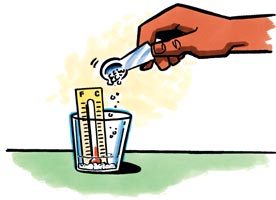
A physical or chemical change in which energy is released by a system.
exothermic change
temperature
chemical
physical
The temperature at which a substance changes from a solid to a liquid (for water, this is 0 degrees Celsius, 32 degrees Fahrenheit)
boiling point
freezing point
melting point
evaporation
The temperature at which a substance changes from liquid to gas (for water this is 100 degrees Celsius, 212 degrees Fahrenheit)
boiling point
melting point
condensation
One of several distinct regions around the nucleus of an atom where electrons are located
energy level / orbital
Tucson
nucleus
proton
The atomic number in a neutral atom tells you what?
only the number of electrons
only the number of protons
only the number of neutrons
the number of both electrons and protons in an atom.
What are valence electrons?
Any of an atom's electrons
Electrons located on the first energy level
Electrons not attached to any atom
electrons located on the outer energy level
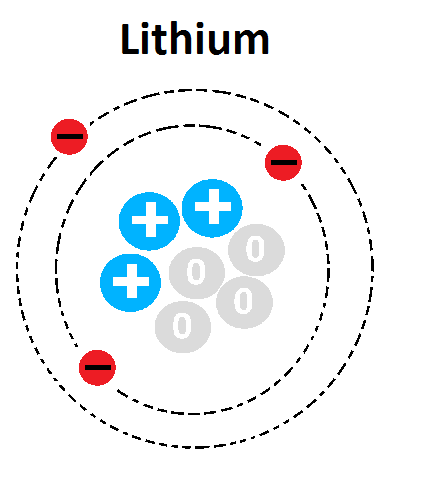
What is the atomic mass of this atom?
1
3
4
7
What does pH measure?
the amount of hydrogen (H+) ions
the amount of hydroxide (OH-) ions
amount of water
all of the above
A solution is made up of
Solvent
Solute
Both solvent and solute
A property of a substance that is always the same whether the sample observed is large or small.
characteristic property
character trait
The temperature at which a substance changes from a liquid to a solid (for water, this is 0 degrees Celsius, 32 degrees Fahrenheit)
freezing point
boiling point
melting point
evaporation

What kind of properties can only be observed when a substance changes into a different substance?
physical properties
chemical properties
liquid properties
real properties