
 Worksheets
Gas Laws
Total questions: 33
Worksheet time: 1hrs 7mins

Calculate the volume that a 0.323-mol sample of a gas will occupy at 265 K and a pressure of 0.900 atm. (Make sure to use the correct R value!)
7.18 L
7.81 L
4.63 L
4.36 L

You have a gas that has a pressure of 2.0 atm and a volume of 10 L. What would be the new volume if the pressure was changed to 1.0 atm?
5 L
20 L
It would stay at 10L
1 L


A sample of oxygen gas has a volume of 150.0 mL when its pressure is .947 atm. What will the volume of the gas be if it is lowered to a pressure of 0.658 atm and the temperature remains constant?
72 mL
144 mL
216 mL
288 mL

Determine the number of moles in a container of propane gas at STP with a volume of 99.2 L.
2222.08 moles
4.43 moles
22.4 moles
76.8 moles
When the temperature is constant (K) inside a balloon, if you add pressure on it, the volume will .....
Decrease
Increase
Not change at all
the gas particles will solidify

If a balloon animal is cooled in a freezer, what will happen to the volume?
Volume will increase
Volume will decrease
Volume will not change
Balloon animal will freeze to death
If 200 mL of a gas at 27 °C is cooled to -33 °C at a constant pressure, the volume will be
250 mL
204 mL
196 mL
160 mL
A scientist needs to store 28.0 moles of xenon gas at STP in the lab. What size gas tank will he need?
628 L
473 L
219 L
376 L
What is the pressure of a car tire that had an initial pressure of 1.8 atm but was heated from 38°C to 123°C?
0.9 atm
2.3 atm
1.6 atm
3.4 atm
What is the volume of a balloon that contains 3.7 moles of helium at 75°C and 5.1 atm?
37 L
13 L
45 L
21 L
In all gas laws calculations, temperature must be measured in
Kelvin (K)
Celcius (ºC)
Farenheit (ºF)
psi, mmHg, and kPa are units used to measure
pressure
temperature
volume
The kinetic molecular theory helps us understand ______
the behavior of gases
how to calculate moles
the attraction between the particles of a solid
how to calculate temperature
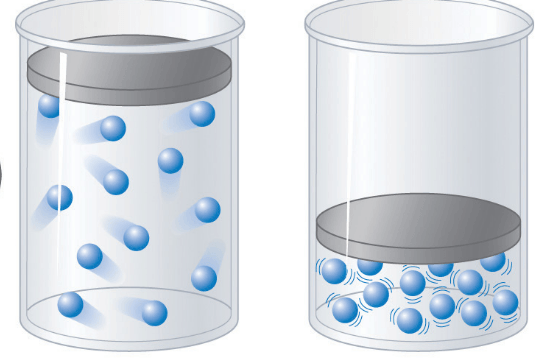
Which container will have a lower pressure?
Left
Right
They both have the same pressure
There is no way to tell from this image
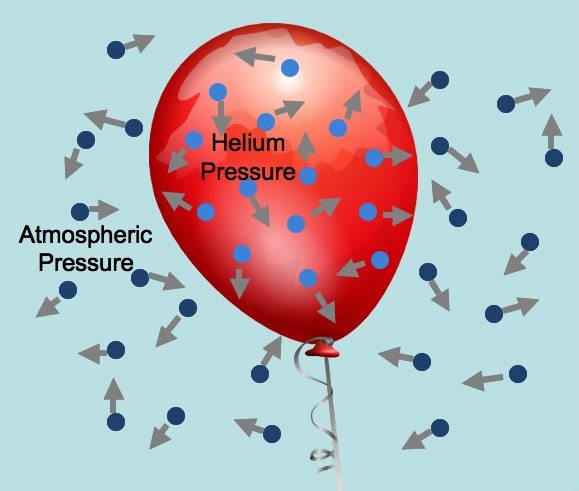
The energy of an object as it is in motion is defined as
Chemical energy
Kinetic energy
Potential energy
Electric energy
Determine the temperature required for 0.0470 mol of gas to fill a balloon to 1.20 L under 750 torr pressure.
0 K
107 K
207 K
307 K
What is 0 degrees Kelvin known as?
(No such thing)
Very cold
Freezing point of water
Absolute zero
A sample of gas has a volume of 0.600 L at 30°C and a pressure of 0.8 atm. What is the number of moles in this sample?
0.192 mol
0.0192 mol
14.4 mol
145.4 mol
A sample of nitrogen gas has a volume of 600 mL at 1 atm. What volume will the gas occupy at a pressure of 3 atm, assuming the temperature remains constant?
125 mL
300 mL
200 mL
400 mL
How do you convert Celsius to Kelvin?
Add 273
Subtract 273
You can't convert those
Multiply by 273
If 10 L of O2 at 273K and 1 atm is compressed to a 7 L container at 250 K, what is the new pressure?
1.31 atm
9.16 atm
0.76 atm
6.0 atm
In the ideal gas law, what does the variable 'n' represent?
gas constant
moles
Temperature
Volume
You have 20 L of a gas at 1 atm and 200 K; you increase the temperature of the gas to 300 K, and raise the pressure to 30 atm. What is the final volume of the gas?
1 L
20 L
30 L
1.5 L
Which one is an amount of standard pressure?
375 atm
101.3 kPa
623 mmHg
15.7 psi
Convert 534 mmHg to kPa
71.2 kPa
4006 kPa
48.2 kPa
285.3 kPa

