

Wayground logo

Free Printable Worksheets

Font size

S
M
L
XL
Worksheets

2nd Semester Final (DISCO)

Total questions: 45

Worksheet time: 31mins

Name
Class
Date
1.
The ability to remove corrupt government officials from office
a)
Referendum
b)
Initiative
c)
Recall
d)
Primary
2.
This was created to allow women to vote nationally
a)
17th Amendment
b)
18th Amendment
c)
19th Amendment
d)
21st Amendment
3.
To preserve water, trees, plants, and other natural resources
a)
Precipitation
b)
Confurion
c)
Conservation
d)
Infusion
4.
Banned people from making, drinking or selling alcohol
a)
17th Amendment
b)
18th Amendment
c)
19th Amendment
d)
21st Amendment
5.
Which of the following is an initiative?
a)
People have the right to remove a politician from office
b)
People have the right to choose who will run for President
c)
People have the right to propose a new law
d)
People have the right to veto or accept a law passed by the government
6.
Key Reforms of the Progressive Era
·  Initiative
·  Referendum
·  Recall
·  Direct Primary
·  17th Amendment

 
How did the reforms listed above impact America?
a)
A system of separate schools for new immigrants
b)
They gave citizens a greater voice in the democratic process of government
c)
More sources of revenue and taxes in state governments.
d)
They successfully brought economic relief to the urban working class
7.
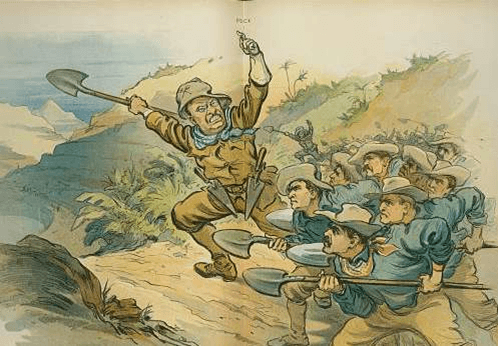
The following political cartoon refers to the construction of what by Teddy Roosevelt?
a)
Naval Base at Guantanamo Bay
b)
Suez Canal
c)
Panama Canal
d)
Washington Monument
8.

The United States began to act as an "international police force" as a result of...

a)

The Roosevelt Corollary to the Monroe Doctrine

b)

The Monroe Corollary to the Roosevelt Doctrine

c)

The Baseball Bat Doctrine

d)

The International Police Force Doctrine

9.

What was the name of President Wilson's plan for peace?

a)

Zimmerman Telegram

b)

Sussex Pledge

c)

Treaty of Versailles

d)

Fourteen Points

10.

Which legislation silenced criticism of the war at home?

a)

Committee on Public Information

b)

Espionage and Sedition Acts

c)

The Red Scare

d)

Palmer Raids

11.

What was the name of the peace-keeping organization proposed by Wilson?

a)

Fourteen Points

b)

League of Nations

c)

United Nations

d)

Sussex Pledge

12.
which industry first benefited from the creation of the assembly line
a)
railroads
b)
automobiles
c)
airplanes
d)
wigits
13.
After World War I, the United States Senate refused to approve the Treaty of Versailles.  This action reflected the Senate’s intention to-
a)
Provide support for the League of Nations.
b)
Punish the nations that began the war.
c)
Return to a policy of isolationism.
d)
Maintain United States leadership in world affairs.
14.
Who was a U.S. socialist that opposed American involvement in World War I?
a)
Vladimir Lenin
b)
Eugene Debs
c)
President Woodrow Wilson
d)
Kaiser Wilhelm II
15.
What was created to protect bank deposits up to $5,000?
a)
WPA
b)
CCC
c)
TVA
d)
FDIC
16.
The New Deal stressed Relief, Recover, and _______.
a)
Reform
b)
Revolution
c)
Reinvention
d)
Reinforcement
17.
This was designed to provide assistance to the elderly, disabled, and poor
a)
Social Security
b)
Securities and Exchange Committee
c)
Wagner Act
d)
National Recovery Act
18.
This law was created to protect workers' right to strike and led to an increase in union participation
a)
Wagner Act
b)
Pendleton Act
c)
Social Security Act
d)
Dawes Act
19.
This man's "Share the Wealth" campaign and campaign for President as a 3rd party ended up with him getting assassinated
a)
Franklin Roosevelt
b)
Herbert Hoover
c)
Huey Long
d)
Huey Short
20.
When was Pearl Harbor attacked?
a)
December 7, 1941
b)
September 1, 1939
c)
October 31, 1941
d)
December 25, 1941
21.

The largest water-to-land invasion in history took place when the Allies stormed the beaches at Normandy, France. This was

a)

VE Day

b)

VJ Day

c)

Iwo Jima

d)

D-Day

22.
Which statement BEST describes the involvement of the United States in World War II before the bombing of Pearl Harbor? 
a)
 The United States maintained strict neutrality with no favoritism.
b)
 The United States provided advisory troops to aid Great Britain
c)
 The United States provided lend-lease aid to Great Britain and the Soviet Union.
d)
 The United States secretly sank German submarines.
23.
The Tuskegee Airmen were a group of American pilots who flew many missions during World War II. They were good pilots who earned a great deal of recognition, but were also unique in the military because they were
a)
Japanese Americans
b)
Asian Americans
c)
African Americans
d)
Mexican Americans
24.

In response to Japanese aggression in French Indochina in 1940 , the United States government

a)

imposed a oil embargo

b)

declared war on Japan

c)

supported Vietnamese aggression

d)

dropped a bomb on Hiroshima

25.

He proposed a a March on Washington DC to demand an end to racial discrimination in 1941

a)

Martin Luther King Jr

b)

A. Philip Randolph

c)

Marcus Garvey

d)

Booker T Washington

26.

Battle of Midway

a)

Organization established near the end of the WW2 to guarantee international peace and security through permanent diplomacy.

b)

Two Japanese cities devastated by atomic bombs dropped by the US in an attempt to end the Second World War.

c)

It was the decisive turning point in the Pacific War as the Allies won basically all of the battles in the Pacific after it.

d)

June 6, 1944, the day on which Allied forces landed in Normandy, France to begin a massive offensive against the Germans and the occupied territory of Europe.

27.

FDR signed an order to put more than 100,000 people with Japanese backgrounds in ____________________.

a)

schools

b)

reservations

c)

nature reserves

d)

internment camps

28.

Why was Rosie the Riveter important?

a)

She had a riveting gun and not a lot of women had one in those days

b)

She was really pretty

c)

She helped inspire over 6 million women to get a war job.

d)

She inspired one women to get a war job

29.
In 1950, Korea fought a civil war over the spread of communism.  Communists from the north tried to take over the south.  What role did he US play in this war?
a)
The US and its allies went to Vietnam to fight Korean Communists.
b)
The US and its allies join the fight to keep communism from spreading.
c)
The US and its allies did not join the Korean War.
d)
The US and its allies fought to defend the North.
30.
What was the name of the first satellite in space launched by the Soviet Union?
a)
Gagarin
b)
Apollo 11
c)
Sputnik
d)
Apollo 13
31.

During the Cold War, what bill did the U.S. Congress pass to provide financial assistance to western European countries?

a)

Truman Doctrine

b)

Open Door Policy

c)

Marshall Plan

d)

Domino Theory

32.

What policy implemented in the Cold War said the U.S. would give military aid to a country that needed to resist communism?

a)

Marshall Plan

b)

Truman Doctrine

c)

Domino Theory

d)

Open Door Policy

33.

What legislation helped American soldiers get an education and buy homes in the suburbs during the Cold War?

a)

Interstate Commerce Act

b)

Federal Housing Authority Act

c)

Social Security Act

d)

GI BIll

34.

Leader who worked to improve treatment, pay, and working conditions for farm workers; you should know this one because you have already used three of these!

a)

Martin Luther King, Jr.

b)

John F. Kennedy

c)

Thurgood Marshall

d)

Cesar Chavez

35.

Outlawed racial discrimination in the workplace and in public places, including schools.

a)

13th Amendment

b)

Jim Crow Laws

c)

Civil Rights Act of 1964

d)

Voting Rights Act of 1964

36.
What event caused a negative shift in U.S. public opinion during the Vietnam War?
a)
The Geneva Accords
b)
Operation Rolling Thunder
c)
The Tet Offensive
d)
Gulf of Tonkin
37.
What provided congressional support for escalating military action in Vietnam? 
a)
Cuban Missile Crisis
b)
Battle Of Midway
c)
Gulf of Tonkin Resolution 
d)
Bay of Pigs Invasion
38.
Which election was decided by the Supreme Court due to voting problems in Florida? 
a)
The Election of  2004
b)
The Election of 2000
c)
The Election of 2016
d)
The Election of 1998
39.
Which of the following was an attack on the US that led to the US fighting in Afghanistan and Iraq?
a)
Pearl Harbor 
b)
7/11
c)
9/11
d)
Cuban Missile Crisis 
40.

Involved a break-in to the Democratic Party Headquarters in Washington, D.C. leading to the resignation of Pres. Nixon

a)

Iran Hostage Crisis

b)

Watergate Scandal

c)

Star Wars

d)

Camp David Accords

41.

Which of the following happened during Jimmy Carter's presidency and cost him his re-election bid?

a)

Iran Hostage Crisis

b)

Iran-Contra Affair

c)

Persian Gulf War

d)

September 11 Attacks

42.

What was Jimmy Carter's greatest achievement as President?

a)

Camp David Accords

b)

Iranian Hostage Crisis

c)

Ending the Cold War

d)

Victory in the Persian Gulf War

43.
Broad tax cuts, and financial deregulation, which would promote economic expansion, are examples of what policy's objective:
a)
Reaganomics
b)
Trade Imbalance
c)
Iran-Contra Affair
d)
Heritage Foundation
44.
The factor that may have most helped JFK win the Election of 1960 was
a)
He was Catholic
b)
He looked good during the TV debates
c)
He was known to be the most experienced candidate
d)
He was friendly with Fidel Castro
45.

First minority President

a)

Bill Clinton

b)

Barrack Obama

c)

George W. Bush

d)

Jimmy Carter
