wayground logo

Free Printable Worksheets

Font size

S
M
L
XL
Worksheets

How to use a microscope and it's parts!

Total questions: 40

Worksheet time: 22mins

Name
Class
Date
1.
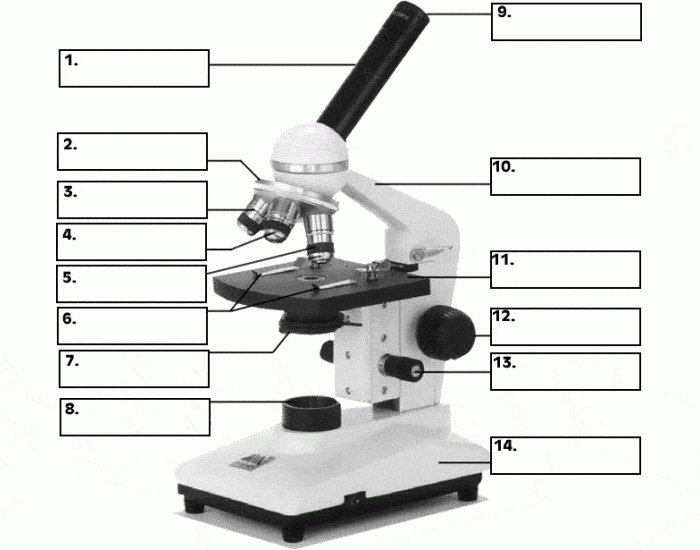
Which number is the arm in the image?
a)
3
b)
6
c)
9
d)
12
2.
Which number is the objective lens in the image?
a)
1
b)
7
c)
8
d)
12
3.
Which number is the course knob in the image?
a)
4
b)
5
c)
9
d)
11
4.
Which number is the stage clips in the image?
a)
9
b)
10
c)
11
d)
12
5.
Which number is the light source in the image?
a)
9
b)
10
c)
11
d)
12
6.
Which number is the revolving nosepiece in the image?
a)
7
b)
8
c)
9
d)
10
7.
Which number is the fine course adjustment knob in the image?
a)
3
b)
4
c)
5
d)
6
8.
Which number is the base in the image?
a)
3
b)
4
c)
5
d)
6
9.

What does a microscope do?

a)

produces a magnified image of a things to small for the eye to see

b)

helps us look at stars

c)

produces a smaller image of something to big too see at once

d)

helps us look at our teeth

10.

What is the light source?

a)

a sore spot of light

b)

where light goes to cry

c)

helps to shine light on the specimen

d)

the Sun

11.

When would you use the course adjustment

a)

low power

b)

medium power

c)

off

d)

high power

12.

Why would you use the diaphragm?

a)

to sing

b)

to let light shine on the specimen

c)

to let the specimen look bigger

d)

to make crackers

13.

Where is the base located on the microscope?

a)

top

b)

front

c)

back

d)

bottom

14.

What does the nose piece on a microscope do?

a)

hold the adjustment knobs

b)

hold the light source

c)

hold the objective lens

d)

holds the glasses on your face

15.

What do objective lenses do?

a)

magnify the specimen

b)

hold the nose piece

c)

support the body tube

d)

the part you look into

16.

What do stage clips do?

a)

hold the specimen in place

b)

where you put the specimen

c)

how you see the specimen

d)

nothing

17.
You should always carry the microscope by the
a)
arm and base
b)
arm and body tube
c)
arm only
d)
the objectives
18.
When looking at a specimen on your slide, you should always start with the
a)
low objective lens
b)
medium objective lens
c)
high objective lens
d)
super extra high power lens
19.
The _______focuses the image under low power.
a)
revolving nosepiece
b)
fine adjustment knob
c)
coarse adjustment knob
d)
arm/neck
20.
The__________ sharpens the image under high magnification.
a)
the diaphragm
b)
fine adjustment knob
c)
coarse adjustment knob
d)
the ocular
21.

Adjusts the amount of light that reaches the specimen

a)
b)
c)
22.

The light source for a microscope.

a)
b)
c)
23.

The flat platform where the slide is placed.

a)
b)
c)
24.
Number 3
a)
Ocular Lens
b)
Objective Lens
c)
Diaphragm
d)
Base
25.
Number 10
a)
Stage
b)
Stage Clips
c)
Diaphragm
d)
Base
26.
Number 11
a)
Course Adjustment
b)
Fine Adjustment
c)
Small Adjuster
d)
Large Adjuster
27.
The factors in an experiment that can be changed. 
a)
variables
b)
quantitative data
c)
hypothesis
d)
steps
28.

Moves the stage slightly to sharpen the image.

a)

fine adjustment

b)

stage clips

c)

course adjustment

d)

arm

29.

Used to support the top part of the microscope when carried.

a)

nose piece

b)

stage

c)

arm

d)

base

30.

Regulates the amount of light on the specimen.

a)

stage

b)

course adjustment

c)

fine adjustment

d)

diaphragm

31.

This part of the microscope connects the top portion with the bottom portion

a)

Legs

b)

Obj. Lenses

c)

Body Tube

d)

Arm

32.
Moves body tube up and down (and stage) to allow gross focusing of microscope image
a)
coarse adjustment
b)
fine adjustment
c)
scanning objective
d)
low power objective
33.
Longest objective (40x); Has the smallest field of view; Most detail; *Never use the coarse adjustment knob*
a)
low power objective
b)
high power objective
c)
scanning objective
d)
eyepiece/ ocular
34.
Shortest objective (4x); largest field of vie; least detail
a)
low power objective
b)
high power objective
c)
scanning objective
d)
eyepiece/ ocular
35.
Part 12
a)
Fine Adjustment Knob
b)
Coarse Adjustment Knob
c)
Diaphragm
d)
Objective
36.
Part 13
a)
Fine Adjustment Knob
b)
Course Adjustment Knob
c)
Stage
d)
Diaphragm
37.
Used to hold the slides in place
a)
Stage
b)
Stage Clips
c)
Diaphragm
d)
Arm
38.
Part 7
a)
Stage
b)
Stage Clips
c)
Light Source
d)
Diaphragm
39.
Which of the following do you not do when cleaning up your microscope?
a)
Move the clips out
b)
Turn the light off
c)
Wrap the cord around the base
d)
Leave it on low power
40.
Never use this knob on high power.
a)
Fine
b)
Large
c)
Course
d)
Small