wayground logo

Free Printable Worksheets

NEW

Font size

S
M
L
XL
Worksheets

Final Review Semester 2

Total questions: 59

Worksheet time: 2hrs 26mins
Name
Class
Date
1.
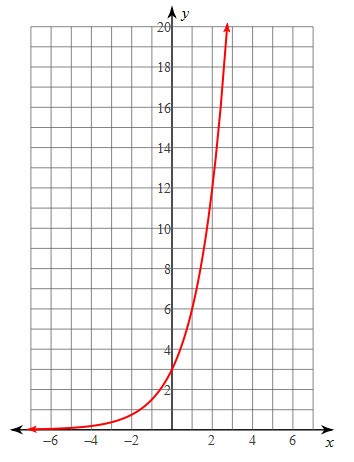
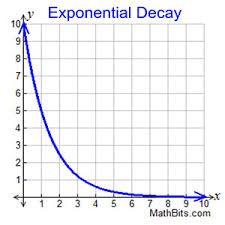
Is the pictured graph growth, decay, or linear or none?  
a)
Growth
b)
Decay
c)
Linear
d)
None
2.
What is the y-intercept of the function?
a)
2
b)
3
c)
1
d)
-2
3.
Identify the y-intercept (initial value) in the function f(x)=13(.27)x
a)
(.27)x
b)
.27
c)
13
d)
3.51
4.
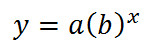
In an exponential function, what does the 'a' represent? 
a)
SLOPE
b)
RATE OF CHANGE
c)
Y-INTERCEPT
d)
COMMON RATIO
5.
Identify the common ratio (multiplier) of the function f(x)=2(4)x.
a)
2
b)
4
c)
(2)x
d)
8
6.

Is the following function and example of decay or growth?

f(x)=2(0.85)x

a)

Exponential Decay

b)

Exponential Growth

7.
The expression 12(1.015)t models the population of elephants in a wildlife refuge after t years since 1975.
Is the population of elephants increasing or decreasing?
a)
Increasing
b)
Decreasing
8.

Suppose a culture of bacteria begins with 5000 cells and dies by 30% each year. Write an equation that represents this situation.

a)

y = 5000(0.7)x

b)

y = 30(5000)x

c)

y = 5000(1.3)x

d)

y = 5000(0.3)x

9.

A population of fish starts at 8,000 and decreases by 6% per year. What is the approximate population of fish after 10 years?

a)

14327

b)

4309

c)

839

d)

7680

10.

Caiden earned $475 from mowing lawns last summer. He deposited this money in an account that pays an interest rate of 3.8% compounded annually. What will be his balance after 15 years?

a)

$827.52

b)

$831.10

c)

$839.45

d)

$846.80

11.
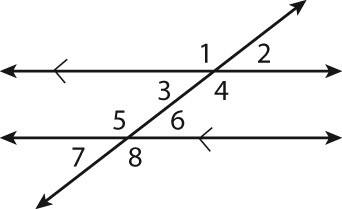
Identify the correct statement.
a)
∠1 & ∠2
are vertical angles
b)
∠2 & ∠4
are vertical angles
c)
∠5 & ∠8
are vertical angles
d)
∠1 & ∠5
are vertical angles
12.
Angles which add up to 180° are called _____.
a)
Vertical angles
b)
Corresponding Angles
c)
Supplementary Angles
d)
Alternate Interior Angles
13.
Solve for  y.
a)
y = 20
b)
y = 120
c)
y = 60
d)
y = 10
14.
Which pair of angles are alternate interior angles?
a)
Angle 5 and Angle 3
b)
Angle 2 and Angle 6
c)
Angle 3 and Angle 6
d)
Angle 1 and Angle 6
15.
Which of these angles is NOT congruent to angle 5?
a)
Angle 6
b)
Angle 8
c)
Angle 1
d)
Angle 4
16.
WHAT IS THE CORRECT EQUATION TO FIND THE VALUE OF X?
a)
X=12
b)
8X - 17 + 5X +19 = 180
c)
8X - 17 = 5X +19
d)
X= -12
17.
A line that passes through parallel lines is called a ______________.
a)
transitive
b)
passer through line
c)
transversal
d)
bisector
18.
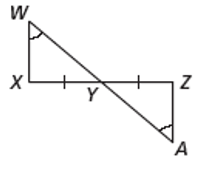
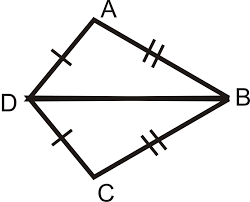
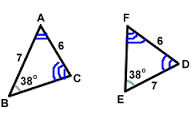
Are these triangles congruent?
a)
Yes, by ASA
b)
Yes, by SAS
c)
Yes, by AAS
d)
No, this is the SSA one!!
19.
Are these triangles congruent?
a)
Yes, by AAS
b)
Yes, by SAS
c)
Yes, by ASA
d)
No, this is the SSA one!!
20.
Are these triangles congruent?
a)
Yes, by AAS
b)
Yes, by SAS
c)
Yes, by SSS
d)
No, this is the SSA one!!
21.
Are these triangles congruent?
a)
Yes, by AAS
b)
Yes, by SAS
c)
Yes, by ASA
d)
No, this is the SSA one!!
22.
Are these triangles congruent?
a)
Yes, by SSS
b)
Yes, by SAS
c)
Yes, by AAS
d)
No, they are not congruent
23.
Are these triangles congruent?
a)
Yes, by SAS
b)
Yes, by SSS
c)
No they are not congruent
d)
Not enough information to know for sure
24.
a)
A
b)
B
c)
C
d)
D
25.
1
a)
a
b)
b
c)
c
d)
d
26.
3
a)
a
b)
b
c)
c
d)
d
27.
What does CPCTC stand for?
a)
Corresponding Parts of Congruent Triangles are Congruent
b)
Congruent Parts of Congruent Triangles are Corresponding
c)
Corresponding Parts of Canadian Triangles are Cool
d)
Congruent Parts of Corresponding Parts are Corresponding
28.
Name the postulate/theorem that proves these triangles congruent.
a)
SSS
b)
SAS
c)
ASA
d)
HL
29.
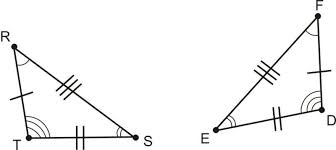
What is the correct congruence statement for these congruent triangles?
a)
ΔRTS ≅ΔEFD
b)
ΔRTS ≅ΔFDE
c)
ΔRTS ≅ΔFED
d)
ΔRTS ≅ΔDEF
30.
Given that C is the midpoint of BD, then...
a)
AC ≅ CE
b)
BD ≅ AE
c)
BC ≅ CD
d)
DE ≅ AB
31.
Given that BQ bisects ∠KQA, then...
a)
KQ = QA
b)
∠KQB ≅∠AQB
c)
KB = AB
d)
∠KBQ ≅∠ABQ
32.
A slide is also called a _________.
a)
Translation
b)
Reflection
c)
Rotation
d)
Transformation
33.
The image shows what type of transformation
a)
Rotation
b)
Translation
c)
Reflection
34.
What transformation is happening to the red triangle to get to the blue triangle?
a)
Translation
b)
Rotation
c)
Reflection
35.
 Describe the Transformation
a)
Translation
b)
Rotation
c)
Reflection
36.
Reflection or Rotation
a)
Reflection
b)
Rotation
37.
Is this rotation or reflection symmetry?
a)
Rotation
b)
Reflection
c)
Translation
38.
Write a rule for the translation.
a)
 (x -1, y  + 2)
b)
 (x -2, y  + 1)
c)
 (x +2, y  - 1)
d)
(x +1, y  -  2)
39.
Identify the transformation from ABC to A'B'C'.
a)
(x+8, y+4)
b)
(x-8, y-4)
c)
(x+4, y+8)
d)
(x-4, y-8)
40.
Identify the transformation from ABCD to A'B'C'D'.
a)
Translation
b)
Reflection across the y-axis
c)
Reflection across the x-axis
d)
90o counter clockwise Rotation
41.
Identify the transformation from ABC to A'B'C'.
a)
90o clockwise rotation
b)
90o counter clockwise rotation
c)
Reflection across the y-axis
d)
Reflection across the x-axis
42.

Which pair have a line of reflection of x = -2?

a)

A & B

b)

B & C

c)

G & H

d)

E & F

43.
∆QRS contains the points: Q(4, 2) R(5, 1) S(3,7). If the triangle is reflected across the y-axis, what will S' be?
a)
S'(3, 7)
b)
S'(-3, 7)
c)
S'(-3, -7)
d)
S'(3, 7)
44.
Reflect the figure across the y-axis. What are the coordinates of A'?
a)
(-2, -4)
b)
(2, 4)
c)
(-2, 4)
d)
(2, -4)
45.
These triangles are congruent. If ∠A is 48o what is the measure of ∠F?
a)
48o
b)
38o
c)
84o
d)
94o
46.

What is the value of the ANGLE A (not just x)?

a)

151

b)

69

c)

151

d)

70

47.
Identify the m<MNL
a)
520
b)
900
c)
1280
d)
1420
48.
Find the value of ∠A.
a)
25 degrees
b)
30  degrees
c)
35 degrees
d)
90 degrees
49.
Which would be the best classification for the triangle shown?
a)
acute isosceles
b)
equiangular scalene
c)
equiangular isosceles
d)
equiangular equilateral
50.
What is the value of x?
a)
51
b)
49
c)
78
51.
What is the measure of ∠ABC?
a)
25°
b)
75°
c)
108°
d)
150°
52.
Find the measure of the angle x.
a)
105
b)
115
c)
65
d)
75
53.
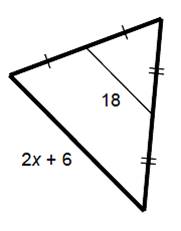
Find the missing length.
a)
x = 12
b)
x = 11
c)
x = 15
d)
x = 9
54.
Find the length of AD
a)
2
b)
4
c)
6
d)
8
55.
What is the length of DC
a)
4
b)
1
c)
2
d)
3
56.
Which point is a solution?
a)
(0, 6)
b)
(-3, 4)
c)
(1, 0)
d)
(-4, 3)
57.
Which of the following is not a solution to this system of inequalities?
a)
(0,-1)
b)
(0,3)
c)
(4,0)
d)
(6,-2)
58.
Which system of inequalities matches the graph?
a)
y > 2x - 4
y < 2
b)
y < 2x - 4
y < 2
c)
y > 2x - 4
<  2 
d)
y < 2x - 4
<   -2
59.

Solve the system of inequalities by graphing.

a)
b)
c)
d)