
NEW
Font size
 Worksheets
Judicial Branch Review
Total questions: 35
Worksheet time: 35mins
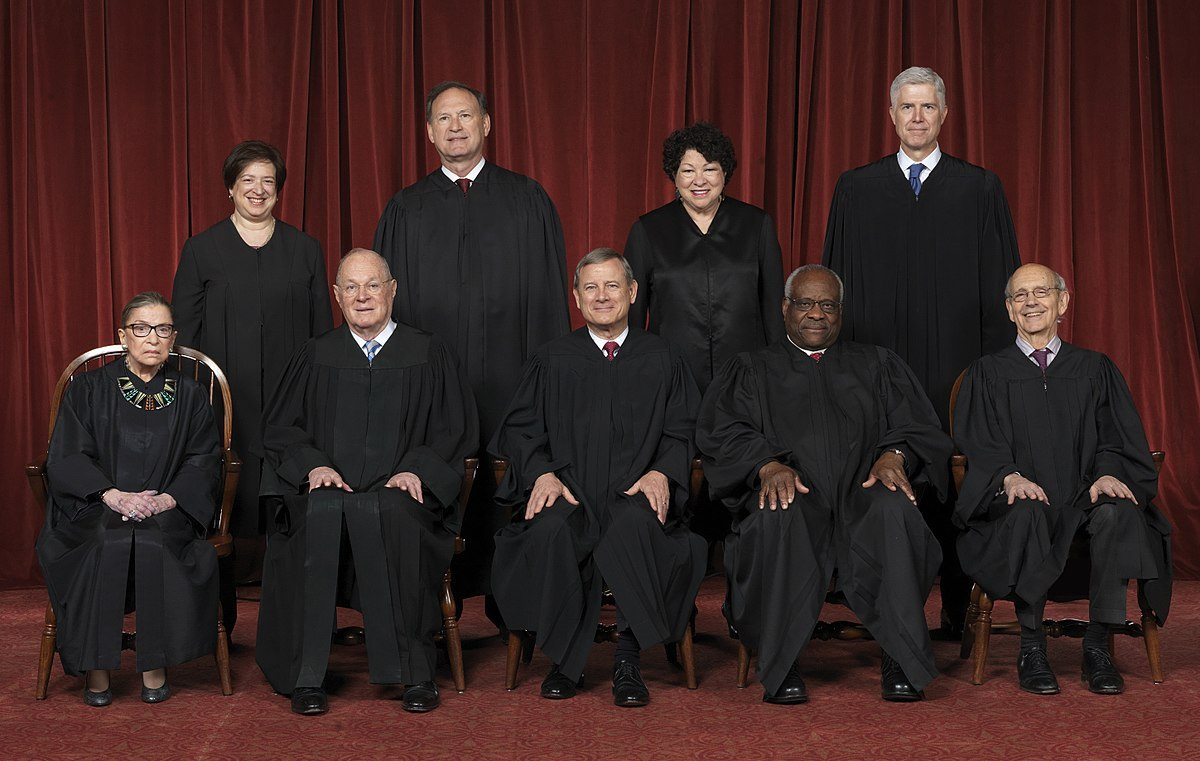
How many Supreme Court Justices sit on the Supreme Court?
7
9
5
12
Appellate Jurisdiction is when:
a court is the first to hear a case
a court has the authority to hear a case
a court reviews the decision of a lower court
power is shared between the Federal and State courts to hear a certain case
Original Jurisdiction is when:
a court is the first to hear a case
a court has the authority to hear a case
a court reviews the decision of a lower court
power is shared between the Federal and State courts to hear a certain case
What argument was the author of this statement, John Marshall, making about how the Federal Government should function?
“It is emphatically the province and duty of the Judicial Department to say what the law is.”
—John Marshall, Marbury v. Madison, Opinion of the Court
The judicial branch of the Federal Government should have the power to make laws.
The judicial branch of the Federal Government should have power to interpret laws.
The judicial branch has the sole authority to establish a federal court system.
Only the laws created by the Federal Government, and approved by the Court, have any authority in the federal system.
Which of the following is an example of the principle of judicial review being exercised?
The Senate first examines, and then rejects a Supreme Court candidate.
The President appoints a candidate to serve on the Supreme Court.
The Supreme Court declares a State law unconstitutional.
Congress decides to impeach a federal judge for failure to uphold the law.
The authority to hear certain cases is called:
judicial review.
litigation of the court.
writ of certiorari.
jurisdiction of the court.
Which of the following best explains what Judicial Review is and why it's important.
It gives the president the power to review cases that the supreme court has issued rulings on. This allows the president to correct mistakes that the court has potentially made. It also allows the checks and balances concept within the government to remain strong.
It gives congress the power to review cases that the supreme court has issued rulings on. This allows congress to correct mistakes that the court has potentially made. It also allows the checks and balances concept within the government to remain strong.
It gives the supreme court the power to create and review treaties with foreign countries. This allows the court to play a greater role in the government than what was previously established by the constitution.
It gives the supreme court the power to review the actions of /laws created by the executive and legislative branch. The court can rule those actions or laws unconstitutional. It also allows the checks and balances concept within the government to remain strong.
The U.S. Constitution creates which court(s)?
The Supreme Court
The Federal Courts
The State Courts
All of the above
If a person loses a trial, they can go to the courts above the trial court. These higher courts are called the ___________.
appellate courts.
Supreme Courts.
state courts.
second trial courts.
The Supreme Court has what type of jurisdiction with these types of cases?
This ruling held held that criminal suspects must be informed of their right to consult with an attorney and of their right against self-incrimination prior to questioning by police.
Regents of California v. Bakke, 1978
Plessy v. Ferguson, 1896
New Jersey v. TLO, 1985
Miranda v. Arizona, 1966
The court declared that "student rights do not stop at the schoolhouse gates." The wearing of black armbands was protected by the Constitution. Students enjoy protection of the Bill of Rights unless their actions materially disrupt the educational environment.
Regents of California v. Bakke,1978
Roe v. Wade, 1973
Tinker v. Des Moines School District, 1969
Texas v. Johnson, 1991

What is the significance of the landmark Supreme Court case Miranda v. Arizona (1966)
Police now must read suspects their “Miranda” rights (a statement explaining that they have the right to remain silent and have an attorney present for questioning).
Police now must read suspects their “Miranda” rights (a statement explaining that they don't have to house soldiers in their home)
Police now must read suspects their “Miranda” rights (a statement explaining that they have the right to bear arms)
This Supreme Court case determined that students do NOT have the same rights with search and seizure as adults in a school setting.
Tinker v Des Moines
Hazelwood v Kuhlmeier
New Jersey v. TLO
Brown v. Board of Education
This ruling held that public school curricular student newspapers that have not been established as forums for student expression are subject to a lower level of First Amendment protection than independent student expression or newspapers established (by policy or practice) as forums for student expression.
In re Gault, 1966
Korematsu v. United States, 1944
Hazelwood School District v. Kuhlmeier, 1988
Mapp v. Ohio, 1961
This ruling invalidated prohibitions on desecrating the American flag in force in 48 of the 50 states. Justice William
Brennan wrote for a five-justice majority in holding that the defendant's act of flag burning was protected speech under the first amendment.
Regents of California v. Bakke,
Roe v. Wade, 1973
Tinker v. Des Moines School District, 1969
Texas v. Johnson, 1991
The person who is being accused of wrong doing or a criminal act is called the-
prosecution
plaintiff
defendant
jury
If you believe your trial was not handled fairly what can you do?
Nothing, the verdict is final
Appeal your verdict to a higher court
Write to the judge
Petition the Supreme Court
If someone is on trial for committing an illegal act they would go to....
the Supreme Court
Civil Court
Criminal Court
jail
Use these words to fill in the blank below.
bailiff appeal plaintiff/prosecutor court clerk verdict
The ___ is the person who brings legal action against another person and is responsible for proving the person's guilt.
verdict
bailiff
plaintiff/ prosecutor
court clerk
hold or express opinions that are at variance, different or in disagreement with those previously, commonly, or officially expressed.
Dissent
Agreement
Contrary
Which is true of the Majority Opinion of the Supreme Court?
It adds or emphasizes a point not made in the other argument.
It is the court’s opinion that sets the model (precedent) for other courts to follow
It is the court’s opinion that really has no power.
It is the losing argument which could be reversed later.

