wayground logo

Free Printable Worksheets

NEW

Font size

S
M
L
XL
Worksheets

Government 2nd Semester Final Review

Total questions: 67

Worksheet time: 36mins

Name
Class
Date
1.

What is the main function of the Legislative branch?

a)

To make the laws

b)

To enforce the laws

c)

To interpret the laws

d)

To govern the states

2.

Checks and balances were created because

a)

it created a balanced work load for each branch

b)

the founding fathers wanted the states to have more power

c)

it stopped any one branch from gaining too much power

d)

it set up the three branches of government

3.

The 2nd amendment:

a)

insures freedom of speech

b)

established due process rights

c)

says that people cannot be forced to house soldiers

d)

gives people the right to own guns

4.
Which branch of the federal government is responsible for interpreting the laws of the U.S?
a)
Executive
b)
Judicial
c)
Legislative
d)
Treasury
5.
The Supreme Law of the Land is the
a)
Bill of Rights
b)
Constitution
c)
will of the people
d)
executive order of the President
6.

The leader of the House of Representatives is:

a)

the vice president

b)

the speaker of the house

c)

the president pro tempore

d)

the majority leader

7.
Amendments Four through Eight deal with rights of
a)
women
b)
slaves
c)
the accused
d)
personal expression
8.
The fact that the Constitution is the "supreme law of the land" illustrates which aspect of our government?
a)
limited government
b)
popular sovereignty
c)
national supremacy
d)
separation of powers
9.
The overall purpose of the Bill of Rights is to
a)
allow people to defend themselves in court
b)
protect the rights of the people from the government
c)
prevent one branch of government from becoming stronger than the others
d)
secure voting rights for all citizens, regardless of race, age, or gender
10.
The Congress may pass laws and they go into effect if the President signs the law. However, the Supreme Court can declare a law unconstitutional. This is an example of
a)
supremacy
b)
veto power
c)
federalism
d)
checks and balances
11.
Which of these is a power of the President?
a)
declaring war
b)
creating legislation
c)
acting as Commander-in-Chief
d)
determining whether a law is unconstitutional
12.
The case of Marbury v. Madison established the right of the Supreme Court's right to declare laws unconstitutional, which is also known as
a)
judicial review
b)
reserved powers
c)
concurrent powers
d)
judicial restraint
13.
What Amendment contains the five basic freedoms?
a)
1st Amendment
b)
2nd Amendment
c)
5th Amendment
d)
8th Amendment
14.
What role do the federal courts play in checking the power of the legislative branch?
a)
Congress creates courts and may impeach judges
b)
federal judges and justices are appointed for life
c)
they review laws of Congress for compliance with the Constitution
d)
the President may veto Congressional legislation with judicial approval
15.
Why did the Anti-federalists push for the addition of a Bill of Rights to the Constitution?
a)
there was a precedent set in Great Britain's Constitution
b)
they believed the government needed protection from possible uprisings
c)
they believed the people's liberties needed protection from the government
d)
there was already a requirement to do so, but the Federalists were ignoring it
16.
A federal system of government is
a)
unique to the U.S.
b)
one in which the central government controls the economy
c)
one in which central government power is limited by a system of checks and balances
d)
one in which power is shared between a central government and state or regional governments
17.
In a constitutional government who holds sovereign power?
a)
the people
b)
head of state
c)
a supreme court
d)
hereditary ruler
18.
which amendment has the most effect on the reserved powers of states?
a)
1st
b)
10th
c)
13th
d)
20th
19.

An example of a check the legislative branch has on the executive branch.

a)

The can review laws to ensure they follow the Constitution

b)

They can reject presidential appointments

c)

They can veto laws

d)

They can appoint judges

20.
Which of the following amendments in the Bill of Rights does not deal with the issue of criminal proceedings?
a)
5th 
b)
6th 
c)
3rd
d)
8th 
21.
How did the 22nd amendment effect the office of the Presidency?
a)
lowered the required age to 35
b)
limited the president to 2 terms
c)
made being a natural born citizen a requirement
d)
changed the date of inauguration to January 20th 
22.
The 25th amendment established the order of succession of the presidency. Who follows the President and Vice-President according to the 25th amendment?
a)
President Pro-temp
b)
Speaker of the House
c)
Secretary of State
d)
Chief Justice of Supreme Court
23.
What right did the 9th amendment help create?
a)
Right to property
b)
Right to symbolic speech
c)
Right to privacy
d)
Right to life
24.
This type of government has people elect representatives to speak for them.
a)
democracy
b)
monarchy
c)
theocracy
d)
republic
25.
How is power distributed in a  FEDERAL system?
a)
More power is held by state governments then national.
b)
Power is not held by the regional governments
c)
Power is shared between Central and Regional
d)
no power is held by the state
26.
-Idea that absolute power rests with the people (people rule)
a)
Limited Government 
b)
Popular Sovereignty 
c)
Federalism
d)
Republicanism 
27.
All 50 states have ___ Senators who serve for ___ years each, barring expulsion, impeachment, resignation, or death.
a)
36 : 2
b)
2 : 6
c)
7 : 11
d)
100 : 435
28.
- Idea that government power is divided/shared between the national and state levels.
a)
Repubicanism
b)
Popular Sovereignty
c)
Limited Government 
d)
Federalism
29.
What is the final step for a bill becoming a law?
a)
Conference committee signs bill
b)
House signs bill
c)
Senate sings bill
d)
President signs, veto, or pocket vetos a bill
30.
If the House and Senate pass different version of the same bill, where does it go next?
a)
conference committee
b)
joint committee
c)
resolution committee
d)
President
31.
The president appoints advisers who are experts in certain areas and head their own departments. They are the president's:
a)
White House Staff
b)
Cabinet
c)
Supreme Court
d)
Justice League
32.
In connection to foreign policy, Congress has the exclusive power to...
a)
Sign treaties
b)
Declare war
c)
Represent the U.S. at the United Nations
d)
Make laws about domestic issues
33.
Which case reaffirmed the right to have a lawyer represent your case?
a)
Gideon v. Wainwright
b)
Miranda v. Arizona
c)
Batson v. Kentucky
d)
New Jersey v. TLO
34.
Which of the following is a characteristic of a civil case?
a)
They are prosecuted by the state
b)
They are based on reasonable doubt
c)
They involve damages being paid
d)
They result in punishment
35.
The Democrats are the majority party in Maryland. If they work the districts to make sure Democrats continue to be elected in Congress, they are...
a)
Gerrymandering
b)
Lobbying
c)
Petitioning
d)
Filibustering
36.
Some argue that the Supreme Court has some of the greatest influence over our laws because of judicial review. How can Congress check the Supreme Court?
a)
The Senate has to approve the members of the Supreme Court
b)
Congress is allowed to make whatever laws they want
c)
Congress can override judicial review with 2/3 majority
d)
Congress can appeal judicial review to the President.
37.
The United States Senate approves a treaty that is created by the President.
This is an example of what concept?
a)
Rule of law
b)
Checks and balances
c)
Representative democracy
d)
Popular sovereignty
38.
Norma Constantineau challenged a Wisconsin law that allowed the chief of police to identify her as "an excessive drinker" and deny her the right to buy alcohol.  Constantineau cited a certain clause and successfully argued that this clause entitled her to a hearing before the state could post her name on the "excessive drinker" list.  Which clause did she cite in her case?
a)
Elastic Clause.
b)
Establishment Clause.
c)
Due Process Clause.
d)
Privileges and Immunities Clause.
39.
Which of the following is NOT an example of thoughtful and effective civic participation? 
a)
registering for military duty. 
b)
paying taxes.
c)
serving on a jury. 
d)
choosing not to vote.
40.
What kinds of rights are those listed below? Grand jury indictment. Confront your accuser. Refrain from self-incrimination. Being tried for the same crime twice. 
a)
Civil liberties.
b)
 Civil rights. 
c)
 Miranda rights.
d)
Due process rights.
41.
How many judges on the federal Supreme Court 
a)
7
b)
9
c)
11
d)
14
42.
In charge of elections in MO, keeps all official records 
a)
Secretary of State 
b)
Auditor 
c)
Lieutenant Governor
d)
Governor 
43.
Acting Governor when needed 
a)
President Pro Tempore
b)
Speaker of the House 
c)
Lieutenant Governor
d)
Governor 
44.
According to the MO non-partisan plan, who decides if the judge is retained or removed? 
a)
Governor
b)
General Assembly
c)
MO Supreme Court
d)
MO voters
45.

Which of the following is a civic responsibility of U.S. citizens?

a)

Voting in elections

b)

Doing jury duty

c)

Following laws

d)

Paying your taxes

46.

Suspects cannot be questioned (interrogated) until they are informed of their rights (right to remain silent, right to an attorney, etc.)

a)

Brown v Board of Education

b)

Miranda v Arizona

c)

Tinker v Des Moines

d)

Bush v Gore

47.

Which amendment said anyone born in United States is a citizen in 1868?

a)

13th Amendment

b)

14th Amendment

c)

15th Amendment

d)

10th Amendment

48.
Which of the following rights and freedoms is specifically guaranteed by the first 1st amendment?
a)
Right to an education
b)
Freedom of press
c)
Right to bear arms
d)
Right to privacy 
49.
How does the National Government determine how many electoral college votes each state gets?
a)
number of senators it has
b)
number of representatives it has
c)
by population
d)
number of representatives and senators it has
50.
The Fifth Amendment states that a person cannot be
a)
tried for the same crime twice.
b)
forced to give evidence against himself or herself.
c)
deprived of life, liberty, and property without due process of law.
d)
all of the above
51.
 What are the term lengths for the House of Representatives and Senate, respectively?
a)
2 years; 6 years.
b)
 6 years; 4 years. 
c)
6 years; 2 years.
d)
 4 years; 2 years.
52.
Why was the Ninth Amendment added to the Constitution?
a)
because the framers worried they might have forgotten an important right
b)
because the framers wanted to make clear that basic rights were guaranteed even if they were not stated specifically
c)
because the Bill of Rights had to have ten parts
d)
because the English Bill of Rights listed nine rights
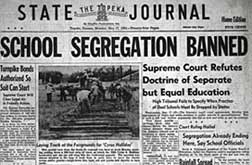
53.

Ruled that “Separate but Equal” was Unconstitutional.

a)

Hazelwood v Kuhlmeier

b)

Marbury v Madison

c)

Plessy v Ferguson

d)

Brown v Board of Education

54.
Which of these is not allowed, according to the Eighth Amendment?
a)
reasonable bail
b)
reasonable fines
c)
jail terms
d)
cruel punishments
55.
What historic document is the Bill of Rights a part of?
a)
Declaration of Independence
b)
The US Constitution
c)
The Articles of Confederation
d)
The English Bill of Rights
56.
a)
1st Amendment
b)
3rd Amendment
c)
4th Amendment
d)
5th Amendment
57.
This case advocated free speech in the schools in the form of an anti-war protest
a)
Tinker vs. Des Moines
b)
Gideon vs. Wainwright
c)
Mapp vs. Ohio
d)
Morse v. Frederick
58.
Voted against public prayer and Bible readings in school
a)
Board of Ed. v. Earls
b)
Engel v. Vitale
c)
Brown v. Board of Education
d)
Plessy v. Ferguson
59.
Which court case is important in protecting the 4th Amendment right to "unreasonable search and seizures"? 
a)
Mapp v Ohio
b)
Gideon v Wainwright
c)
US v Nixon
d)
Brown v Board of Ed
60.
What is the difference between original jurisdiction and appellate jurisdiction?
a)
Original jurisdiction refers to a case being heard in a federal court; appellate jurisdiction refers to a case being heard in a State court.
b)
Original jurisdiction refers to criminal or civil cases; appellate jurisdiction refers to only to civil cases.
c)
Original jurisdiction refers to a case that could be heard in a federal or a State court; appellate jurisdiction refers to a case that must be heard in a federal court.
d)
Original jurisdiction refers to a court where a case is first heard; appellate jurisdiction refers to a case being heard after it was tried in a lower court.
61.
The legislative branch of the U.S. government is also called ________________--
a)
cabinet
b)
representatives
c)
Parliament
d)
Congress
62.

Who is the President of the Senate?

a)

Majority Leader

b)

Minority Leader

c)

Vice President

d)

President

63.
Reapportionment of house seats is based on what?
a)
State Size
b)
State Population
c)
Number of Political Districts
d)
The number of chairs in the room
64.
Name the 2 parts of Congress.
a)
President & Supreme Court
b)
House of Representatives & Senate
c)
Supreme Court & Senate
d)
House of Representatives & Supreme Court
65.

The phrase that "No one is above the law" is known as what?

a)

Elastic Clause

b)

14th Amendment

c)

Rule of Law

d)

Checks and Balances

66.

What does it mean when a law is considered unconstitutional?

a)

The law supports the Constitution.

b)

The law follows the orders of Congress.

c)

The law disagrees with the Constitution.

d)

The law is vetoed by the President.

67.
How many electoral college votes is needed in order to win the Presidency?
a)
100
b)
270
c)
435
d)
538