wayground logo

Free Printable Worksheets

Font size

S
M
L
XL
Worksheets

3A EarthSci 052419

Total questions: 150

Worksheet time: 2hrs 10mins

Name
Class
Date
1.
Wastes produced by agriculture, households, industry, mining, and other human activities can end up in ______________.
a)
groundwater
b)
streams and rivers
c)
oceans
d)
All of these choices
2.
About 97% of the water on Earth is ___________________.
a)
fresh water
b)
groundwater
c)
salt water
d)
ice
3.
Increase in which gas is primarily responsible for increased global warming?
a)
Carbon dioxide
b)
Water vapor
c)
Methane
d)
Nitric oxides
4.
When fertilizers run off farmland into streams and ponds, the nitrogen content of the water increases. This can lead to rapid growth of algae in a process called eutrophication. How can this process affect other organisms in the water?
a)
Oxygen is used up as algae is decomposed, reducing the amount available to other organisms.
b)
The water becomes better able to support aerobic organisms.
c)
The algae provide food for fishes and other organisms, leading to decreased algae populations.
d)
The extra nitrogen provides additional food for the other organisms, increasing their population.
5.
Which of the following historical events most likely triggered the largest increase in the human population? 
a)
the Black Death plague, which occurred in the mid-1300s
b)
the domestication of wheat crops, which began around 8000 B.C
c)
the fall of the Roman Empire, which occurred around A.D. 800
d)
the Industrial Revolution, which began in the late 1700s
6.
largest number of individuals of a population that the environment can support  
a)
carrying capacity
b)
primary succession 
c)
denitrification
d)
mutualism
7.
What is the most dramatic result of deforestation?
a)
land is no longer green and full of life
b)
pictures from space show deforestation
c)
loss of habitat for approximately 70% of the worlds species
d)
people can't explore rainforests
8.
Which has the least negative impact on wildlife habitat?
a)
agriculture
b)
development
c)
deforestation
d)
recreation
9.
Less rainfall in an area and higher temperatures could lead to ____________.
a)
urbanization
b)
deforestation
c)
desertification
d)
higher pollution
10.
What are some reasons deforestation occurs?
a)
clearing land for agriculture, ranching, and mining
b)
just wanting to destroy things
c)
Population moving from rural areas to cities
d)
to make room for infrastructure
11.
The natural resources used by society are limited by various factors. Why is coal considered a nonrenewable resource?
a)
Once coal is used up, it can never be replaced.
b)
Coal is a nonrenewable resource, because it comes from the impact of meteors with the Earth
c)
Coal was a renewable resource, until it was mismanaged by humans
d)
Coal is considered a nonrenewable resource, because it takes millions of years to form
12.
Fossil fuels are an important natural resource used by society. Which of the following best describes fossil fuels?
a)
They are any liquid fuel derived from once-living matter.
b)
They are organic fuels derived from ancient plants and animals.
c)
They are fuels in which dinosaur fossils are commonly found.
d)
They are naturally occurring inorganic fuels like coal and petroleum.
13.
Carbon is released into the atmosphere through all of the following ways except:
a)
respiration
b)
cow flatulence
c)
photosynthesis
d)
all of the above
14.
Wind is a __________ energy resource.
a)
Renewable
b)
Nonrenewable
15.
In the U.S., laws enacted from the 1780's to the late 1800's reflected the perception that
a)
the amount of land and natural resources in the west was endless.
b)
the natural resources of the west could be used up and required legal protection.
c)
Americans were living amid dirtier air, dirtier water, and more waste and toxic chemicals.
d)
a sustainable future should be a primary goal.
16.

1. What are renewable resources?

a)

. Resources that are used faster than they form

b)

resources that can replenish themselves over time

c)

resources that formed over millions of years

d)

resources that exist only in rural areas

17.

1. What would Earth be like without the greenhouse effect?

a)

The same temperature

b)

a little cooler than it is now

c)

. Too cold to live

d)

a little warmer than it is now

18.

According to the graph, what material’s recycling would reduce the largest portion of America’s trash?

a)

Metals

b)

paper

c)

plastics

d)

Yard trimmings

19.

1. Which level of the food chain is most affected by biomagnifications?

a)

Producers

b)

primary consumers

c)

secondary consumers

d)

tertiary consumers

20.

1. Which biome has the highest biodiversity and is the most threatened?

a)

Temperate forests

b)

grasslands

c)

tropical rain forests

d)

deserts

21.

1. Why is firewood considered to be a renewable resource?

a)

It can be replenished over time.

b)

It is used up faster than it can form.

c)

It is made from coal.

d)

It can be made synthetically.

22.

1. Why has Earth's human carrying capacity increased greatly?

a)

Other organisms have been displaced by agriculture, so there is more space for humans.

b)

Humans have modified their environment due to technological advances.

c)

Humans can live closer together than other animals

d)

Humans are now eating fewer plants than they used to.

23.

1. Which of the following is not a renewable resource?

a)

coal

b)

wind energy

c)

solar energy

d)

water

24.

1. What factor does not determine the size of an individual's ecological footprint?

a)

amount and efficiency of resource use

b)

amount of waste produced

c)

size of population

d)

toxicity of waste produced

25.

What is global warming

a)

the normal temperature fluctuations of Earth's climate cycle

b)

the melting of the polar ice caps

c)

the trend of increasing temperatures on Earth

d)

the changes in Earth's biosphere that affect the atmosphere

26.

Which member of the following food chain is most likely to be affected by mercury, a pollutant? Algae - zooplankton - salmon – bear

a)

algae

b)

salmon

c)

zooplankton

d)

bear

27.

How might an introduced plant species kill native plant species?

a)

. Its rapid growth can deprive native plants of sunlight.

b)

Its rapid growth can deprive native plants of food.

c)

It can cause soil loss from erosion.

d)

Its rapid growth can deprive native plants of oxygen.

28.

1. What is one of the greatest threats to biodiversity on Earth?

a)

habitat destruction

b)

loss of drinking water

c)

decrease in food supply

d)

pollution

29.

1. Why might an introduced animal species overrun native species in an ecosystem?

a)

. Its population size is smaller than those of native species.

b)

. It is more energy efficient, so it eats less food.

c)

It is a predator of the native species.

d)

It often has no natural enemies

30.

1. What does the Endangered Species Act do?

a)

It provides food for endangered species.

b)

It protects organisms that are near extinction and their environments

c)

It protects populations of animals from predators

d)

It protects endangered plant species only.

31.
Global warming has been linked to a decrease in 
a)
the size of the polar ice caps 
b)
the temperature of Earth 
c)
the rate of species extinction 
d)
the rate of carbon dioxide production
32.
Which human activity would preserve nonrenewable resources?
a)
deforestation
b)
removing carnivores from a forest 
c)
recycling
d)
heating homes with fossil fuels  
33.
Continued depletion of the ozone layer will most likely result in
a)
an increase in skin cancer among humans 
b)
a decrease in atmospheric pollutants 
c)
an increase in marine ecosystem stability 
d)
a decrease in climatic changes
34.
The acidity of a local stream would most likely be affected by
a)
a change in the percentage of decomposers living in the stream
b)
a new source of air pollution 
c)
a new predator species being introduced to the ecosystem
d)
a decrease in the amount of sunlight that reaches the stream
35.
Increased industrialization will most likely
a)
decrease available habitats 
b)
increase environmental carrying capacity 
c)
increase the stability of ecosystems 
d)
decrease global warming
36.
Which human activity is correctly paired with its likely future consequence?
a)
overfishing in the Atlantic — increase in supply of flounder and salmon as food for people 
b)
development of electric cars or hybrid vehicles — increased rate of global warming 
c)
use of fossil fuels — depletion of underground coal, oil, and natural gas supplies 
d)
genetically engineering animals — less food available to feed the world’s population
37.
Why are trees a natural resource?
a)
The leaves are green
b)
We use them to make paper, lumber, and other products.
c)
They are beautiful
d)
They grow back after they are cut down.
39.
All of the following are nonrenewable resources EXCEPT
a)
Coal
b)
animals
c)
petroleum (oil)
d)
natural gas
39.
All of the following are nonrenewable resources EXCEPT
a)
Coal
b)
animals
c)
petroleum (oil)
d)
natural gas
40.
Which of the following means of transportation uses a renewable resource for its energy source?
a)
solar powered car
b)
coal powered steam train
c)
natural gas car
d)
gasoline truck
41.
A farmer decides that he is going to produce his own energy on the farm by using a type of renewable energy. The renewable energy could come from--
a)
setting up wind turbines
b)
having a coal furnace
c)
using natural gas
d)
burning oil
42.
Which of the following is a way a person could conserve natural resources?
a)
recycling waste materials like plastic, glass, paper, and aluminum
b)
limiting water use when showering, brushing teeth, and shaving
c)
using rechargeable batteries
d)
all of the above are good conservation practices
43.
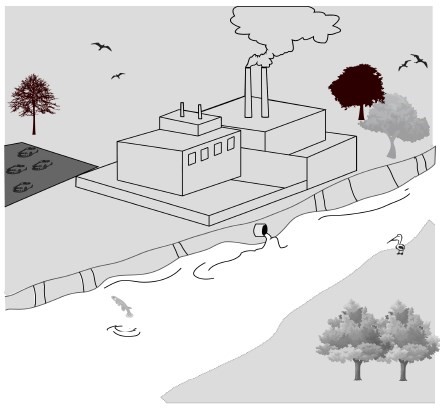
If the factory in this diagram was NOT practicing good environmental conservation, what effect would be produced?
a)
air and water pollution
b)
good fishing for recreation
c)
plentiful animals in the river
d)
purified drinking water
44.
A way the factory could help conserve the river water as a natural resource is to--
a)
filter the water before dumping into the river
b)
remove all of the animals from the area for their protection
c)
set up nets down river to remove contaminated fish
d)
post signs of "No swimming in the river"
45.
Which of the following natural resources are nonrenewable?
a)
Water
b)
Animals
c)
Natural gas
d)
Wind
46.
What does conserving resources mean?
a)
Use as much of the resources as you can
b)
Only use the resources at school
c)
Protecting the resource so it does not run out
47.
Any useful material that is found in nature:
a)
Natural Resource
b)
Human Resource
c)
Plants
48.
The Jones family cares about the environment. They run their dishwasher only when it is completely full. Which of the following BEST explains why they do this?
a)
To save money
b)
To recycle dish soap
c)
To reduce sewage
d)
To conserve water
49.

Claim: the consumption of natural resources by humans has a negative impact on the environment. What data would provide evidence for this claim?

a)

Increased human lifespan and increased ice cap size

b)

Increased human population and decreased habitats for plants and animals

c)

Increased consumption of resources by humans and increased biodiversity (variety) in nature

d)

Increased of fossil fuel burning by humans and decreased use of other resources

50.

Some factories that burn coal produce smoke with harmful chemicals, such as sulfur. Scrubbers are devices that are attached to the smokestacks to reduce the amount of sulfur put into the atmosphere. To evaluate the effectiveness of these devices, what data would need to be collected?

a)

The average amount of sulfur in a certain amount of coal

b)

The amount of coal a factory burns each year and how much sulfur it emits (produces)

c)

The increase in the use of scrubbers by factories that burn coal

d)

The amount of sulfur emitted (produced) by a smokestack before and after the scrubber is attached

51.

Ths graph presents data from a city showing the amount of land used to bury solid waste each year. From 1990 to 1999, the amount of space needed to bury waste increased by 1 to 2 square kilometers per year. In the year 2000, the city started a recycling program to slow the increase of land needed for this burying this solid waste. The city claims that since this recycling program started, the amount of land needed for burying solid waste has decreased.

Which evidence would support this claim?

a)

Data showing that by the year 2010, more than 40% of the citizens were participating in the recycling program

b)

Data showing that the land used for burying solid waste in 2010 was less than 22 square kilometers

c)

Data showing that by the year 2010, there was five times more solid waste being buried than being recycled

d)

Data showing that the land used to build a recycling facility is greater than the amount of land used to bury solid waste

52.

As the human population increases, so does the consumption of natural resources. What are some ways this impacts natural ecosystems and environments?

a)

negative impact

b)

positive impact

c)

habitat loss

d)

environmental pollution

53.

What type of data would be required to show that the

amount of carbon dioxide emissions from the burning of fossil fuels for energy can be reduced by using

renewable resources?

a)

the amount of emissions from the burning of fossil fuels

b)

the amount of scrubbers on a smoke stack

c)

the amount of emissions from renewable sources

d)

the amount of renewable resources in a landfill

54.

The people or animals living in a particular area.

a)

population

b)

species

c)

community

d)

consumer

55.

The _____________ the human population, the ______________ the amount of resources being used.

a)

greater, greater

b)

greater, least

c)

least, greater

d)

least, least

56.

Urbanization is

a)

the process by which human activity and natural process damage land to the point that it can no longer support the local ecosystem.

b)

replacing forests, fields, and grasslands with houses, roads, schools and shopping area.

c)

the growth of urban areas caused by people moving into cities

d)

The process by which wind, water, ice, or gravity transports soil and sediment from one location to another

57.

When human activity and natural process damage land to the point it can no longer support the local ecosystem.

a)

Urbanization

b)

Erosion

c)

Land Degradation

d)

Deforestation

58.

When wind, water, ice, or gravity transports soil and sediment from one area to another it is called

a)

Erosion

b)

Desertification

c)

Deforestation

d)

Urbanization

59.

This image is an example of what type of land degradation

a)

Desertification

b)

Deforestation

c)

Urban Sprawl

d)

Urbanization

60.

This image is an example of what type of land use

a)

Residential

b)

Commercial

c)

Agricultural

d)

Recreational

61.

Land that is kept untouched but is used for hiking and other leisure activities

a)

Transport land

b)

Agricultural Land

c)

Residential Land

d)

Recreational Land

62.

This image is an example of what type of land degradation

a)

Desertification

b)

Deforestation

c)

Urbanization

d)

Urban Sprawl

63.

Land used for business and/or use of natural resources is called

a)

Residential Land

b)

Transport Land

c)

Commercial Land

d)

Agricultural Land

64.

Land use for building homes and small communities

a)

Recreational Land

b)

Residential Land

c)

Transport Land

d)

Commercial Land

65.

Urban Sprawl is

a)

large network of roads and train tracks that connect urban and rural areas across the country

b)

process by which land becomes more desert-like and unable to support life

c)

replacing forests, fields, and grasslands with houses, roads, schools and shopping area.

d)

the process by which human activity and natural process damage land to the point that it can no longer support the local ecosystem.

66.

Land use for roads and train tracks is called

a)

Transport land

b)

Industrial Land

c)

Residential Land

d)

Agricultural Land

67.

True or false: Rural areas have a dense population and many buildings.

a)

True

b)

False

68.

Several factors can lead to land degradation. Which of these activities is least likely to contribute to land degradation?

a)

Urbanization

b)

Deforestation

c)

Poor farming methods

d)

Using an irrigation system on crops

69.

Soil erosion can increase when humans remove trees and other vegetation from an area. What is this process called?

a)

Decomposition

b)

Conservation

c)

Deforestation

d)

Urbanization

70.

Choose the following that describes why land is important to humans . (Choose all that apply)

a)

Fossil Fuels for energy

b)

Nutrients for plants to grow

c)

Buildings

d)

Minerals for Construction

71.

Where an organism lives

a)

Ecosystem

b)

Ecological footprint

c)

House

d)

Habitat

72.

A resource that is in limited supply and cannot be replaced once it has been used.

a)

Renewable resource

b)

Habitat

c)

Non-renewable resource

d)

Ecosystem

73.

Any substance intended for preventing or killing pests

a)

Pollutants

b)

Agriculture

c)

Pesticides

d)

Landfills

74.

Waste matter that contaminates the water or air or soil

a)

Pesticides

b)

Landfills

c)

Habitat

d)

Pollutant

75.

Farming

a)

Recycle

b)

Agriculture

c)

Conservation

d)

Mining

76.

Taking old materials and making them into something new

a)

Recycle

b)

Conservation

c)

Composting

77.

A specific area where living and non-living organisms interact.

a)

Habitat

b)

Family

c)

Landfill

d)

Ecosystem

78.

The act of using a resource wisely or making good choices with our natural resources.

a)

Compost

b)

Recycle

c)

Conservation

d)

Hiding

79.

A solid waste disposal area, a dump

a)

Landfill

b)

Natural resource

c)

Fossil fuel

d)

Habitat

80.

The government agency that makes laws and sets rules to protect the environment, Environmental Protection Agency

a)

DDT

b)

CIA

c)

EPA

d)

FBI

81.

Animals with very small numbers that might no longer exist

a)

Keystone species

b)

Endangered species

c)

Extinct species

d)

Ecosystem

82.

A dangerous pesticide, no longer in the USA, used to kill insects.

a)

DDT

b)

Raid

c)

Off

d)

Antibacterial soap

83.

A non-renewable energy source formed from the remains of organisms that lived long ago.

a)

Compost

b)

Recycle

c)

Fossil fuels

d)

Solar power

84.

A mixture of decaying organic matter (food waste, grass clippings, leaves) used to fertilize soil

a)

Compost

b)

DDT

c)

Conservation

d)

Ecological footpring

85.

The positive and negative impact we have on the environment.

a)

Recycle

b)

Compost

c)

Farming

d)

Ecological footprint

86.

What is the largest contributor to global warming?

a)

Farming

b)

Mining and oil drilling

c)

Aviation

d)

Road transport (cars, trucks and busses)

87.

Erosion is increased most by which of these human activities.

a)

Acid rain

b)

Deforestation

c)

Excessive fertilization

d)

Fossil fuel emission

88.

What is a main cause of global warming?

a)

Acid rain

b)

Deforestation

c)

Excessive fertilization

d)

Fossil fuel emission

89.

When toxins build up in living things as they go up the food chain

a)

biomagnification

b)

global warming

c)

eutrophication

d)

umbrella species

90.

A wide variety of life on the planet

a)

biomagnification

b)

indicator species

c)

invasive species

d)

biodiversity

91.

Which of the following is likely to be affected by a population of over 7 billion people?

a)

amount of land for agriculture

b)

amount of clean water

c)

number of people who are unemployed

d)

all of the above

92.
What could happen if a keystone species goes extinct
a)
Nothing
b)
Others will replace its place in the ecosystem
c)
It would greatly effect the ecosystem
93.
How could pesticides get into lakes and streams?
a)
too much could be used
b)
it could be sprayed too close to a stream
c)
rain could wash pesticides into a stream
d)
all of the above
94.
Which of the following results when levels of COin the atmosphere increase due to fossil fuel burning?
a)
ecological succession 
b)
acid rain 
c)
ozone depletion
d)
global warming
95.
Fishermen have harvested certain fish to the point where the population of that fish is decreasing. This level of direct harvesting could cause
a)
ecosystems to be improved for future generations
b)
ecosystems to be severely damaged
c)
the restoration of environmental stability
d)
all other fish species to increase in number
96.

Human impact on the environment is often more dramatic than the impact of most other living things because humans have a greater

a)

need for water

b)

need for food

c)

ability to alter the environment

d)

ability to adapt to change

97.
Pollution can cause harm to the ___________.  
a)
air
b)
land
c)
water
d)
all of the above
98.

Some factories that burn coal produce smoke with harmful chemicals, such as sulfur. Scrubbers are devices that are attached to the smokestacks to reduce the amount of sulfur put into the atmosphere. To evaluate the effectiveness of these devices, what data would need to be collected?

a)

The average amount of sulfur in a certain amount of coal

b)

The amount of coal a factory burns each year and how much sulfur it emits (produces)

c)

The increase in the use of scrubbers by factories that burn coal

d)

The amount of sulfur emitted (produced) by a smokestack before and after the scrubber is attached

99.

Ths graph presents data from a city showing the amount of land used to bury solid waste each year. From 1990 to 1999, the amount of space needed to bury waste increased by 1 to 2 square kilometers per year. In the year 2000, the city started a recycling program to slow the increase of land needed for this burying this solid waste. The city claims that since this recycling program started, the amount of land needed for burying solid waste has decreased.

Which evidence would support this claim?

a)

Data showing that by the year 2010, more than 40% of the citizens were participating in the recycling program

b)

Data showing that the land used for burying solid waste in 2010 was less than 22 square kilometers

c)

Data showing that by the year 2010, there was five times more solid waste being buried than being recycled

d)

Data showing that the land used to build a recycling facility is greater than the amount of land used to bury solid waste

100.

The fertilizers that farmers use to improve the growth of crops can result in excess nitrogen in water that flows into ponds and lakes. This sometimes results in a rapid growth of algae, called an algal bloom, killing fish. What data might be collected to monitor the amount of excess nitrogen in local water systems?

a)

The rate of crop growth

b)

The size of ponds and lakes

c)

The frequency of algal blooms

d)

The kinds of fish that eat algae

101.

Using up a resource.

a)

consumptions

b)

being wasteful

c)

pollution

d)

emitted

102.

__________________________ can help _________________________ the amount of natural resources being wasted. One example is to turn off the faucet when brushing your teeth.

a)

consumers, reduce

b)

consumers, increase

c)

natural resources, greater

d)

population, consumes

103.

Pick two ways we can help reduce waste by recycling.

a)

recycle paper & plastic

b)

putting trash in the landfill

c)

create new products from trash

d)

doing small loads of laundry

104.

Pick 3 effects humans might see with the over-consumption of a natural resource.

a)

Destruction of natural habitats

b)

shortage of food and/or water

c)

greater weathering and erosion.

d)

larger landfills

105.
An example of a non-point solution is 
a)
waste water from leaking pipe
b)
fertilizer runoff from lawns
106.
An example of point source pollution is
a)
trash floating in the ocean
b)
oil spilling from a supertanker
107.
For what types of water does the Clean Water Act relate to?
a)
surface waters
b)
ocean waters
108.
A body of water that has high turbidity is ...
a)
cloudy
b)
clear
109.
Which of the following are indicators of healthy water systems?
a)
high nitrates, high pH, and low temperatures
b)
low temperatures, high dissolved oxygen, and neutral pH
110.
What is the possible effect of high nitrate level in water systems?
a)
algal bloom
b)
fewer algae
111.
Which best determines the health of a lake used as a source of freshwater?
a)
its temperature and pH
b)
its location and depth
112.
If a body of water has high turbidity levels, what can most likely be concluded?
a)
It is unsafe to drink
b)
It contains a lot of chemicals
113.
Which describes a nonpoint source of pollution?
a)
runoff from a road into a nearby stream
b)
liquid fertilizer flowing
114.
Which is most likely indicated by a sudden increase in turbidity in water?
a)
high biodiversity
b)
rapid increase in the amount of algae
115.
Under which condition are large numbers of fish in a lake likely to die?
a)
when the water's dissolved oxygen is low and temperature is high
b)
right after a storm with heavy rainfall
116.
What pH level is best for marine organisms?
a)
1.0
b)
7.4
117.
An algae bloom in a water system is most likely caused by
a)
high oxygen levels in the water
b)
large amounts of nitrates in runoff
118.
What is an indicator that a lake is healthy?
a)
low number of indicators
b)
high number of indicators
119.
Which is responsible for ensuring the safety of our drinking water?
a)
EPA (Environmental Protection Agency)
b)
NOAA (National Oceanic and Atmospheric Administration)
120.
Which factors can have the greatest effect on the health of a river system?
a)
type of soil and salinity
b)
nitrate levels and turbidity
121.
The best difference between point-source and non-point source pollution is ...
a)
Point-source come from one site; non-point comes from many sites
b)
Point-source comes from pipes; non-point comes from runoff
122.
What kind of pollution could cause low pH in a lake?
a)
acid rain
b)
fertilizer runoff
123.
Why do high water temperatures reduce the amount of fish in a water system?
a)
High temperatures decrease the nutrient levels
b)
High temperatures can reduce the amount of dissolved oxygen in the water
124.

How do power plants effect rivers?

a)

They don't

b)

By releasing carbon in the air, it causes rivers to dry up

c)

By dumping chemicals into rivers it dries up

d)

All of the above

125.

How do power plants pollute the water?

a)

It dumps chemical filled barrels into rivers

b)

It releases gas into the air

c)

Releases carbon dioxide (CO2) into the air

d)

All of the above

126.

When chemical mixed water vapor falls down to earth as rain what does it do to ground water?

a)

Soak into the ground and run into a under ground aquifer

b)

Run into a under ground reservoir

c)

All of the above

127.

Power plants are the only source ground water pollution?

a)

True

b)

False

128.

Power plants deplete the amount of fresh water

a)

True

b)

False

129.

Power plants can pollute mutable different types of bodies of water.

a)

True

b)

False

c)

Maybe

130.

Every power plant pollute the same way.

a)

True

b)

False

131.

Power plants can pollute the air.

a)

True

b)

False

132.

Power plants can pollute the water supplie of a city.

a)

True

b)

False

133.
"Bio" in biosphere means ____.
a)
air, vapor
b)
rock, earth
c)
water
d)
life
134.
"Atmo" in atmosphere means ____.
a)
air, vapor
b)
rock, earth
c)
water
d)
life
135.
"Hydro" in hydrosphere means ____.
a)
air, vapor
b)
rock, earth
c)
water
d)
life
136.
"Geo" in geosphere means ____.
a)
air, vapor
b)
rock, earth
c)
water
d)
life
137.
How do the geosphere and the hydrosphere interact? 
a)
The geosphere stores parts of the hydrosphere.
b)
The geosphere erodes (shapes) the hydrosphere.
c)
The hydrosphere stores parts of the geosphere.
d)
These spheres do not interact
138.
How do the geosphere and the biosphere interact? 
a)
Soil contains living parts.
b)
Bacteria is in the air.
c)
Water rains onto the geosphere.
d)
Water is made up of air
139.
How do the geosphere and the atmosphere interact?
a)
Air contains water.
b)
Volcanic ash can enter the atmosphere.
c)
Living things need air to survive.
d)
Rocks make up the ocean floor.
140.
How do the biosphere and the atmosphere interact?
a)
Air contains water.
b)
Volcanic ash can enter the atmosphere.
c)
Living things need air to survive.
d)
Rocks make up the ocean floor.
141.
1)  Name the fossil fuels.
a)
Coal, Oil, Natural Gas
b)
Coal, Petroleum, Nuclear
c)
Petroleum, Natural Gas, Nuclear
d)
Nuclear, Coal, Wind
142.
1)  What other non-renewable energy source is not a fossil fuel?
a)
Wind
b)
Uranium
c)
Water
d)
Geothermal
143.
1)  Why are NR resources called nonrenewable?
a)
They can be replaced almost as fast they are used.
b)
They take much longer to replace than to use.
c)
They are very expensive in startup cost
d)
They originate from the sun
144.
1)  Which fossil fuel is the cleanest to burn?
a)
Coal
b)
Petroleum/Oil
c)
Nuclear
d)
Natural Gas
145.
1)  Name one advantage of using solar energy.
a)
It is inexpensive to begin using
b)
It will be around for millions of years
c)
It can be used on cloudy days
d)
It can be used day and night
146.
1)  Which of these would cause cars to use less energy? 
a)
Bigger and more metal
b)
Going faster speeds
c)
Running on electricity
d)
Using only unleaded gasoline
147.
1)  What is the source of almost all energy on earth?
a)
Sun
b)
Earth
c)
Air
d)
Water
148.
1)  Name two energy sources that do NOT come from the sun.
a)
Wind and water
b)
Biomass and geothermal
c)
Coal and oil
d)
Nuclear and geothermal
149.
1)  What is the source of the most products from any fuel?  Examples are wax, crayons, tires, plastics…
a)
Coal
b)
Petroleum/Oil
c)
Natural Gas
d)
Hydro
150.
1)  Layer of material that slows heat transfer is called what?
a)
Insulation
b)
Percolation
c)
Barrier
d)
Thermostat