wayground logo

Free Printable Worksheets

Font size

S
M
L
XL
Worksheets

Algebra 2/Trig Spring Final Review

Total questions: 74

Worksheet time: 4hrs 57mins

Name
Class
Date
1.
What type of function is f(x)=2(1/7)x ?
a)
Exponential Growth
b)
Linear
c)
Exponential Decay
d)
None of the Abovee
2.
What type of function is y = 7(5/4)x?
a)
Exponential Growth
b)
Exponential Decay
c)
Linear
d)
None of the above
3.
A new savings account is opened with $400 and gains 3% every year. What is the exponential function?
a)
f(x)=400(1+3)x
b)
f(x)=400(1-0.03)x
c)
f(x)=400(1+0.03)x
d)
f(x)=400(0.03)x
4.
Solve for x
5x = 17
a)
x = log175
b)
x = log 5 + log 17
c)
x = log517
d)
x = (log 5)/(log 17)
5.
Evaluate.
log381
a)
4
b)
1/4
c)
-4
d)
-1/4
6.
Evaluate log41
a)
1
b)
0
c)
4
d)
undefined
7.
Evaluate.
log6(1/216)
a)
3
b)
1/3
c)
-1/3
d)
-3
8.
log (x - 1)  - log (x - 2)  = log 5
a)
7
b)
4/9
c)
9/4
d)
1/7
9.
Solve the following equation for x.  Round your solution to two decimal places.
ln2x - ln41 = 2
a)
x = 0.36
b)
x = 151.48
c)
x = 41
d)
None of these are solutions
10.
Solve for x:
23x + 1 = 32
a)
0
b)
-1
c)
5/3
d)
4/3
11.

Solve the following equation for x:  log5(x+13)=2\log_5\left(x+13\right)=2  

a)

 x=12x=12  

b)

 x=38x=38  

c)

 x=19x=19  

d)

 x=3x=-3  

12.

Which exponential function best represents the graph?

a)


y=20(2)xy=20\cdot\left(2\right)^x

b)

y=2(x)5y=2\cdot\left(x\right)^5

c)

y=20(2)xy=20\cdot\left(-2\right)^x

d)

y=20(12)xy=20\cdot\left(\frac{1}{2}\right)^x

13.

 (15)(x2)=125(2x5)\left(\frac{1}{5}\right)^{\left(x-2\right)}=125^{\left(2x-5\right)}  
What would be the BEST first step in solving the equation?

a)

Divide by 125

b)

Use expansion to "bring the exponents down"

c)

Set the exponents equal to each other

d)

Rewrite the bases as powers of 5

14.

 f(x)=2log3(x+1)+5f\left(x\right)=2\log_3\left(x+1\right)+5  
What is the domain of the function?

a)

 (,)\left(-\infty,\infty\right)  

b)

 (5,)\left(5,\infty\right)  

c)

 (1,)\left(1,\infty\right)  

d)

 (1,)\left(-1,\infty\right)  

15.

 f(x)=2log3(x+1)+5f\left(x\right)=2\log_3\left(x+1\right)+5 
What is the range of the function?

a)

 (,)\left(-\infty,\infty\right)  

b)

 (5,)\left(5,\infty\right)  

c)

 (2,)\left(2,\infty\right)  

d)

 (1,)\left(1,\infty\right)  

16.

log 9 (1/3) =

a)

-1/2

b)

-2

c)

-3

d)

-1/3

17.
The end behavior of a polynomial function is determined by the degree and the sign of the leading coefficient.
Identify the degree of the polynomial and the sign of the leading coefficient 
a)
Leading Coefficient Positive
Degree - Even
b)
Leading Coefficient Positive
Degree - Odd
c)
Leading Coefficient Negative
Degree - Even
d)
Leading Coefficient Negative
Degree - Odd
18.
The end behavior of a polynomial function is determined by the degree and the sign of the leading coefficient.
Identify the degree of the polynomial and the sign of the leading coefficient 
a)
Leading Coefficient Positive
Degree - Even
b)
Leading Coefficient Positive
Degree - Odd
c)
Leading Coefficient Negative
Degree - Even
d)
Leading Coefficient Negative
Degree - Odd
19.
In the above graph complete the following end behavior:
As x --> -∞, f(x) --> ____
As x --> +∞, f(x) --> ____
a)
-∞
-∞
b)
+∞
-∞
c)
-∞
+∞
d)
+∞
+∞
20.
Given f(x) = 3x + 10
and g(x) = x - 2
Find f(g(5))
a)
19
b)
23
c)
-10
d)
None of these.
21.

What is f(g(3))?

a)

1/8

b)

8

c)

1/4

d)

1/2

22.
f(x) = 3x2 + 7x and g(x) = 2x2 - x - 1, find (f - g)(x).
a)
x2 + 8x + 1
b)
x2 + 6x - 1
c)
5x2 + 8x - 1
d)
x2 + 8x -1
23.

If f(x) = x2 and g(x) = 3x - 1, find f(g(x))

a)

9x2 - 6x + 1

b)

3x - 1

c)

3x2 - 1

d)

9x2 - 1

24.

The height of a water balloon that is launched into the air is given by h(t) = -5x2+20x+25. When will the balloon explode on the ground?

a)

5 seconds

b)

1 second

c)

2 seconds

d)

3 seconds

25.

A dolphin jumps from the water at at initial velocity of 16 feet per second. The equation h = -8t2 + 16t models the dolphin's height at any given time, t. What is the maximum height the dolphin jumps?

a)

1 foot

b)

5 feet

c)

7 feet

d)

8 feet

e)

12 feet

26.
Identify the common difference.
97, 86, 75, 64, ...
a)
8
b)
11
c)
-11
d)
-8
27.
Is the sequence 2, 4, 12, 48,... geometric?
a)
yes
b)
no
28.
What is the common ratio for the sequence:
28, 14, 7, 3.5...
a)
2
b)
1/2
c)
-14
d)
-7
29.
Find the 22nd term of the following sequence:
5, 8, 11, ...
a)
14
b)
68
c)
63
d)
71
30.
Find the 32nd term of this sequence.
9, 4, -1, -6, -11, ...
a)
81
b)
-34
c)
-146
d)
-225
31.

Find the sum of the infinite geometric series, if it exists:

5 + 4 + 3.2 + 2.56 + ...

a)

25

b)

30

c)

-1

d)

0.8

32.
a)

2400

b)

2450

c)

4800

d)

9700

33.
Find the sum for the following series. 
a)
1.49
b)
3.14
c)
1.33
d)
1.66
34.
What is the sum of the first 50 terms of the series 2 + 17 + 32 + 47 + ...?
a)
1,600
b)
18,235
c)
18,475
d)
19,125
35.

Find the first 6 terms of the sequence.

a)

13, 19, 25, 31, 37, 43

b)

7, 13, 19, 25, 31, 37

c)

1, 7, 13, 19, 25, 31

d)

7, 12, 17, 22, 27, 32

36.

Find an explicit rule for the nth term of the sequence.

a)

an= -2(4)n-1

b)

an= -2(4)n

c)

an= 2(-4)n-1

d)

an= 2(4)n-1

37.

Find the explicit rule for the nth term of the sequence. The second and fifth terms of a geometric sequence are -24 and 1536, respectively.

a)

an= 6(-4)n-1

b)

an= 6×-4n-1

c)

an= 6(-4)n

d)

an= -6(4)n-1

38.
What equation can be used to solve for x?
a)
Sin(40°)= x/40 
b)
Sin(40º)=x/19
c)
Cos(40º)=x/19
d)
Tan(40°)=19/x
39.
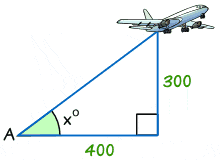
Susan is flying a kite, which gets caught in the top of a tree.  Use the diagram to estimate the height of the tree. 
a)
63 ft
b)
65 ft
c)
74 ft
d)
87 ft
40.
Find the measurement of the missing side indicated
a)
4.39
b)
3.21
c)
2.19
d)
2.05
41.

Select the correct ratio for SinA

a)

3735\frac{37}{35}

b)

1235\frac{12}{35}

c)

3537\frac{35}{37}

d)

1237\frac{12}{37}

42.
Find the value of x and y.
a)
x = 8√3, y = 16
b)
x = 4, y = 8√3
c)
x = 16, y = 8√3
43.
Solve for the missing angle.
a)
50.5 degrees
b)
12.7 degrees
c)
36.9 degrees
d)
72.2 degrees
44.

What is the reference angle of an angle that is  240°240\degree 

a)

 20°20\degree  

b)

 30°30\degree  

c)

 40°40\degree  

d)

 60°60\degree  

45.

 cos 210° = \cos\ 210\degree\ =\   

a)

 12\frac{1}{2}  

b)

 12-\frac{1}{2}  

c)

 32-\frac{\sqrt{3}}{2}  

d)

 32\frac{\sqrt{3}}{2}  

46.

 cos 3π2 = \cos\ \frac{3\pi}{2}\ =\   

a)

 00  

b)

 11  

c)

 1-1  

d)

 undefinedundefined  

47.

 tan π =\tan\ \pi\ =  

a)

 00  

b)

 11  

c)

 1-1  

d)

 undefinedundefined  

48.

a)

√2

b)

-1 / √2

c)

1

d)

1 / √2

49.

 tan 300°=\tan\ 300\degree=  

a)

 12-\frac{1}{\sqrt{2}}  

b)

 32-\frac{\sqrt{3}}{2}  

c)

  3-\ \sqrt{3}  

d)

  13-\ \frac{1}{\sqrt{3}}  

50.

 cos ( π3) = \cos\ \left(-\ \frac{\pi}{3}\right)\ =\   

a)

 12\frac{1}{2}  

b)

 12-\frac{1}{2}  

c)

 32\frac{\sqrt{3}}{2}  

d)

  32-\ \frac{\sqrt{3}}{2}  

51.

Evaluate: cos-1(√3/2)

a)

π/3

b)

2π/3

c)

π/6

d)

5π/6

52.
Evaluate: Csc-1(-√2)
a)
π/4
b)
3π/4
c)
-π/4
d)
-3π/4
53.
a)
3π/4
b)
π/4
c)
5π/4
d)
-3π/4
54.
What is the period
of
 y = 3 sin 2x?
a)
2
b)
3
c)
180
d)
360
55.
What is the amplitude of y = 3 cos 2x?
a)
3
b)
2
c)
90
90⁰
d)
350⁰
56.
Use inverse trig ratios (SOH CAH TOA) to solve for the missing angle
a)
32°
b)
44°
c)
61°
d)
50°
57.

Use your calculator to find the following angles whose trigonometric functions are given. Give your answer to the nearest tenths.


sin I = 0.468

(a)  

58.
What is the equation of graph? 
a)
y = sin 5x
b)
y =  cos 5x
c)
y = 5 sin x
d)
y = 5 cos x 
59.

Where does the graph of cosine begin?

a)

(0,0)

b)

(0,1)

c)

(0, Pi)

d)

(1, Pi)

60.
The vertical stretch of the graph; distance between the midline and the max/min.
a)
Period
b)
Cycle
c)
Axis of Oscillation
d)
Amplitude
61.
1.  Determine an equation for this graph:
a)
y=2csc(x)
b)
y=csc(x) + 1
c)
y=2csc(x) + 1
d)
y= csc(x) + 2
62.

What is the equation of the graph shown?

a)

y = -sinθ -1

b)

y = -sinθ/2 -1

c)

y = -2sin2θ + 1

d)

y = sinθ/2 + 1

63.

Describe the horizontal shift.

a)

left 3π / 4

b)

left 4π / 3

c)

right 3π

d)

right 3π / 4

64.
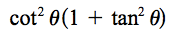
Simplify
a)
-1
b)
sin θ
c)
csc θ
d)
1
65.
Simplify
a)
csc²θ
b)
sec²θ
c)
cscθ
d)
1
66.

Simplify

 sinθ(cscθsinθ)\sin\theta\left(\csc\theta-\sin\theta\right)  

a)

secθ

b)

cos²θ

c)

sin²θ

d)

sin²θ/cos²θ

67.

Simplify  (cscx+1)(cscx1)\left(\csc x+1\right)\left(\csc x-1\right)  

a)

 csc2x+1\csc^2x+1  

b)

 tan2x\tan^2x  

c)

 cot2x\cot^2x  

d)

 2cscx2\csc x  

68.

Solve for x


don't forget cot = cos/sin

a)

π

b)

π/3

c)

π/2

d)

69.
a)
No solution
b)
π/3 +2πn, 5π/3 +2πn
c)
π/6 +2πn, 11π/6 +2πn
d)
2π/3 +2πn, 4π/3 +2πn
70.

Solve equation for  0θ<2π0\le\theta<2\pi  .
 2+cotθ=3-2+\cot\theta=-3  

a)

 θ=3π4,4π3,7π4\theta=\frac{3\pi}{4},\frac{4\pi}{3},\frac{7\pi}{4}  

b)

 θ=3π4,7π4\theta=\frac{3\pi}{4},\frac{7\pi}{4}  

c)

 θ=π3,4π3\theta=\frac{\pi}{3},\frac{4\pi}{3}  

d)

 θ=3π4,4π3\theta=\frac{3\pi}{4},\frac{4\pi}{3}  

71.

Solve equation for  0θ<2π0\le\theta<2\pi  .
 12sec2θ=3sec2θ-1-2\sec^2\theta=-3\sec^2\theta  

a)

 θ=0,π,4π3\theta=0,\pi,\frac{4\pi}{3}  

b)

 θ=0\theta=0  

c)

 θ=π4,3π4,5π4,7π4\theta=\frac{\pi}{4},\frac{3\pi}{4},\frac{5\pi}{4},\frac{7\pi}{4}  

d)

 θ=0,π\theta=0,\pi  

72.

Solve equation for  0θ<2π0\le\theta<2\pi  .
 3sin2θ+4=5+sin2θ3\sin^2\theta+4=5+\sin^2\theta  

a)

 θ=π4,5π4,7π4\theta=\frac{\pi}{4},\frac{5\pi}{4},\frac{7\pi}{4}  

b)

 θ=π4,7π4\theta=\frac{\pi}{4},\frac{7\pi}{4}  

c)

 θ=π4,3π4\theta=\frac{\pi}{4},\frac{3\pi}{4}  

d)

 θ=π4,3π4,5π4,7π4\theta=\frac{\pi}{4},\frac{3\pi}{4},\frac{5\pi}{4},\frac{7\pi}{4}  

73.

Solve equation for  0θ<2π0\le\theta<2\pi  .
 0=3sinθ2sin2θ0=-\sqrt{3}\sin\theta-2\sin^2\theta  

a)

 θ=0,2π3,π,5π3\theta=0,\frac{2\pi}{3},\pi,\frac{5\pi}{3}  

b)

 θ=π2,7π6,3π2,11π6\theta=\frac{\pi}{2},\frac{7\pi}{6},\frac{3\pi}{2},\frac{11\pi}{6}  

c)

 θ=0,π,4π3,5π3\theta=0,\pi,\frac{4\pi}{3},\frac{5\pi}{3}  

d)

 θ=0,π,5π3\theta=0,\pi,\frac{5\pi}{3}  

74.

Solve equation for  0θ<2π0\le\theta<2\pi  .
 sin2θ=sinθ+13sin2θ-\sin^2\theta=\sin\theta+1-3\sin^2\theta  

a)

 θ=π2,11π6\theta=\frac{\pi}{2},\frac{11\pi}{6}  

b)

 θ=π2,7π6,11π6\theta=\frac{\pi}{2},\frac{7\pi}{6},\frac{11\pi}{6}  

c)

 θ=2π3,7π6\theta=\frac{2\pi}{3},\frac{7\pi}{6}  

d)

 θ=0,2π3,4π3\theta=0,\frac{2\pi}{3},\frac{4\pi}{3}