wayground logo

Free Printable Worksheets

NEW

Font size

S
M
L
XL
Worksheets

Review

Total questions: 50

Worksheet time: 46mins

Name
Class
Date
1.
What kind of plate boundary is shown here?
a)
divergent
b)
convergent
c)
transform
d)
strike slip
2.

What is this image of ?

a)

Revolving boundary

b)

San Andreas (Transform fault)

c)

Convergent

3.

Tectonic Plate movement is caused by ______________.

a)

the rotation of the Earth

b)

ocean tides

c)

convection currents in the mantle

d)

the moon's gravity

4.

Which correctly identifies the geologic process that formed the Himalayan mountains (The World's Tallest Mountains, including Mt. Everest)?

a)

Two continental plates converging

b)

An earthquake in a subduction zone

c)

A tectonic plate moving over a hot plate

d)

Movement at a transform fault boundary

5.

Volcanoes and Earthquakes typically occur _______________.

a)

along plate boundaries

b)

only under water

c)

only in hawaii

d)

where it is usually hot

6.

What type of boundary is this?

a)

Divergent

b)

Convergent

c)

Transform

7.

What type of Boundary is this? What event will occur at this boundary?

a)

Transform / Earthquakes

b)

Subduction / Volcano Eruption

c)

Tornado / Rain

d)

Mountain Building / Volcanism

8.

What is the process that breaks down rocks?

a)

Erosion

b)

Weathering

c)

Convection current

d)

Equilibrium

9.

The lowest layer of the crust that is solid rock:

a)

outer core

b)

subsoil

c)

bedrock

d)

strata

10.

Topsoil is usually light brown in color because it is less rich in minerals and humus.

a)

True

b)

False

11.

When ice causes rocks to break into smaller pieces, ___________ has occurred.

a)

chemical weathering

b)

physical weathering

12.
What is one cause of air pollution?
a)
litter found on the side of the road
b)
water used as a coolant by power plants
c)
burning fossil fuels
d)
Dropping litter
13.
A farmer is using a crop duster to help spray chemicals on his crops to kill insects. The chemicals the farmer uses seeps into the soil and drains into the nearby river. How does this affect the animals that live in the river?
a)
They swim away
b)
They change color
c)
They get sick or die
d)
The chemicals give them more energy
14.
In what ways can algal blooms be harmful?
a)
blocks out sunlight
b)
releases toxins into the water
c)
consumes oxygen when it dies
d)
All of the above
15.
Which human activity would be most likely to have a negative impact on the environment?
a)
Planting trees to control soil erosion
b)
Limiting the use of chemicals that kill weeds.
c)
Stopping the draining of swamps.
d)
Burning coal and oil to generate electric power.
16.
The greenhouse effect affects life on Earth by
a)
trapping oxygen
b)
cooling the temperatures
c)
trapping warmth
d)
recycling nitrogen
17.
the trend of increasing global temperatures is known as 
a)
global warming
b)
ozone layer
c)
greenhouse effect
d)
acid rain
18.
After a cold front passes through, what type of weather will there be?   
a)
Rainy or stormy, and cloudy
b)
Clear, dry, and sunny
19.
After a warm front passes through what type of weather will there be?
a)
Rainy or stormy, and cloudy
b)
Clear, dry, and sunny
20.
What type of weather is associated with areas of low pressure?
a)
Low pressure = humid, because there is room in the air for moisture to get in 
b)
Low pressure = dry, because there is not room in the air for moisture to get in
21.
What type of weather is associate with areas of high pressure?
a)
High pressure = dry, because there is not room in the air for moisture to get in
b)
High pressure = humid, because there is room in the air for moisture to get in 
22.
What direction is the cold front moving?
a)
Northwest
b)
Southeast
c)
Northeast
d)
Southwest
23.
What direction is the warm front moving?
a)
Northeast
b)
Northwest
c)
Southeast
d)
Southwest
24.
Which city can expect to see an increase in temperatures over the next 24 hours?
a)
Billings, Montana
b)
Atlanta, Georgia
c)
Minneapolis, Minnesota
d)
Miami, Florida
25.
Cold air (RISES/ FALLS)  _________.
a)
RISES
b)
FALLS
26.
Hot air (RISES / FALLS) __________.
a)
RISES
b)
FALLS
27.
Warm air mass that does not carry water:
a)
continental tropical
b)
continental polar
c)
maritime tropical
d)
maritime polar
28.
Warm air moving upwards from the Gulf of Mexico is:
a)
continental tropical
b)
continental polar
c)
maritime tropical
d)
maritime polar
29.
Cold air traveling south from Canada is:
a)
continental tropical
b)
continental polar
c)
maritime tropical
d)
maritime polar
30.
Cold air mass that is carrying water is:
a)
continental tropical
b)
continental polar
c)
maritime tropical
d)
maritime polar
31.
Warm air near the Earth’s surface rises and then cools and drops, this creates a _________________ in the atmosphere.
a)
run-off
b)
Greenhouse Effect
c)
convection current
d)
water cylce
32.
A(n) _____ is a large body of air that has properties similar to the part of Earth's surface over which it depends.
a)
tornado
b)
pressure system
c)
front
d)
air mass
33.
_____________ has the same temperature and moisture content throughout. 
a)
convection current
b)
front
c)
air mass
34.
The place where two air masses meet.
a)
air mass
b)
air pressure
c)
water cycle
d)
front
35.
Warm air is __________ dense than cold air and rises creating convection currents.
a)
more
b)
less
36.
How do we name air masses?
a)
Water and temperature
b)
Air pressure
c)
Humidity and temperature
d)
Cold and warm
37.
A wet and cold air mass would be a...
a)
Maritime polar
b)
Continental polar
c)
Maritime tropical
d)
Continental tropical
38.
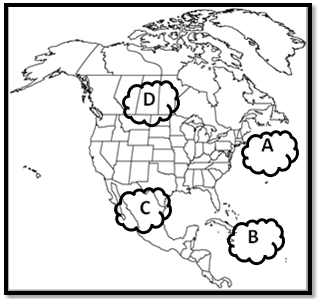
Which type of air would you find at air mass A?
a)
cold, dry
b)
warm, humid
c)
warm, dry
d)
cold, humid
39.

In the continental US, air masses travel consistently in the same direction. Which way do they travel?

a)

Northeast to Southwast

b)

Southeast to West

c)

East to West

d)

West to East

40.

When air masses collide or interact with one another, what formation always occurs?

a)

Fronts are formed

b)

High amounts of wind

c)

Thunderstorms form

d)

Extreme weather occurs

41.
Which term describes when the Earth spins on its axis.
a)
Rotation
b)
Revolution
c)
Kepler's Laws
d)
Precession
42.
Which type of motion causes night / day? 
a)
Rotation
b)
Revolution
c)
Kepler's 1st Law
d)
Nutation
43.
Which term describes the time it takes for Earth to complete one circle around the sun.
a)
Rotation
b)
Revolution
c)
Kepler's 1st Law
d)
Barycenter
44.
Earth's orbit follows an elliptical path.
a)
Kepler's 1st law
b)
Kepler's 2nd law
c)
Kepler's 3rd law
d)
Nutation
45.
When Earth orbits around the sun, it slows down when it is close to the sun. It speeds up its orbit when it is further from the sun. This is because the sun's gravity is stronger when you are closer to it.
a)
Kepler's 1st law
b)
Kepler's 2nd law
c)
Kepler's 3rd law
d)
Nutation
46.
Planets further from the sun have an orbit that lasts MUCH longer than planets that are close to the sun.
Pluto's orbit lasts over over 90,000 days.
Mercury's orbit lasts 88 days.

a)
Kepler's 1st law
b)
Kepler's 2nd law
c)
Kepler's 3rd law
d)
Nutation
47.
During precession, the Earth wobbles a little. This DOES change the angle of the axis.
a)
Nutation
b)
Precession
c)
Barycenter
d)
Revolution
48.
Causes the stars to change direction in the sky (every 26,000 years)
a)
Nutation
b)
Precession
c)
Barycenter
d)
Revolution
49.
When the moon revolves around the Earth, the Earth wobbles a little because the moon's gravity is tugging on it.
a)
Nutation
b)
Precession
c)
Barycenter
d)
Revolution
50.
What protects life on Earth from gamma rays, X rays, and particles emitted by the Sun?
a)
The ozone layer in the stratosphere
b)
The ionosphere
c)
The magnetosphere (Earth's magnetic field)
d)
Clouds