wayground logo

Free Printable Worksheets

NEW

Font size

S
M
L
XL
Worksheets

Purple Lab Book Review

Total questions: 50

Worksheet time: 37mins

Name
Class
Date
1.

Who is considered the "father" of modern genetics?

a)

Einstein

b)

Gregor Mendel

c)

Walt Disney

d)

Mr. Peter

2.

What type of "square" helps us show genetic probability problems?

a)

carpenter square

b)

Mendel square

c)

Punnett square

d)

genetic square

3.
TT,tt,PP,pp,SS,ss are examples of alleles that are?
a)
homozygous
b)
heterozygous
c)
different
d)
homologous 
4.
The exact genetic makeup of an organism, such as RR, Tt, PP is its?
a)
phenotype
b)
dominance
c)
genotype
d)
trait
5.
Y for yellow body is dominant over y for blue body.  What alleles would produce yellow bodies?
a)
YY,yy
b)
Yy,yy
c)
YY only
d)
YY,Yy
6.
Genotype refers to the ...
a)
physical expression of the genes
b)
the possible combination of alleles in a gene
c)
whether an allele is dominant or recessive
d)
how an organism will appear
7.
What is a phenotype
a)
The genetic make up (code)
b)
The physical trait
8.
having two of the same genes for the trait (sometimes called purebred).
a)
homozygous
b)
hetrozygous
c)
protein
d)
chromosome
9.
having two different genes for a trait (sometimes called hybrid).
a)
protein
b)
homozygous
c)
heterozygous
d)
genotype
10.
G = green, g = yellow
The genotype for a yellow plant is...
a)
GG
b)
Gg
c)
gg
d)
all of the choices result in yellow
11.

Where, in the eukaryotic cell, is DNA located?

a)

ribosomes

b)

nucleus

c)

E.R.

d)

cytoplasm

12.

What does heterozygous mean?

a)

An organism that has the same genes for a trait (TT or tt)

b)

An organism that has different genes for a trait (Tt)

c)

When neither gene is fully dominant; offspring is a mixture of genes

d)

the different forms of a trait (hair color--> brown, blonde, red

13.
Which of the following is homozygous dominant?
a)
Yy
b)
Y
c)
yy
d)
YY
14.
Natural selection is when ____________ decides who survives and who doesn't
a)
nature
b)
humans
c)
animals
d)
years
15.
Which of the following is a phenotype?
a)
BB
b)
Bb
c)
bb
d)
Blue eyes
16.

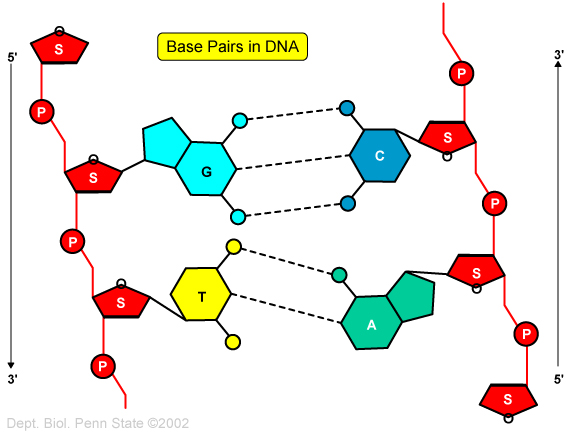
Which sequence of DNA bases would pair with this partial strand

ATG TGA CAG

a)

ATG TGA CAG

b)

TAC ACT GTC

c)

GTA AGT GAC

d)

CAT TCA CTG

17.
Which of the following best describes a DNA molecule?
a)
double helix
b)
contains ribose
c)
made of amino acids
d)
contains Uracil
18.

Which of the following units ("besties") are repeatedly joined together to form a strand of DNA?

a)

amino acids

b)

nucleotides

c)

fatty acids

d)

polysaccharides

19.
In a molecule of double-stranded DNA, the amount of Adenine present is always equal to the amount of
a)
cytosine
b)
guanine
c)
thymine
d)
uracil
20.

Adenine bonds with ______________.

a)

Guanine

b)

Thymine

c)

Cytosine

d)

Adenine

21.

Guanine bonds with ______________.

a)

Adenine

b)

Guanine

c)

Cytosine

d)

Thymine

22.
Why is DNA important?
a)
it is very small and very complicated
b)
it's in everything
c)
it serves as the blueprint for traits of all living things
d)
because we eat it every day for energy
23.

Which 2 molecules form the sides (backbone) of the DNA ladder?

a)

deoxyribose sugar and adenine

b)

deoxyribose sugar and a hydrogen bond

c)

deoxyribose sugar and the nucleus

d)

deoxyribose sugar and phosphate

24.
Which organelle is DNA usually found in?
a)
cell membrane
b)
vacuole
c)
chloroplast
d)
nucleus
25.
Nitrogenous bases are joined by which type of bond?
a)
polar bonds
b)
ionic bonds
c)
covalent bonds
d)
hydrogen bonds
26.
A process in which DNA has the unique ability to make an exact copy of itself.
a)
Replication
b)
Translation
c)
Transcription
27.
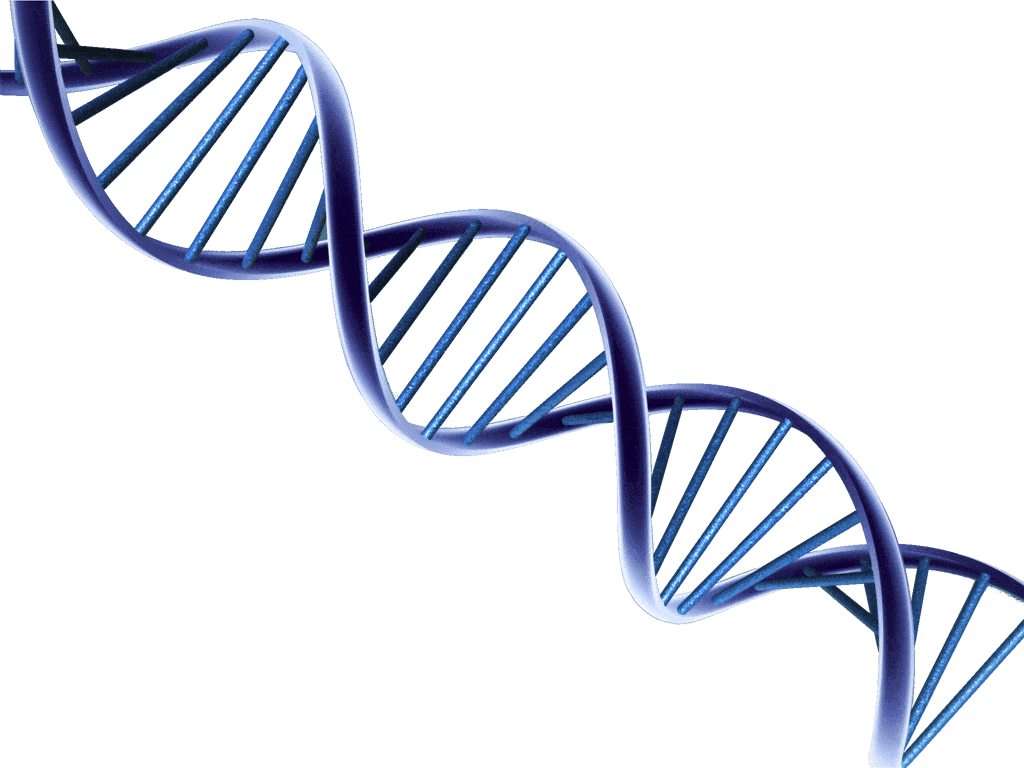
The drawing shows the structure of what molecule?
a)
A DNA molecule
b)
A lipid molecule
c)
A carbohydrate molecule
d)
A protein molecule
28.

What are the three components of a nucleotide?

a)

sugar, hydrogen, nitrogen base

b)

sugar, oxygen, nitrogen base

c)

sugar, phosphate, nitrogen base

d)

sugar, phosphate, protein

29.

What is the process of biological change in organisms over time?

a)

Fossils

b)

Evolution

c)

Mutations

d)

Species

30.
How can you determine the age of a fossil?
a)
Examining the rings found inside
b)
Radiometric dating
c)
You can't determine fossil age
d)
Traveling back in time to when the organism existed
31.

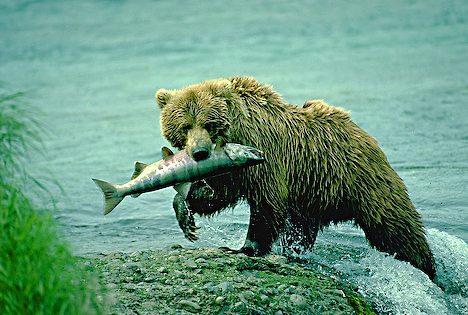
A grizzly bear survives because he is well-adapted to his environment. When he reproduces he passes on those traits to his offspring. this process is called

a)

Natural Selection

b)

Selective Breeding

c)

Random mutations

d)

Variations in a species

32.

The peppered moth's color camouflaged it on the light colored tree bark. It's color was an example of a/n

a)

Predator

b)

Dominant trait

c)

Recessive trait

d)

Adaptation

33.

If a sick person takes an antibiotic but it doesn't kill all of the bacteria causing the sickness, what might explain this?

a)

Variations in the bacteria allowed some organisms to be less affected by the antibiotic?

b)

Bacteria cannot be killed by antibiotics

c)

You cannot cure a bacterial infection

d)

Bacteria do not cause sicknesses

34.
Which of the following is a term for a group of similar organisms that can reproduce fertile offspring?
a)
individual
b)
population
c)
species
d)
fossil
35.
Finches on the Galapagos Islands had different beaks in order to help them do what?
a)
Build nests
b)
Fight off predators
c)
Collect food sources
d)
Compete with rivals
36.
This scientist came up with the idea of natural selection.
a)
Jean Baptiste Lamarck
b)
Gregor Mendel
c)
Charles Darwin
d)
Thomas Malthus
37.
A remnant or trace of an organism from the past is called a _______.
a)
Ancestor
b)
Skeleton
c)
Fossil
d)
Imprints
38.
Inherited trait that helps an organism survive is a(n) __________.
a)
Fossil
b)
Adaptation
c)
Ancestor
d)
Natural selection
39.
According to the diagram, which organism is older?
a)
ammonite
b)
coral
c)
gastropod
d)
trilobite
40.
Which domain is capable of living in extreme environments like hot springs, geysers, or very salty waters?
a)
Bacteria
b)
Archaea
c)
Eukarya
41.
Which domain includes all animals and plants?
a)
Archaea
b)
Eukarya
c)
Bacteria
42.
Almost all bacteria are...
a)
Unicellular
b)
Multicellular
43.
Which two kingdoms are entirely multicellular?
a)
Animalia and Plantae
b)
Animalia and Protista
c)
Protista and Plantae
44.
Which kingdoms have some organisms that can make their own food (autotrophic)?
a)
Plantae and Animalia
b)
Fungi and Plantae
c)
Protista and Plantae
45.
Organisms whose cells have NO nucleus are classified as...
a)
Eukaryotic
b)
Prokaryotic
c)
Dead
46.

True or False: All human cells have DNA.

a)

True

b)

False

47.
True or False: All living things are made of one or more cells.
a)
True
b)
False
48.
Moss belongs in the kingdom...
a)
Fungi
b)
Plantae
49.
Fungi are a type of...
a)
decomposer
b)
producer
50.
Mold, yeast, and mushrooms all belong to the Kingdom _______.
a)
Archaebacteria
b)
Fungi
c)
Eubacteria
d)
Protista