
 Worksheets
Chemical Reactions and Molecules
Total questions: 25
Worksheet time: 21mins
Name
Class
Date
1.
All ____________ are made up of two or more atoms bonded together.
a)
atoms
b)
molecules
c)
electrons
d)
elements
2.
Bonds between atoms in a molecule form as a result of the sharing of?
a)
formulas
b)
electrons
c)
atoms
d)
chemicals
3.
H2O2← ?
This number tells the number of atoms present.
This number tells the number of atoms present.
a)
coefficient
b)
molecule
c)
subscript
d)
atom
4.
→2H2O
This number tells how many molecules are in a chemical equation.
This number tells how many molecules are in a chemical equation.
a)
coefficient
b)
subscript
c)
compound
d)
element
5.
2H2O
How many Hydrogen atoms are present?
How many Hydrogen atoms are present?
a)
2
b)
4
c)
1
d)
10
6.
2H2O
How many Oxygen atoms are present?
How many Oxygen atoms are present?
a)
2
b)
4
c)
1
d)
5
7.
2H2O
How many H2O molecules are present?
How many H2O molecules are present?
a)
1
b)
4
c)
2
d)
8
8.
In making the molecule HPNa, which element is not used?
a)
Hydrogen
b)
Phosphorus
c)
Potassium
d)
Sodium
9.
What is the chemical formula for water?
a)
H2O
b)
H2O2
c)
KCl
d)
NaCl
10.
Which of the following can be broken apart in a chemical reaction?
a)
Noble gases
b)
Molecules and compounds
c)
only molecules
d)
only compounds
11.
In chemical reactions, what does the principle of conservation of mass mean?
a)
Matter is not created or destroyed.
b)
The total mass of the reactants is greater than the total mass of the products.
c)
The total mass of the reactants is less than the total mass of the products.
d)
Matter is not changed.
12.
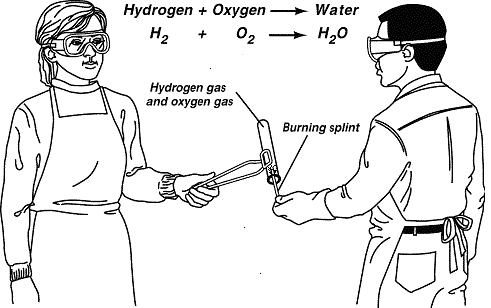
Identify the reactant(s) and product(s) of the reaction.
a)
All three are reactants and none are products.
b)
Hydrogen and water are the reactants, and oxygen is the product.
c)
Water and oxygen are the reactants, and hydrogen is the product.
d)
Hydrogen and oxygen are the reactants, and water is the product.
13.
How many Hydrogen (H) atoms are in NH3O5
a)
3
b)
4
c)
5
d)
1
14.
What is the part of the chemical equation in green called?
Fe + S --> FeS
Fe + S --> FeS
a)
products
b)
reactants
c)
yield
d)
chemical formula
15.
Two Reactants and One Product
a)
Decomposition
b)
Combination
c)
Combustion
d)
Single Replacement
16.
CxHy +O2 --> H2O + CO2
a)
Decomposition
b)
Double replacement
c)
Combustion
d)
Single Replacement
17.
One reactant into several products.
a)
Decomposition
b)
Synthesis
c)
Combustion
d)
Single Replacement
18.

What is the type of reaction shown at the top?
a)
Combination
b)
Decomposition
c)
Single Replacement
d)
Double Replacement
19.

What type a reaction is taking place in this picture?
a)
Synthesis
b)
Decomposition
c)
Single Replacement
d)
Double Replacement
20.

This pictures simulates what type of reaction?
a)
Synthesis
b)
Decomposition
c)
Single Replacement
d)
Double Replacement
21.
Pb(NO3)2 --> PbO + NO2 + O2
a)
Synthesis (combination)
b)
Decomposition
c)
Single replacement
d)
Combustion
22.
KOH + H3PO4 --> K3PO4 + H2O
a)
Synthesis (combination)
b)
Decomposition
c)
Single replacement
d)
Double replacement
23.
Si + S8 --> Si2S4
a)
Synthesis (combination)
b)
Decomposition
c)
Single replacement
d)
Double replacement
24.
What are always the product(s) for the combustion of a hydrocarbon?
a)
O2
b)
Acids and Bases
c)
H2O and CO2
d)
H2 and C
25.
What is the right part of a chemical equation called?
H2 + O → H2O
H2 + O → H2O
a)
Reactants
b)
Products
c)
Yields
d)
Chemical Equation
100 %

