wayground logo

Free Printable Worksheets

Font size

S
M
L
XL
Worksheets

Exam 4

Total questions: 150

Worksheet time: 4hrs 33mins

Name
Class
Date
1.

Identify part 3

a)

uterus

b)

ovary

c)

fallopian tube

d)

cilia

2.

Identify part 5

a)

uterus

b)

ovary

c)

fallopian tube

d)

cervix

3.

Identify part 8

a)

uterus

b)

ovary

c)

cilia

d)

endometrium

4.

Identify part 7

a)

uterus

b)

ovary

c)

fallopian tube

d)

fimbriae

5.

Identify part 6

a)

fallopian tube

b)

fimbriae

c)

ovary

d)

cilia

6.

What is the purpose of the fimbriae?

a)

guide the egg from the ovary into the Fallopian tube

b)

release a hormone to stimulate the follicles

c)

guide the egg through the Fallopian tube into the uterus

d)

none of the above

7.

If fertilization does not occur, after luteal phase what phase does a woman go into next?

a)

follicular phase

b)

menstruation

c)

none, she is pregnant!

d)

none of the above

8.
Which is not part of the female's reproductive system?
a)
Labia
b)
Uterus
c)
Cervix
d)
Vas Deferens
9.
The nesting of a fertilized egg in the wall of the uterus.
a)
Implantation
b)
Fertilization
c)
Conception
d)
Menstruation
10.
Oxytocin
a)
Increases blood calcium levels
b)
Stimulates contraction of uterus
c)
Development of male characteristics
d)
Removes excess water
11.
This hormone raises blood calcium levels
a)
Calcitonin
b)
Prolactin
c)
Parathyroid hormone
d)
Growth hormone
12.
This hormone stimulates metabolism.
a)
Insulin
b)
Thyroxine
c)
Insuin
d)
ADH
13.
Stimulates ovaries and testes.
a)
Luteinizing hormone
b)
Testosterone
c)
Calcitonin
d)
Prolactin
14.
Reduces blood sugar.
a)
PTH
b)
Progesterone
c)
TSH
d)
Insuline
15.
Calcitonin comes from this gland.
a)
nucleus
b)
Thymus
c)
Pancreas
d)
Thyroid
16.
Makes bones longer.
a)
Prolactin
b)
Glucagon
c)
Oxytocin
d)
Growth hormone
17.
This hormone comes from the adrenal medulla
a)
Folicle stimulating hormone
b)
Estrogen
c)
Epinephrine
d)
Thymosin
18.
Promotes retention of water by kidneys.
a)
Antidiuretic hormone
b)
Insulin
c)
Progesterone
d)
Melatonin
19.
Oxytocin
a)
Increases blood calcium levels
b)
Stimulates contraction of uterus
c)
Development of male characteristics
d)
Removes excess water
20.

The "master gland" of the endocrine system, a gland that controls many body activities.

a)

hormone

b)

pituitary gland

c)

hypothalamus

d)

adrenal gland

21.

What hormone is responsible for the "fight or flight" response?

a)

Testosterone

b)

Cortisol

c)

Adrenaline

d)

Parathyroid Hormone

22.
Pineal gland – 
a)
produces a hormone (melatonin) that helps you go to sleep
b)
produces a hormone that stimulates the immune response in children
c)
hormone that increases blood
d)
decreases bone calcium levels
23.
The parathyroid gland is involved in regulating blood glucose levels of __.
a)
glucose
b)
iodine
c)
calcium
d)
cholesterol
24.
What hormone lowers blood calcium?
a)
Calcitonin
b)
PTH
c)
Glucagon
d)
Insulin
25.
What is letter B
a)
Optic nerve
b)
Lens
c)
Cornea
d)
Retina
26.
What is letter C
a)
Vitreous humor
b)
Lens
c)
Optic nerve
d)
Cornea
27.
What is letter E?
a)
Vitreous humor
b)
Retina
c)
Cornea
d)
Optic nerve
28.
What is letter F?
a)
Retina
b)
Pupil
c)
Vitreous humor
d)
Iris
29.
What is letter G?
a)
Sclera
b)
Retina
c)
Lens
d)
Vitreous humor
30.
What is letter H?
a)
Cornea
b)
Optic nerve
c)
Iris
d)
Retina
31.
What is letter I?
a)
Cornea
b)
Lens
c)
Vitreous humor
d)
Optic nerve
32.
The main difference between cone cells and rod cells in the human eye is that:   
a)
rod cells are bigger than cone cells.
b)
rod cells respond to color and cone cells respond to shades of gray.
c)
there is a greater number of cone cells than rod cells. 
d)
 rod cells respond to light intensity and cone cells respond to color.
33.
The part of the female reproductive system where fertilization takes place
a)
Uterus
b)
Womb
c)
Vaginal opening
d)
Fallopian Tubes
34.

The two hormones that maintain the lining of the uterus are:

a)

FSH and estrogen

b)

LH and estrogen

c)

estrogen

d)

Progesterone and estrogen

35.
What is the main role of Progesterone?
a)
Completes development of uterus wall, promotes glycogen storage
b)
Stimulates follicle to burst and release the ovum
c)
Stimulates rebuilding of the uterus wall
d)
Stimulates one egg cell to develop (become follicle)
36.
What do we call a fertilized egg?
a)
Sperm
b)
Testosterone
c)
Zygote
d)
Egg
37.
When a neuron is not engaged in an impulse.
a)
Resting potential
b)
Action potential
c)
Neural potential
d)
Synaptic potential
38.
Heroin mimics the effects of this neurotransmitter.
a)
Dopamine
b)
Serotonin 
c)
Endorphin
d)
Norepinephrine 
39.
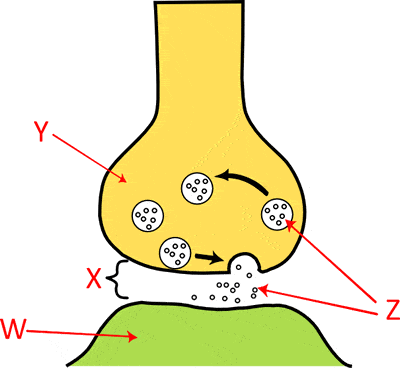
W
a)
Axon Terminal Button
b)
Neurotransmitters
c)
Dendrite
d)
Synapse
40.
X
a)
Axon Terminal Button
b)
Neurotransmitters
c)
Dendrite
d)
Synapse
41.
Y
a)
Axon Terminal Button
b)
Neurotransmitters
c)
Dendrite
d)
Synapse
42.
Z
a)
Dendrite
b)
Axon Terminal
c)
Neurotransmitters
d)
Synapse
43.
Mimics the effects of brain-produced neurotransmitters.
a)
Agonist
b)
Antagonist
44.
Inhibits or blocks the effects of neurotransmitters.
a)
Aganost
b)
Antagonist
45.
Multiple sclerosis is an autoimmune disease in which the body's own immune system destroys the _____________ of the nerve axons. 
a)
Myelin
b)
Dendrites
c)
Axon Terminal
d)
Nodes of Ranvier
46.
Which is the correct sequence in the transmission of a neural impulse?
a)
axon, dendrite, cell body, synapse
b)
dendrite, axon, cell body, synapse
c)
synapse, axon, dendrite, cell body
d)
dendrite, cell body, axon, synapse
47.
The brain's supporting cells are called: 
a)
glial cells
b)
mitochondria
c)
neurons
d)
nuclei
48.
Label the Neuron-What does the letter "E" represent?
a)
Schwann Cell
b)
Node of Ranvier
c)
Axon Terminal
d)
Myelin Sheath
49.
After depolarization what happens to restore resting potential? 
a)
Sodium channels open & sodium ions diffuse out of the neuron.
b)
Potassium channels open & potassium ions diffuse into the neuron.
c)
Potassium channels open and potassium ions diffuse into the neuron.
d)
Sodium channels open and sodium ions diffuse into the neuron. 
50.
Name the ion that is pumped into the axon to maintain resting potential. 
a)
Calcium
b)
Hydrogen
c)
Potassium 
d)
Sodium 
51.
What describes the phase of quick entry of sodium ions into an axon during an action potential? 
a)
passive transport
b)
depolarization
c)
ion transport
d)
repolarization 
52.
The nucleus and most of the organelles in a neuron are located in the ______.
a)
dendrites
b)
axon
c)
cell body
d)
Schwann cells
53.
For a neuron with a resting membrane potential at -70mv, an increase in the movement of sodium ions into the neuron's cytoplasm would result in:
a)
the depolarization of the neuron.
b)
the repolarization of the neuron 
c)
the replacement of potassium ions with sodium ions.
d)
the replacement of potassium ions with calcium ions.
54.
For a neuron with a resting membrane potential at -70mv, an increase in the movement of sodium ions into the neuron's cytoplasm would result in:
a)
the depolarization of the neuron.
b)
the repolarization of the neuron 
c)
the replacement of potassium ions with sodium ions.
d)
the replacement of potassium ions with calcium ions.
55.
Depolarization occurs because
a)
more potassium ions diffuse into the cell than sodium ions diffuse out of 
b)
more potassium ions diffuse out of the cell than sodium ions diffuse into it 
c)
more sodium ions diffuse into the cell than potassium ions diffuse out of it
d)
more sodium ions diffuse out of the cell than potassium ions diffuse into it
56.
Role in controlling sleep, respiratory function, hearing, as well as motor control and touch in the region of the face.
a)
midbrain
b)
brainstem
c)
pons
d)
medula oblongata
57.
Controls cardiac and respiratory function.
a)
midbrain
b)
pons
c)
brainstem
d)
medulla oblongata
58.
Lobe that interprets vision (visual perception).
a)
parietal
b)
temporal
c)
frontal
d)
occipital 
59.
Controls all endocrine glands and is primary hormone secreting structure in the brain.  Controls the hypothalamus.
a)
pituitary gland
b)
pineal gland
c)
amygdala
d)
thalamus
60.
Controls heartbeat and breathing
a)
Pons
b)
Medulla
c)
Cerebellum
d)
Thalamus
61.
A  person has difficulty speaking possibly due to a stroke.
a)
Broca's Aphasia
b)
Wernicke's Aphasia
c)
Visual Agnosia
d)
Neglect Syndrome
62.
Processes visual information
a)
Frontal Lobe
b)
Temporal Lobe
c)
Occipital Lobe
d)
Parietal Lobe
63.
The link between the nervous system and the endocrine system is maintained by the:
a)
hypothalamus
b)
temporal lobe
c)
cerebellum
d)
motor cortex
64.
What hormone lowers blood calcium?
a)
Calcitonin
b)
PTH
c)
Glucagon
d)
Insulin
65.
What short term storage polysaccharide is glucose converted to? 
a)
Glucagon
b)
Glycogen
c)
Estrogen
d)
Starch
66.
Homeostatic blood glucose controlling enzymes are produced in
a)
the islets of Langehans in the pancreas
b)
in the liver
c)
Loop of henle in the kidneys
d)
pituitary gland
67.
Where is insulin produced?
a)
alpha cells
b)
beta cells
68.
where is glucagon produced?
a)
alpha cells
b)
beta cells
69.
What happens if glucose levels fall?
a)
Insulin levels rise
b)
glucagon levels rise
c)
glucagon levels drop
d)
glycogen levels rise
70.
Insulin causes
a)
a decrease in the concentration of blood glucose
b)
a decrease in the permeability of cell membranes to glucose
c)
an increase in the production of glucose from glycogen
d)
none of these is correct
71.

Too low insulin can cause ?

a)

Type 1 diabetes

b)

Type 2 diabetes

c)

Type 3 diabetes

72.
The tube that connects the ear to the pharynx
a)
esophagus
b)
Eustachian tube
c)
palatine
d)
tympanic
73.

What part is #1?

a)

Pinna

b)

Ear Canal

c)

Ear Drum

d)

Oval Window

74.

What part is #2?

a)

Pinna

b)

Ear Canal

c)

Ear Drum

d)

Oval Window

75.

What part is #3?

a)

Pinna

b)

Ear Canal

c)

Ear Drum

d)

Oval Window

76.

What part is #5?

a)

Semicircular Canals

b)

Eustachian Tube

c)

Cochlea

d)

Oval Window

77.

What part is #6?

a)

Semicircular Canals

b)

Eustachian Tube

c)

Cochlea

d)

Oval Window

78.

What part is #7?

a)

Semicircular Canals

b)

Eustachian Tube

c)

Cochlea

d)

Oval Window

79.

What parts are #8?

a)

Semicircular Canals

b)

Auditory Nerves

c)

Ear Bones

d)

Ossicles

80.

What part is #9?

a)

Semicircular Canals

b)

Eustachian Tube

c)

Cochlea

d)

Oval Window

81.

What part is #10?

a)

Incus/Anvil

b)

Malleus/Hammer

c)

Cochlea/Snail Shell

d)

Stapes/Stirrup

82.

What part is #12?

a)

Incus/Anvil

b)

Malleus/Hammer

c)

Cochlea/Snail Shell

d)

Stapes/Stirrup

83.

What part is #13?

a)

Incus/Anvil

b)

Malleus/Hammer

c)

Cochlea/Snail Shell

d)

Stapes/Stirrup

84.

What part is #15?

a)

Outer Ear

b)

Middle Ear

c)

Inner Ear

d)

Sub Ear

85.

What part is #16?

a)

Outer Ear

b)

Middle Ear

c)

Inner Ear

d)

Sub Ear

86.

What part is #17?

a)

Outer Ear

b)

Middle Ear

c)

Inner Ear

d)

Sub Ear

87.

What happens in the eardrum?

a)

Sound waves vibrate the skin and delivers vibrations

b)

Sound waves make the tiny hairs in your ear move

c)

Carries the message to the brain

88.

What does the fluid inside your ears doing?

a)

Vibrates the skin in your ear

b)

Sends sound waves to the brain

c)

Vibrates the cilia (tiny hairs).

89.

What is in the Semi-Circular canals?

a)

Cilia (Tiny Hairs)

b)

Liquid filled tubes

c)

Thin Skin

90.

Where is the Eardrum located?

a)

The Outer ear

b)

The Inner Ear

c)

The Middle Ear

91.

These nerve endings allow us to see black white and gray

a)

Rods

b)

Cones

c)

Ruffini

92.

Nerve endings that allow us to see the colors red, blue, and green.

a)

Rods

b)

Cones

93.

This relays visual messages to the brain

a)

Auditory Nerve

b)

Spinal Cord

c)

Optic Nerve

d)

Eustachian Tube

94.

What does the Eustachian tube do?

a)

changes light into electrical messages

b)

allows air to pass from the nose to the middle ear.

c)

controls balance

d)

creates wax to protect the ear from foreign invaders

95.

This is the colored part of the eye

a)

Cochlea

b)

Pupil

c)

Cornea

d)

Iris

96.

What hormone helps maintain the early pregnancy and is detectable in the urine and blood?

a)

Human chorionic gonadotropin

b)

Estrogen

c)

Prolactin

d)

Progesterone

97.
Smell
a)
Olfactory
b)
optic
c)
oculomotor
98.

Which cranial nerve controls the movement of the eyeball?

a)

optic

b)

oculomotor

c)

vagus

d)

trochlear

99.
eye muscle and eyelid
a)
trochlear
b)
optic
c)
oculomotor
d)
trigeminal
100.
sensory nerve of the face
a)
olfactory
b)
optic
c)
trigeminal
d)
accessory
101.
shoulder
a)
abducens
b)
accessory
c)
vagus
d)
auditory
102.
tongue/speech
a)
glossopharyngeal
b)
auditory
c)
facial
d)
hypoglossal
103.
tongue/speech
a)
glossopharyngeal
b)
auditory
c)
facial
d)
hypoglossal
104.

Cranial Nerve 3 =

a)

Olfactory

b)

Oculomator

c)

Optic

d)

Trochlear

105.

The Accessory CN function is to...

a)

help with speech

b)

Move your eyes

c)

Tongue movements

d)

Turning your head, shoulder movement

106.

What is the other name for the Vestibulocochlear CN

a)

Accessory

b)

Acoustic

c)

Ulnar

d)

Median

107.

What is the other name for the Vestibulocochlear CN

a)

Accessory

b)

Acoustic

c)

Ulnar

d)

Median

108.

CN # 10 is which one...

a)

Vegas

b)

Vagas

c)

Vagus

d)

Vegis

109.

Olfactory nerve function to what....

a)

Sense of taste

b)

Sense of Touch

c)

Sense of smell

d)

Sense of pain

110.

CN # 10 is which one...

a)

Vegas

b)

Vagas

c)

Vagus

d)

Vegis

111.

The Optic nerve is what number CN?

a)

2

b)

3

c)

1

d)

4

e)

5

112.

Which CN helps with chewing food?

a)

1st

b)

Facial

c)

Abducens

d)

5th

113.

Which CN helps with chewing food?

a)

1st

b)

Facial

c)

Abducens

d)

5th

114.

Which CN helps with chewing food?

a)

1st

b)

Facial

c)

Abducens

d)

5th

115.

What is the Number and function of the Glossopharyngeal

a)

#5 - moves the tongue

b)

#8 - helps you hear

c)

#11 - moves the tongue

d)

#9 - taste, swallowing, saliva

116.

What is the Number and function of the Glossopharyngeal

a)

#5 - moves the tongue

b)

#8 - helps you hear

c)

#11 - moves the tongue

d)

#9 - taste, swallowing, saliva

117.

What does CN # 4 function to...

a)

move your nose

b)

move your eyes

c)

move your mouth

d)

Balance and equilibrium

118.

What does CN # 4 function to...

a)

move your nose

b)

move your eyes

c)

move your mouth

d)

Balance and equilibrium

119.

what is the correct order of the first 3 CN?

a)

Optic, Olfactory, Oculomotor

b)

Oculomotor, Optic, Olfactory

c)

Olfactory, Optic, Oculomotor

d)

Optic, Olfactory, Oculomotor

120.

What system are the Cranial nerves a part of?

a)

The Central Nervous System

b)

The Autonomic Nervous System

c)

The Peripheral Nervous System

d)

None of the above

121.

What system are the Cranial nerves a part of?

a)

The Central Nervous System

b)

The Autonomic Nervous System

c)

The Peripheral Nervous System

d)

None of the above

122.

Which # cranial nerve is the Accessory?

a)

6

b)

8

c)

11

d)

none of these

123.

How many cranial bones are there? ;)

a)

4

b)

6

c)

8

d)

9

124.

Controls most of the movement of the eye

a)

Abducens

b)

Trochlear

c)

Oculomotor

d)

Hypoglossal

125.

VII MOTOR AND SENSORY NERVE TO 5 PARTS

OF THE FACE - FACIAL EXPRESSION

a)

abducens

b)

facial

c)

trochlear

d)

accessory

126.

sense of smell

a)

olfactory

b)

optic

c)

oculomotor

d)

trigimenal;

127.

sense of smell

a)

olfactory

b)

optic

c)

oculomotor

d)

trigimenal;

128.

MOTOR MOVEMENT OF NECK AND SWALLOWING

a)

accessory

b)

hypoglossal

c)

facial

d)

vagus

129.

CN XII MOTOR MOVEMENT OF THE TONGUE

TALKING - SPEECH

a)

trochlear

b)

vestibulocochlear

c)

hypoglossal

d)

vagus

130.

movement of the tongue talking- speech

a)

accessory

b)

vestibulochlear

c)

hypoglossal

d)

glossopharyngeal

131.

vision

a)

ociulomotor

b)

trigeminal

c)

optic

d)

abducen

132.

hearing and balance

a)

trigeminal

b)

olfactory

c)

hypoglossal

d)

vestibulocochlear

134.

looking outward and up

a)

trochlear

b)

trigeminal

c)

glossopharyngeal

d)

optic

134.

looking outward and up

a)

trochlear

b)

trigeminal

c)

glossopharyngeal

d)

optic

135.

SENSORY AND MOTOR NERVES TO PART OF THE FACE - CHEWING

a)

Trochlear

b)

Trigeminal

c)

Abducens

d)

Facial

136.

Tasting and swallowing

a)

vestibulochelear

b)

vagus

c)

hypoglossal

d)

glossopharyngeal

137.

abducts the eyes

a)

Trigeminal

b)

Abducens

c)

oculomoter

d)

facial

139.

How many TOTAL sections is the spine divided into?

a)

3

b)

4

c)

5

d)

6

139.

How many TOTAL sections is the spine divided into?

a)

3

b)

4

c)

5

d)

6

140.

The movable sections of the spine contain how many individual vertebrae?

a)

12

b)

24

c)

30

d)

50

141.

The movable sections of the spine, in order from top to bottom are:

a)

Cervical, Thoracic, Lumbar

b)

Thoracic, Lumbar , Cervical

c)

Lumbar, Cervical Thoracic

d)

Cervical, Lumbar, Thoracic

142.

The movable sections of the spine, in order from top to bottom are:

a)

Cervical, Thoracic, Lumbar

b)

Thoracic, Lumbar , Cervical

c)

Lumbar, Cervical Thoracic

d)

Cervical, Lumbar, Thoracic

143.
How many cervical vertebrae exist in the spine? 
a)
7
b)
12
c)
5
d)
4
144.
How many thoracic vertebra exist in the spinal column? 
a)
15
b)
5
c)
12
d)
7
145.
There are __________ lumbar vertebrae. 
a)
12
b)
5
c)
7
d)
6
146.

Which bone is better known as the "tailbone"?

a)

Sacrum

b)

Coccyx

147.

The cervical and lumbar sections of the spine both have which type of curve?

a)

Posterior

b)

Anterior

148.
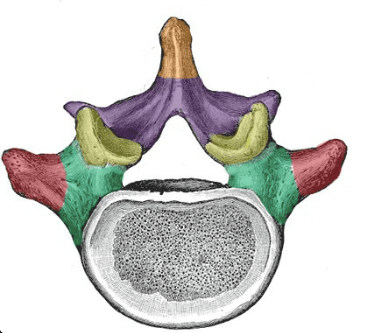
The brown represents 
a)
transverse process
b)
spinous process
c)
foramen 
d)
body 
149.

The gray represents

a)

transverse process

b)

spinous process

c)

foramen

d)

body

150.

How many pairs of nerves come off of the cervical region of the spinal cord?

a)

7

b)

8

c)

12

d)

5