Wayground logo

Free Printable Worksheets

Font size

S
M
L
XL
Worksheets

Final Review Unit I-II: Geography, Culture, Exploration, Colonization

Total questions: 40

Worksheet time: 40mins

Name
Class
Date
1.
Which of these is NOT an example of a primary source?
a)
Original uniforms worn at a time in history
b)
Diaries written at the time of an event
c)
Film footage of a historical event
d)
A poem about World War II from your classmate
2.
Which of these is NOT an example of a secondary source?
a)
Newspaper articles
b)
Diary entry
c)
Encyclopedia
d)
Textbook
3.
The study of the earth, its features and its people is called
a)
Environment
b)
Cartography
c)
Geography
d)
Schoolology
4.

Geography is...

a)

The study of Earth and how we, the people who live there, interact with it.

b)

The study of Earth and its atmosphere.

c)

The study of rocks, minerals, and all physical attributes of Earth

5.
What is culture? 
a)
A shared way of life
b)
The spread of ideas
c)
a short well known expression 
d)
a custom prohibiting or restricting a practice 
6.
The set of beliefs, values, and practices that a group of people have in common.
a)
culture
b)
culture trait
c)
culture region
d)
culture diffusion
7.

The pathway created by the frozen water in the Bering Strait is called a....

a)

strait

b)

land bridge

c)

nomads

d)

theory

8.

People who travel from place to place and take their shelters with them (they follow the food)

a)

nomads

b)

Bering Srait

c)

land bridge

d)

theory

9.

According to the Land Bridge Theory, Native Americans spread across North America after migrating from

a)

Australia

b)

Europe

c)

Asia

10.

Which 2 continents were connected by the land bridge?

a)

South America and North America

b)

Asia and North America

c)

Africa and Europe

11.

What happened to the population of many indigenous Americans due to Europe's invasion and colonization of Latin America?

a)

The population decreased significantly due to diseases and warfare

b)

The population increased significantly due to diseases and warfare

c)

The population didn't change much

d)

The population increased significantly due to the new crops and animals

12.
The Columbian Exchange was the exchange of ____________ between the Old World and the New World.
a)
men and ships for exploring
b)
money for items
c)
products, ideas, plants, animals and diseases
d)
buying goods from Africa
13.
Plants, animals, ideas and diseases shared between the Old World and the New World following Columbus voyages.
a)
Old World Market
b)
New World Swap
c)
Columbus Trade 
d)
Columbian Exchange
14.
Why were Africans captured and forced to work in the Americas?
a)
to share riches and wealth with them
b)
to provide more workers for the plantations
c)
to give them diseases
d)
to spread Christianity
15.
When slaves were loaded onto boats to be taken and sold, this part of the triangular trade route was called what?
a)
the American Passage
b)
the Middle Passage
c)
the Lower Passage
d)
the African Passage
16.
England produced manufactured goods and the colonies produced rum which would be traded to Africa for what?
a)
slaves
b)
rice
c)
sugar
d)
tobacco
17.

The trade that allowed movement of goods, people and materials among the continents.

a)

Continental trade

b)

Triangular Trade

c)

Slave Trade

d)

European Trade

18.
*Distance from Great Britain
*Mayflower Compact
*Town hall meetings
The factors listed above contributed most to the
a)
creation of alliances between British settlers and American Indians
b)
election of British colonists to Parliament
c)
growth of representative government in the British colonies
d)
expansion of British trade in the Americas
19.
What is the significance of the Mayflower Compact?
a)
it provided the basis for a self-governing colony
b)
it established the first representative assembly in America
c)
it extended voting rights to non-church members
d)
It established the idea of due process
20.
Which statement accurately describes the people who were allowed to vote in elections of representatives to colonial assemblies?
a)
they were colonists of means born in America
b)
they were men who owned property
c)
they were women who were able to read and write
d)
they were colonists born in England
21.
The House of Burgesses gave settlers (colonists) the power to 
a)
be involved in creating their own laws
b)
be free of British rule under King James I
c)
determine if laws had been broken
d)
enforce the rules of the settlement
22.
The House of Burgesses is an example of a -
a)
representative democracy
b)
controlling democracy
c)
direct democracy
d)
weak democracy
23.

The area of land in New York that the Dutch settled was called _________________.

a)

New Amsterdam

b)

New Netherland

c)

New York

d)

Fort Orange

24.

The area of land that the Dutch settled and is now present-day Manhattan is called __________________.

a)

New Netherland

b)

Albany

c)

Fort Orange

d)

New Amsterdam

25.
The first permanent English settlement in North America was
a)
Werowocomoco
b)
Yorktown
c)
Richmond
d)
Jamestown
26.
Jamestown was located on a peninsula in ...
a)
Virginia
b)
North Carolina
c)
Florida
d)
New York
27.
What were some of the reasons England wanted to start colonies in North America?
a)
to gain wealth
b)
to stop slavery
c)
to gain indentured servants
d)
to gain independence
28.
The most profitable agricultural product in the Virginia colony was
a)
lumber
b)
peanuts
c)
corn
d)
tobacco
29.
What brought the original colonists from England to Jamestown?
a)
the search for food
b)
the search for gold and silver
c)
the search for tobacco
d)
the search for religious freedom
30.

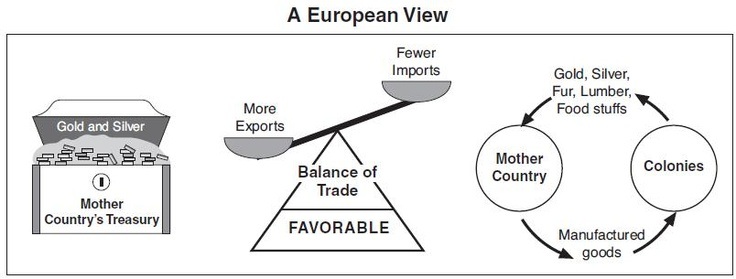
What is mercantilism?

a)

A system where a mother countries gains money and power from natural resources that come from its colonies.

b)

where colonies trade gold and silver with each other.

c)

Wars that start over money.

d)

Plantation colonies trading slaves for money.

31.

The impact of mercantilism was that

a)

The rate of slavery in the Americas went down

b)

Trade was limited in the Atlantic

c)

The Colony grew wealthy

d)

The Mother Country grew wealthy

32.

This colony depended on slaves and indentured servant for labor.

a)

New England colony

b)

Middle colony

c)

Southern colony

33.

This colony had poor rocky soil and very cold harsh winters.

a)

Middle Colonies

b)

New England Colonies

c)

Southern Colonies

34.

This colony was known as the "Breadbasket" colonies.

a)

Southern Colonies

b)

New England Colonies

c)

Middle Colonies

35.

Which colonies have large plantations?

a)

Middle

b)

Southern

c)

New England

d)

Northeast

36.

What region produced huge amounts of grain during the colonial period?

a)

Middle Colonies

b)

Southern Colonies

c)

New England Colonies

d)

frontier region

37.

The long cold winters in the ____________________ colonies was not ideal for growing cash crops and so they focused on lumbering, fishing & fur trading.

a)

New England

b)

Middle

c)

Southern

d)

Winter

38.

The Middle Passage refers to

a)

The ocean crossing of the slaves

b)

The route taken to reach New York

c)

A step in climbing the social ladder

d)

A system of trade between the colonies

39.

Which colony was originally founded by the Dutch?

a)

New Jersey

b)

New York

c)

Delaware

d)

Pennsylvania

40.

What was the major religious group of the New England colonies?

a)

Quakers

b)

Church of England

c)

Puritans