wayground logo

Free Printable Worksheets

NEW

Font size

S
M
L
XL
Worksheets

Year 9 Electricity Review

Total questions: 54

Worksheet time: 3590secs

Name
Class
Date
1.
What is a closed path for electrons to flow through?
a)
static electricity
b)
circuit
c)
amperes
2.
Identify the conductor below.
a)
cloth rag
b)
plastic bottle
c)
gold ring
3.
Identify the insulator below.
a)
aluminum foil
b)
paperclip
c)
rubber eraser
4.
Thicker wires have _______ resistance than thinner wires.
a)
more
b)
less
c)
the same
5.
As the resistance in a circuit increases, the electric current __________.
a)
increases
b)
decreases
c)
stays the same
6.
Which formulas represents Ohm's law?
a)
V=IR
b)
R=IV
c)
I=RV
7.
Electric current is measured in ______.
a)
Watts
b)
Volts
c)
Amperes
8.
Which subatomic particles have a positive charge?
a)
neutrons
b)
electrons
c)
protons
9.
What is the unit for resistance?
a)
Volts
b)
Amperes
c)
Ohms
10.
How many volts are in a circuit with a battery that has a resistance of 10 Ohms and a current of 2 Amps? 
a)
.5 Volts
b)
5 Volts
c)
20 Volts
11.
Electricity is the flow of _________.
a)
protons
b)
neutrons
c)
electrons
12.
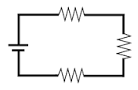
What type of circuit is pictured?
a)
series
b)
Parallel
13.
What type of circuit is pictured?
a)
series
b)
parallel
14.
Electrical resistance is low in a good conductor.
a)
true
b)
false
15.
This is an example of a/an:
a)
Parallel circuit
b)
Series circuit
16.
What is an example of a CONDUCTOR?
a)
Glass
b)
Plastic
c)
Metal
17.
This is an example of a/an:
a)
Closed circuit
b)
Open circuit
18.
What is an example of a INSULATOR?
a)
Light Bulb
b)
Wood
c)
Human Body
19.
What allows electricity to PASS EASILY THROUGH?
a)
Conductors
b)
Insulators
c)
Resistors
20.
What BLOCKS THE FLOW of electricity through it?
a)
Conductors
b)
Insulators
c)
Resistors
21.
What allows electricity to flow through, but SLOWS IT DOWN?
a)
Conductors
b)
Insulators
c)
Resistors
22.
What is an example of a RESISTOR?
a)
Light bulb
b)
Plastic
c)
Water
23.
This is an example of a/an:
a)
Closed circuit
b)
Open circuit
24.
What is resistance measured in?
a)
Ω (Ohms)
b)
V (Volts)
c)
A (Amps)
d)
W (Watts)
25.
What is Resistance?
a)
The flow of electrons
b)
Electric potential difference
c)
A battery
d)
The ability to reduce the flow of electrons
26.
If the Voltage is increased and the resistance stays the same, Current will
a)
Increase
b)
Decrease
c)
Stay the same
d)
X
27.
If the Voltage stays the same and Resistance is increased, Current will 
a)
Increase
b)
Decrease
c)
Stay the same
d)
X
28.
What size resistor would produce a 3 Amp current flow with a 12 Volt battery
a)
1 Ohm
b)
3 Ohms
c)
4 Ohms
d)
12 Ohms
29.
How many Volts would it take to push 1 Amp through a resistance of 1 Ohm
a)
10 volts
b)
1 volt
c)
48 volts
d)
5 volts
30.
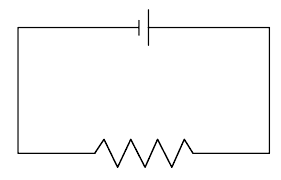
This circuit has a 24 volt battery and the resistor is 8 ohms. How many amps are running through the circuit?
a)
3 Amps
b)
192 Amps
c)
2 Amps
d)
4 Amps
31.

What is the name for the pressure that forces electrons to flow through a circuit?

a)

Voltage

b)

Capacitance

c)

Resistance

d)

Current

32.
What is the Voltage of a circuit that has a resistance of 5 Ω and a current of 2 A?
a)
25 V
b)
10 V
c)
2.5 V
d)
0.4 V
33.
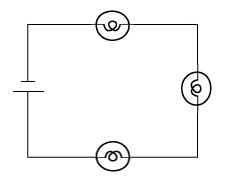
The picture shows an electrical circuit. This circuit is a series circuit because: 
a)
It has 3 light bulbs.
b)
The same current flows through all three light bulbs.
c)
It uses a single battery.
d)
The electrical current is divided between the three light bulbs.
34.
This circuit has more than one loop. When one light goes out, the others stay on. 
a)
closed circuit
b)
series circuit
c)
parallel circuit
d)
open circuit
35.
what is this symbol for?
a)
light bulb
b)
switch
c)
battery
d)
resistor
36.
this is the symbol for a _____?
a)
switch
b)
light 
c)
battery
d)
wires
37.
This is the symbol for a ...
a)
Wire
b)
Battery
c)
Buzzer
d)
Fuse
38.
This is the symbol for 
a)
An Ammeter
b)
A Voltmeter
c)
A Meter
d)
A Motor
39.
This is the symbol for a ...
a)
Bulb
b)
Battery
c)
Horn
d)
Fuse
40.
This is the circuit symbol for ...
a)
an AC current source
b)
a DC current source
c)
an ammeter
d)
a voltmeter
41.
This is the circuit symbol for ...
a)
an AC current source
b)
a DC current source
c)
an ammeter
d)
a voltmeter
42.
This is the symbol for a _____?
a)
Lamp
b)
Water wheel
c)
Loudspeaker
d)
Motor
43.

What is the following symbol represent?

a)

Wire

b)

Resistor

c)

Battery

d)

Switch

44.

Which contribution toward understanding electricity was made by Michael Faraday?

a)

Created the first electric power generator

b)

Discovered that lightning carried electricity

c)

Concentrated on mass-producing long-lasting light bulbs

d)

Improved the telegraph system

45.
What is the power source for this circuit?
a)
Battery
b)
Electric socket
c)
Wires
d)
Magic
46.
Who designed the first battery?
a)
Alessandro Volta
b)
Ben Franklin
c)
Thomas Edison
d)
Nikola Tesla
47.
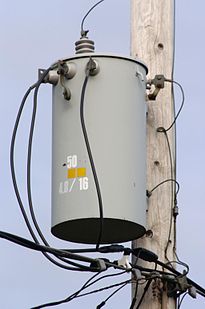
The device that lowers our AC voltage so we can use it in our homes
a)
Transformer
b)
Rectifier
c)
Splicer
d)
Voltmeter
48.

which type of renewable energy is currently creating the most electricity generation?

a)

geothermal

b)

hydroelectric

c)

solar

d)

wind

49.
95% of all electricity is produced from this mechanical device
a)
a motor
b)
the power station
c)
a turbine and magnet generator
d)
a transmission line
50.

Wet cell batteries work by:

a)

one metal gaining electrons and another losing electrons

b)

one metal gaining electrons and another gaining electrons

c)

one metal gaining electrons

d)

one metal losing electrons

51.

Electricity is generated by:

a)

rotating a coil around a magnetic

b)

rotating a magnet

c)

rotating a coil

d)

Gluing together a coil and a magnet

52.

A coal electrical plant generates electricity by:

a)

heating a magnet which then heats a coil

b)

heating a coil which then heats a magnet

c)

heating water from burning gas that produces steam which turns a turbine (coil) around a magnet

d)

heating water from burning coil that produces steam which turns a turbine (coil) around a magnet

53.

Advantages of parallel circuits over series circuits are:

a)

lights get progressively dimmer when more globes are added AND if one globe breaks, not all of them will turn off

b)

lights remain the same brightness even when more globes are added AND if one globe breaks, not all of them will turn off

c)

lights remain the same brightness even when more globes are added AND if one globe breaks all of them turn off

d)

nothing

54.

Primary differences be†ween series and parallel circuits are:

a)

series - 1 loop

parallel - 2 or more loops

b)

parallel - 1 loop, same current, divided voltage across component

series - 2 or more loops, divided current across loops, voltage the same across components

c)

series - 1 loop, same current, divided voltage across component

parallel - 2 or more loops, divided current across loops, voltage the same across components

d)

series - divided voltage across component

parallel - voltage the same across components