
 Worksheets
Intro quiz atoms molecules and ions
Total questions: 12
Worksheet time: 13mins
Name
Class
Date
1.
The atomic number is equal to _.
a)
the number of protons and electrons
b)
the number of neutrons only
c)
the total number of protons and neutrons
d)
the number of protons neutrons and electrons
2.
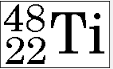
How many protons does this isotope of titanium have? Hint titanium has an atomic number of 22.
a)
48
b)
22
c)
26
d)
70
3.

Carbon has an atomic number of 6 and an atomic mass of 12. Which elements are considered isotopes of carbon?
a)
Carbon-12
b)
Carbon-13
c)
Carbon-14
d)
Both Carbon-13 and Carbon-14
4.
If an atom has an extra neutron, it is a(n)
a)
Positive ion
b)
Negative ion
c)
Isotope
d)
Neutral Atom
5.
If an atom gains an electron it is a(n)
a)
Positive ion
b)
Negative ion
c)
Isotope
d)
Neutral Atom
6.
If an atom has more electrons than protons, it is a(n)
a)
Positive ion
b)
Negative ion
c)
Isotope
d)
Neutral atom
7.
Which answer choice describes the subatomic particles and their respective charges?
a)
p- e+ n
b)
p+ e n-
c)
p+ e- n
d)
p- e+ n
8.
An iron atom has an atomic mass of 56. Its atomic number is 26. How many neutrons does the iron atom have?
a)
30
b)
26
c)
56
d)
82
9.
What is the total number of electrons in an Mg2+ ion?
a)
2
b)
10
c)
12
d)
24
10.
The atomic mass of an element is defined as the weighted average mass of that element’s
a)
naturally occurring isotopes
b)
least abundant isotope
c)
radioactive isotopes
d)
most abundant isotope
11.

What is the mass number of this Neon atom?
a)
10
b)
11
c)
21
d)
20
12.
What is the atomic number?
a)
the number of protons
b)
the number of protons and neutrons
c)
the number of neutrons
d)
the number of protons and electrons
100 %

