
 Worksheets
Periodic Test 3 (Electrolysis)
Total questions: 21
Worksheet time: 5hrs 15mins
Calcium carbonate powder does not conduct electricity because
it does not contain ions
it contains covalent molecules
it contains calcium ions and carbonate ions that are not free to move
all the atoms in calcium carbonate are bonded by strong covalent bonds
Which of the following statements are true about an electrolyte?
it has ions that conduct electricity in the solid state
it can conduct electricity in the molten state or in aqueous solution
it is a compound with ionic bonds only
it can be decomposed by electric current
When molten lead(II) iodide solution is electrolysed using carbon electrodes, which of the following represents the half-equation that occurs at the cathode?
Pb2++2e−→Pb
Pb→Pb2++2e−
I2→2I−+2e−
2I−+2e−→I2
Which of the following substances will produce aluminium metal when electrolysis is carried out using carbon electrodes?
aqueous aluminium sulphate solution
aqueous aluminium chloride solution
solid aluminium oxide
molten aluminium oxide
In an experiment, 0.5 mol dm-3 copper(II) nitrate solution is electrolysed using carbon electrodes. Which of the following happens if the experiment is carried out for 1 hour?
Bubbles of gas are produced at the cathode.
The anode becomes thicker.
The intensity of the blue colour in the solution decreases.
The concentration of the solution remains unchanged.
Electrolysis is used to extract aluminium metal from molten aluminium oxide. Which chemical is used to lower the melting point of aluminium oxide to 900ºC?
Cryolite
Bauxite
Silicon Dioxide
Calcium carbonate
Which of the following statements is not true about lead-acid accumulator?
The electrolyte used is sulphuric acid.
Lead plate is the negative terminal.
Carbon is the positive terminal.
Lead(II) sulphate is formed when the cell is being used.
If a piece of metal X is immersed in copper(II) sulphate solution, a brown deposit is formed. Metal X may be
copper
platinum
aluminium
silver
A piece of zinc metal is immersed in a beaker containing a mixture of copper(II) sulphate and magnesium nitrate solution. Which of the following does not happen?
Zinc metal dissolves.
Concentration of magnesium ion in the solution decreases.
A brown deposit is formed.
Zinc ions are formed.
Which of the following pairs can undergo a displacement reaction?
Magnesium and potassium chloride solution
Calcium and zinc sulphate solution
Iron and calcium nitrate solution
Copper and magnesium nitrate solution
Excess metal X powder is added to copper(II) sulphate solution and is stirred. After half an hour, the solution becomes colourless and brown deposit is formed. Metal X may be
calcium
aluminium
magnesium
silver
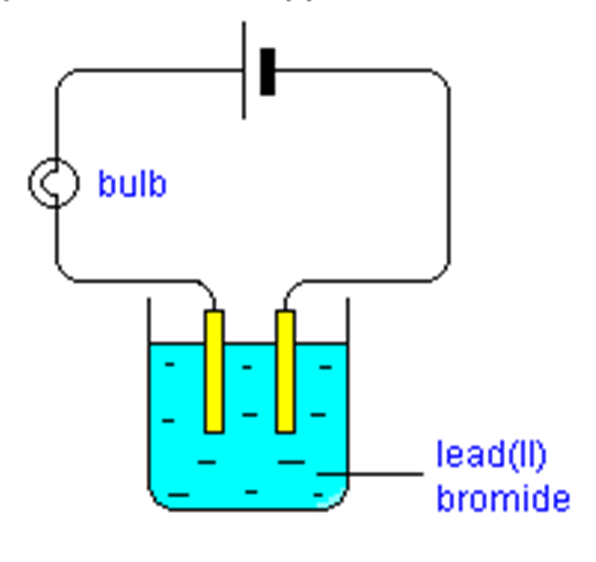
What is the half-equation for the discharge of hydroxide ions?
2O2- --> O2 + 4e-
OH- --> OH + e
4OH- --> 2H2O + O2 + 4e-
2H2O + O2 + 4e- --> 4OH-



