
NEW
Font size
S
M
L
XL
 Worksheets
MATTER MATTERS!
Total questions: 40
Worksheet time: 41mins
Name
Class
Date
1.
Matter is anything that takes up space
a)
True
b)
False
2.
Matter has to main properties mass and volume
a)
True
b)
False
3.

Liquids have a certain shape and a volume of their own. Liquids are something you can touch.
a)
True
b)
False
4.

Solid have a certain shape and a volume of their own. Solid are something you can touch.
a)
True
b)
False
5.

Gasses do not have a shape or volume of their own. You cannot see most gasess.
a)
True
b)
False
6.
Liquids can be changed to solid
a)
True
b)
False
7.
What form of matter has a definite shape?
a)
Solid
b)
Liquid
c)
Gas
d)
Square
8.
What can causes ice to transform from a solid to a liquid?
a)
The air.
b)
The cold.
c)
Shape
d)
Heat
9.
This state of matter does not have a definite size or shape.
a)
Gas
b)
Liquid
c)
Solid
d)
Milk
10.
Which is not a property of matter?
a)
Shape
b)
Mass
c)
Liquid
d)
Volume
11.
Name the three states of matter:
a)
crystalline, amorphous, solid
b)
solid, liquid, gas
c)
energy, matter, mass
d)
solid, fluid, liquid
12.
What is an example of a solid?
a)
wind
b)
water
c)
rock
d)
juice
13.

Which state of matter has particles that are tightly packed?
a)
liquid
b)
gas
c)
solid
14.

A puddle of water seemed to disappear. The heat caused the water to -
a)
melt
b)
condense
c)
evaporate
d)
cool
15.

The steam coming off the pot of boiling water is an example of....
a)
a solid becoming a liquid
b)
a liquid becoming a solid
c)
a liquid becoming a gas
d)
a gas becoming a liquid
16.
True or False: Matter can changes states by adding heat or cooling.
a)
True
b)
False
17.
What is a example of a conductor?
a)
wood
b)
metal
c)
rubber
d)
rock
18.
What is a example of a insulator?
a)
metal
b)
rubber
c)
water
19.
Material that allow heat and electricity to pass through them easily are called _________
a)
Conductors
b)
Insulators
c)
D-cell
20.
Material that do not allow heat and electricity to pass through them easily are called _________
a)
Conductors
b)
Insulators
c)
D-Cell
21.

The freezing point of the ice was increased when the salt came in contact with it.
a)
True
b)
False
22.

What is the correct order of the states of matter shown?
a)
Solid, Liquid, Gas
b)
Gas, Liquid, Solid
c)
Liquid, Gas, Solid
d)
Solid, Gas, Liquid
23.

During the process of condensation, a gas is _______ down to a liquid.
a)
getting
b)
smelling
c)
heating
d)
cooling
24.

If the tops were removed from the cylinders, the following would happen:
a)
The solid would fly out of the container
b)
The liquid would fly out of the container.
c)
The gas would fly out of the container.
d)
They ALL would fly out of the container.
25.

What do u call a pig that knows KARATE?
a)
Porkchop
b)
kid pig
c)
KUNG FU
d)
kapig
26.

At higher temperatures
a)
particles in an object have less energy
b)
particles in an object move faster
c)
a gas contracts
27.
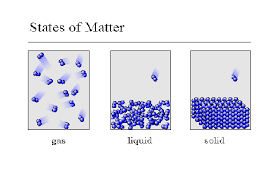
A gas
a)
has a definite shape but no definite volume
b)
has a definite volume but no definite shape
c)
has fast-moving particles
28.
What term describes a solid changing to a gas?
a)
Deposition
b)
Sublimation
c)
Evaporation
d)
Freezing
29.
What is condensation?
a)
gas to solid
b)
gas to liquid
c)
liquid to solid
d)
solid to liquid
30.
Which has a greater distance between particles?
a)
Solid
b)
Liquid
31.

What does this picture represent?
a)
solid
b)
liquid
c)
gas
d)
plasma
32.

What does this picture represent?
a)
solid
b)
liquid
c)
gas
d)
plasma
33.

Which of the following statements is NOT true of all different types of matter?
a)
They are made of atoms and molecules
b)
The particles are always in motion
c)
The particles always move at the same speed
d)
They are made of particles that are too small to see
34.

Boiling
a)
liquid to gas
b)
gas to solid
c)
gas to liquid
d)
solid to liquid
35.

Freezing
a)
Solid to gas
b)
Liquid to solid
c)
Gas to solid
d)
Liquid to gas
36.

Define a liquid.
a)
Indefinite shape, indefinite volume
b)
Definite shape, definite volume
c)
Found in stars
d)
Definite volume, indefinite shape
37.

What term describes a solid changing to a gas?
a)
Deposition
b)
Sublimation
c)
Evaporation
d)
Freezing
38.

What is condensation?
a)
gas to solid
b)
gas to liquid
c)
liquid to solid
d)
solid to liquid
39.
212 degrees F
a)
Melting point
b)
Freezing point
c)
Boiling point
d)
Evaporation point
40.
32 degrees F
a)
Melting point
b)
Freezing point
c)
Boiling point
d)
Both melting & freezing point
Reset

