
 Worksheets
Justinian, Theodora and Constantinople
Total questions: 40
Worksheet time: 21mins

How does the person pictured contribute to the legacy of Rome, regarding the Byzantine Empire?
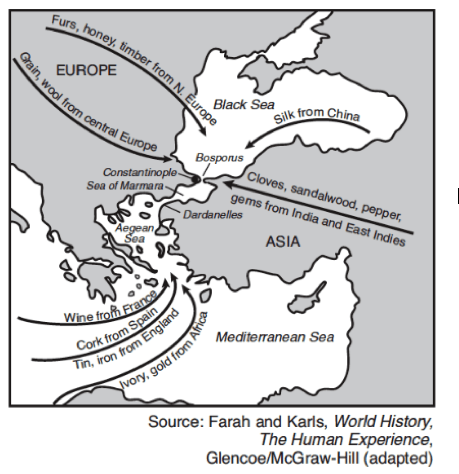
What can you conclude about the city of Constantinople?

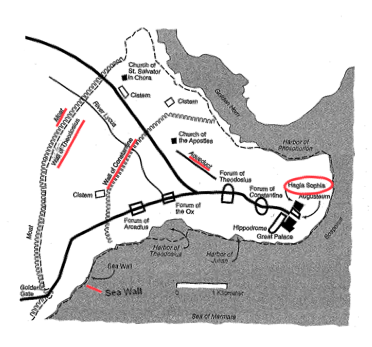
What can be assumed about the location of Constantinople?

What made Constantinople an easily fortified site?
It was on a peninsula bordered by natural harbors.
It was an island surrounded by the Aegean Sea.
It was located on top of a mountain.
It was in a valley surrounded by mountains.
Which statement best describes the strategic location of Constantinople?
It was located on an island and therefore free from invasions.
It bordered the Mediterranean Sea.
It was close to the city of Rome.
It was located at the crossroads of the Asian and European continents.
Constantinople was an important trading center because of its location on the —
Black Sea
Adriatic Sea
Mediterranean Sea
Caspian Sea
The Byzantine Empire preserved the cultural heritage of which empires?
Egypt and Mesopotamia
China and Persia
Greece and Persia
Greece and Rome

Which number represents the city that served as the center of trade for the Byzantine Empire?
1
2
3
4
Which of the following was NOT a reason for the capital of Rome to be moved to the Byzantine Empire?
It was isolated from German barbarian attacks.
It was located closer to important trade routes.
It was a holy city for Christians.
It was located on a peninsula making it easier to defend.
Justinian was the ruler of the —
Egyptian Empire
Carthaginian Empire
Byzantine Empire
Persian Empire
The best reason for Emperor Justinian's codification of Roman law was to —
abolish Roman law and establish a new set of laws
grant Emperor Justinian complete control over his subjects
clarify and change Roman law to better fit Byzantine society
abolish the system of slavery used during the Roman Empire
Under Justinian, the Byzantine Empire –
made peace with the Arab Empire.
expelled the Visigoths from Europe.
founded new colonies in southern Africa.
reclaimed some Roman territory that had been lost.
Which Byzantine emperor rebuilt the Hagia Sophia?
Justinian
Constantine
Zeno
Irene
The city of _____________ was the capital of the Eastern Byzantine Empire.
Alexandria
Rome
Istanbul
Constantinople
Over time the Byzantine Empire became less Roman and more ?
Greek
Latin
Persian
Italian

What type of art is the picture?
montage
mural
mosaic
oil portrait

Justinain was known for building the __________.
Ankor Wat
Hagia Sophia
Colosseum
Parthenon
The world's first Christian Empire was?
Persian
Egyptian
Roman
Byzantine
Justinian was able to reconquer lands once held by the Western Roman Empire?
True
False
Roman Emperor _______________ made Christianity the main religion of the Roman Empire.
Diocletian
Galerius
Constantine
Augustus
Constantinople is now known as ?
Alexandria
Istanbul
Rome
Venice
Helped Byzantine women win more legal rights.
Tribonian
Theodora
Justinian
Justin
The new capital of the Roman Empire was Constantinople, which was formerly the city of
Alexandria
Byzantanium
Carthage.
Rome.
When it was first established, the city of Constantinople
resembled other cities in the Roman Empire.
showed a great influence by Greek culture.
was much like an Egyptian city.
displayed many Persian influences.
When Justinian became emperor, he realized that the empire's laws were
disorganized and confusing.
not detailed enough.
outdated.
too limiting

