
 Worksheets
Analytical Techniques
Total questions: 30
Worksheet time: 17mins

I paper chromatoraphy
II TLC
III HPLC
IV GC
Which technique is able to separate gaseous substances into different components
Thin Layer Chromatography
HPLC
Gas Chromatography
Mass Specroscopy
I paper chromatoraphy
II TLC
III HPLC
IV GC
Which of the gases below can be used as a carrier gas for GC?
I Oxygen
II Nitrogen
III Chlorine
IV Argon
I and II
III and IV
II and IV
IV only
Separation in GC occurs in the ____
Gas tank
Oven
Detector
Column
A pure substance shows ------------------ spot on chromatogram
0
1
2
3
Proteins can be identified and quantified by using HPLC by comparison with known standards.
The concentration of the fatty acids can be determined by measuring
their retention times
the temperature of the column
the flow rate of the mobile phase
the area under each of the peaks
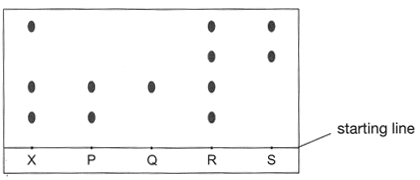
The diagram below shows a chromatogram obtained when a sample X was analysed together with four other known dyes P, Q, R and S. Dye Q was known to cause cancer. Which of the following dye(s) is/are safe for use?
P only
S only
P and S
P and X
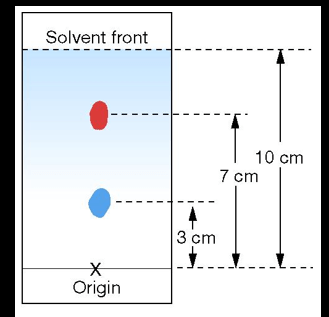
A sample of caffeine has a retention time of 18.0 min on a HPLC. Which of the following changes in conditions would increase the retention time?
Increasing the operating temperature.
Decreasing the eluent flow rate
Increasing the concentration caffeine in the sample
Decreasing the concentration of caffeine in the sample
Which instrumental technique allows you to determine the concentration of a solution?
Paper chromatography
Mass spectroscopy
UV-Vis spectroscopy
Infrared spectroscopy

Based on the colour wheel, if a compound absorbs yellow light, what colour will it appear as?
Red
Green
Purple
Yellow
The function of the monochromator in a UV Visible spectrophotometer is to
detect the transmitted light
detect the absorbed light
produce light of a range of wavelengths
select the wavelength of light

The graph shows absorption spectra of three food dyes: Blue No. 1, Red No. 2 and Yellow No. 4.
Which one of the following is the best wavelength to determine the concentration of Red No. 2 dye in a solution containing only Red No. 2?
400 nm
500 nm
530 nm
600 nm

The graph shows absorption spectra of three food dyes: Blue No. 1, Red No. 2 and Yellow No. 4.
Which one of the following is the best wavelength to determine the concentration of Red No. 2 dye in a solution containing a mixture of all three dyes?
400 nm
500 nm
530 nm
620 nm
Which is the correct order of steps to determine the concentration of a solution using UV-Vis spectroscopy?
I Determine absorption maxima
II Plot calibration curve
III Measure absorbance
IV Prepare standard solutions and blank
I, II, III, IV
II, III, IV, I
I, IV, III, II
IV, III, II, I

