
 Worksheets
Module 1 DBA & Exam Review
Total questions: 22
Worksheet time: 11mins
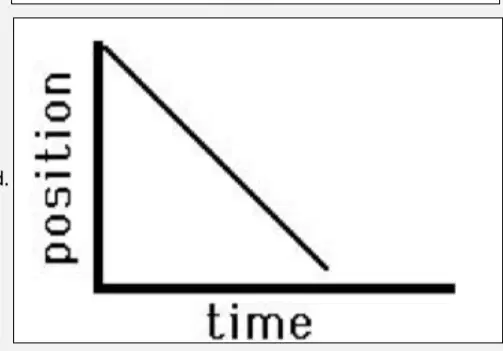
linear graph


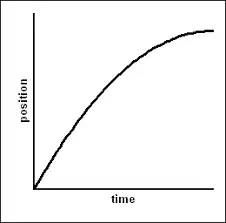
half parabola
hyperbola
7 Fundamental Units
Mile, pound, minutes, Fahrenheit, amp, mole and Watt
Mile, ounce, hour, Celcius, ampere, mole, and candela
meter (m), the gram (g), the second (s), the kelvin (K), the ampere (A), the mole (mol), and the candela (cd)
the meter (m), the kilogram (kg), the second (s), the kelvin (K), the ampere (A), the mole (mol), and the candela (cd)
Five plants are placed under five different colors of light. The height of the plants is recorded daily. The independent variable is
The five plants
The five colors of light
The five measurements of plant height
The day of the week
Five plants are placed under five different colors of light. The height of the plants is recorded daily. The dependent variable is
The five plants
The five colors of light
The five measurements of plant height
The day of the week
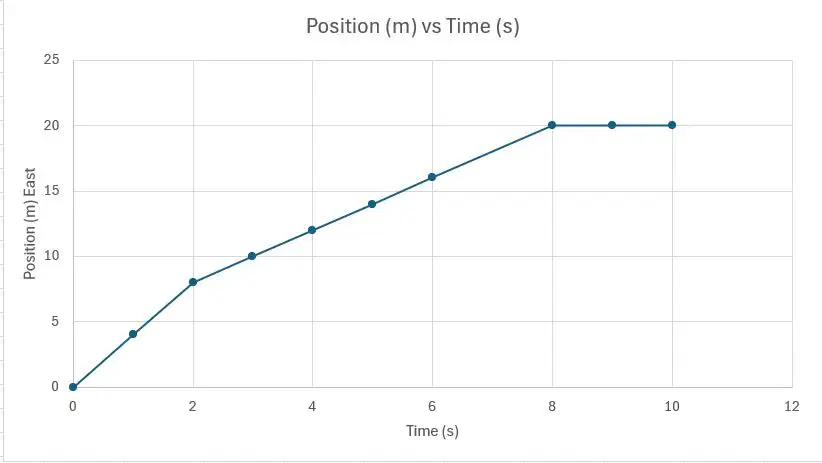
When is the object at rest?
Never
Only at 0,0
from t=0 to t=8 seconds
from t = 8 to t = 10 s
Choose the true statement
Indirect measurement is the same as direct measurement
Indirect measure is never a good idea.
Indirect measure involves use of measurement and calculation, while direct measurement involves only measurement.
Direct measure involves use of measurement and calculation, while indirect measurement involves only measurement.

A = Minimum, B = Maximum
A = Interpolation, B = Extrapolation
A = Extrapolation, B = Interpolation
A = Direct, B = Indirect
Which of the following is an example of a direct measurement?
Measuring the height of a building using its shadow and trigonometry
Measuring the mass of an object using a balance scale
Calculating the speed of a car using the Doppler effect
Estimating the distance of a star telescope readings
What does the term "magnitude" refer to in physics?
The direction of a vector quantity
The amount or size of a quantity, without regard to direction
The speed of an object in a specific direction
The force of gravity acting on an object
Which of the following best distinguishes a scalar quantity from a vector quantity, considering their use in physics?
Scalar quantities have both magnitude and direction, while vector quantities have only magnitude.
Scalar quantities can only be added algebraically, while vector quantities may require more than just addition depending on the directions given.
Scalar quantities are measured using instruments, while vector quantities are calculated using equations.
Scalar quantities involve only linear motion, while vector quantities involve rotational motion.
Why is the independent variable typically placed on the x-axis when graphing data in physics?
The x-axis is always reserved for time measurements.
The independent variable usually has a larger range of values, which fits better on the x-axis.
The independent variable is the one that is controlled or chosen by the experimenter, so it is plotted first.
The x-axis can only display numerical data, which is required for independent variables.
In the context of a graph, what does the slope of a line represent?
The y-intercept of the line
The rate of change of the dependent variable with respect to the independent variable or m = (y2-y1)/(x2-x1)
The total area under the curve
The difference between the highest and lowest values on the graph
How can "at rest" be represented on a speed vs time graph?
vertical line anywhere
horizontal line anywhere
diagonal line with positive slope
a horizontal line at zero
What must happen for a change in velocity to occur?
The speed must remain constant
The object must change direction or speed or both
The object must remain at rest
The object must move in a straight line
How can the speed equation be solved for t?
v = dt
t = dv
v = t/d
t = d/v
Average velocity is ___ divided by time.
Average speed is ___ divided by time.
distance
distance
displacement
distance
displacement
displacement
10
20
How do distance and displacement compare?
Apply the average speed equation given the following: Sadie runs 3 miles east and then turns around and runs 3 miles back to her starting location. What is her displacement? What is the distance traveled?
0 miles
6 miles
6 miles for both
0 miles for both
6 miles
0 miles
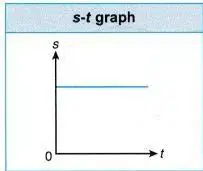
Based on the given speed vs time graph, which position vs time graph depicts the same type of motion?
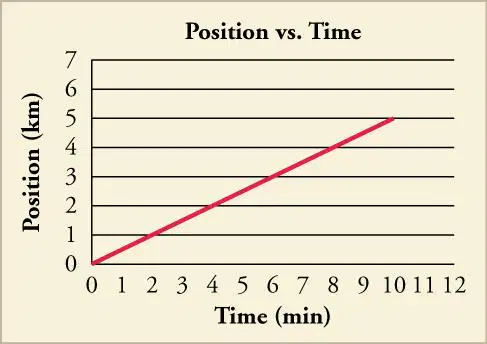
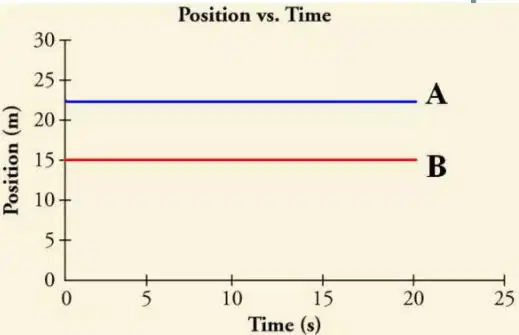
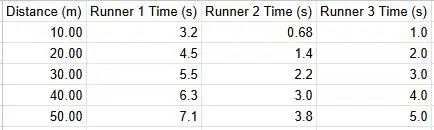
How can you determine who was going the slowest in the first 10 meters of this race?
use v = d/t
If traveling the same distance, look for longest time
Graph and look for lowest slope
all of these

