
 Worksheets
K3 MT Computer Programming Languages
Total questions: 100
Worksheet time: 51mins
A disadvantage of programming in Low Level is
No technical skill is required
Needs to be translated before it can be executed
Difficult for humans to learn and understand

Which generation?
Machine Code (1st Gen)
Assembly Code (2nd Gen)
High Level (3rd Gen)

Which generation?
Machine Code (1st Gen)
Assembly Code (2nd Gen)
High Level (3rd Gen)
Computers must translate everything into binary
True
False
High Level Code is easier for humans to understand as it is written in English
True
False
What is a computer program?
a collection of instructions that performs a specific task when executed by a computer
Something you can use to write a document
Prolog is an example of what type of programming paradigm?
Logic
Imperative
Object oriented
Procedural
This paradigm tells how to do something rather than what to do:
object-oriented
procedural
scripting
functional
This paradigm is relatively simple:
object-oriented
scripting
procedural
functional
This paradigm is difficult to search for errors:
object-oriented
procedural
scripting
aspect-oriented
Java is...
A Functional Programming Language
An Object Oriented Programming Language
A Procedural Programming Language
A Weakly Typed Programming Language

What is a Programming Paradigm?
A collection of programming languages
A general framework of designing and organizing program
A type of computer
A type of Cheese
High level languages are easy to understand...
True
False
Low level programming languages are... [2 answers]
Easy to read, understand and modify
Difficult to read, understand and modify
Very simple to understand
More memory efficient than high-level languages
High level languages...
Can be run directly from the code
Need to be translated before execution
Are targeted at a specific CPU
Translates all of the source code into machine code in one go
Assembler
Compiler
Interpreter
Translates low level assembly language mnemonic into machine code
Assembler
Compiler
Interpreter
What is a MNEMONIC?
A single action that can be performed by a computer.
A symbol that represents an instruction in assembly code.
A high level language keyword.
A register used inside a CPU A register used inside a CPU.
Program is translated line by line as the program is running
Assembler
Compiler
Interpreter
Translates source code from high level languages into object code and then into machine code
Assembler
Compiler
Interpreter
Which of the following is NOT a translator?
Assembler
Compiler
Interpreter
Executable
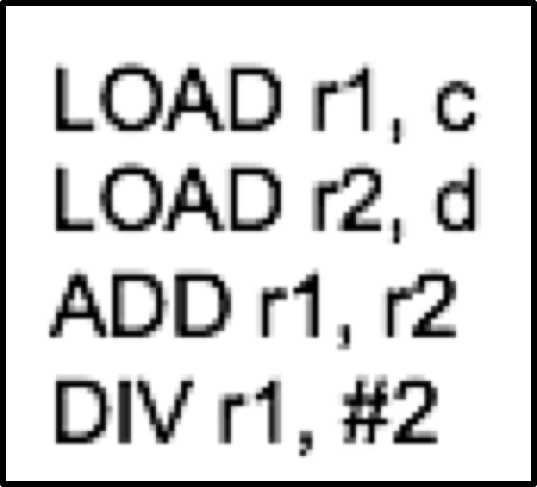
LOAD r2,
ADD r1,
DIV r1, #2
_____ level language is faster for the humans to use. (However, these take longer for a CPU to calculate).
Low
High
An example of a LOW level language would be:
C#
Python
Assembler
Scratch

what is a compiler
patrick star
A program that converts instructions into a machine code or lower level form so that they can be read and executed by a programmer
A program that takes basic computer instructions and converts them into a pattern of bits that the computers processors can use to perform its basic operations
A computer program that directly executes instructions written in a programming or scripting language without requiring them previously to have been compiled into a machine language program
Translates low level assembly language mnemonic into machine code
Assembler
Compiler
Interpreter
Program is translated line by line as the program is running
Assembler
Compiler
Interpreter
What is a MNEMONIC?
A single action that can be performed by a computer.
A symbol that represents an instruction in assembly code.
A high level language keyword.
A register used inside a CPU A register used inside a CPU.
Assembly is a...
high level programming language
low level programming language
Machine code is a...
high level programming language
low level programming language
Machine code is written using...
Binary/hexadecimal
English-like key words
Plain English
Abbreviated mnemonic keywords
Assembly langauge is written using...
Binary/hexadecimal
English-like key words
Plain English
Abbreviated mnemonic keywords
Advantages of low-level languages include... ( 2 answers)
Direct access to the CPU
Programs written will often be more efficient than high-level programs
Easier to remember programming commands
Can use subroutines and advanced data structures
Assembly language is better than machine code because...(3 answers)
it is easier for humans to read
it is easier to remember the instructions
a person is less likely to make mistakes in assembly language
it is written using English-like words
Which of these are high-level languages ? (2 answers)
Java
Assembly
Machine code
Ada

Which of these is machine code?
A
B
One advantage of programming in a high level language is.
Eliminates bugs
Easier to understand
Executes faster than other levels
Useful for programming device drivers
Define the relationship between low and high level languages.
One to One (One high level instruction = one low level)
One to Two (Each high level instruction has two low level instructions)
One to Many (Each high level instruction has many low level instructions)
Many to One (Many high level instruction has only one low level instruction)
What is used to translate assembly code.
Assembler
Compiler
Interpreter
Router
What is the only thing that computers understand?
Machine Code
Low Level Language
High Level Language
Algorithm
Before a computer can understand a program it must be...
Translated into its machine code.
Translated into a high level language.
Translated into a low level language.
Java, Python, Assembly and C++ are examples of
high level languages
Graphic arts languages
medium level languages
programming languages
What is machine code?
A programming language that a computer understands
The make and model of a computer
The serial number of a computer
High level languages feature...(2 answers)
English-like words
Named subroutines
No variables names
Abbreviated command names

The binary codes representing each of the instructions in the in the instruction set.
Translator
Machine code
Source Code
Assembly language

A program that coverts source code into machine code
Object code
Interpreter
Compiler
A translator
Python is an example of . . . . .
A Visual programming language
A Low level programming language
A High level programming language
Machine language

A translator converts high-level language source code into object code, often machine code. The source code is translated all at once and saved to be executed later.
Compiler
Interpreter
high level language
Low level language

A machine code program would look like. . . .
Binary (ones and zeros)
Written english
a high level language

A low level language written using mnemonics
Machine code
Assembly language
High level language
Source code
"Contain both data and the procedures that read or manipulate that data". This statement describe which programming paradigm ?
Logic
Object Oriented
Procedural
Data is exposed to whole program, so no security for data. This statement refer to which paradigm ?
Object-oriented
Logic
Procedural
This programming paradigm is largely utilized in the construction of artificial intelligence (AI).
Object-oriented
Procedural
Logic
This programming paradigm uses bottom-up approach
Procedural
Object-oriented paradigm
Logic

