wayground logo

Free Printable Worksheets

Font size

S
M
L
XL
Worksheets

Transformations!

Total questions: 137

Worksheet time: 5hrs 15mins

Name
Class
Date
1.
(x, y) -------> (x, -y) is a reflection over the x axis.       
a)
True
b)
False
2.
(x,y) -------> (-x, -y) is a reflection over the y = x axis.
a)
True 
b)
False
3.
a)
True
b)
False
4.
a)
True
b)
False
5.
(x, y) -------> (x - 3, y) is a translation of 3 units to the left.   
a)
True
b)
False
6.
(x, y) -------> (x, y - 2) is a translation of 2 units up.  
a)
True
b)
False
7.
(x, y) -------> (-x, -y) is a rotation of 180 degrees.  
a)
True 
b)
False
8.
(x, y) -------> (-y, -x) is a rotation of 90 degrees counterclockwise.  
a)
True 
b)
False
9.
A dilation with a scale factor of 2 is a reduction. 
a)
True
b)
False
10.
A dilation with a scale factor of 1/3 is a reduction. 
a)
True 
b)
False
11.
Which transformation changes the orientation of the shape?
a)
Translation
b)
Reflection
c)
Rotation
d)
Dilation
12.
Which transformation is not a rigid transformation?
a)
Translation
b)
Reflection
c)
Rotation
d)
Dilation
13.
C(-6, 2) and B(-1, -1)
Reflect over the line y = x
a)
C' (-6, 2), B' (-1, -1)
b)
C' (6, 2), B' (1, -1)
c)
C' (2, -6), B' (-1, -1)
d)
C' (-6, -2), B' (-1, -1)
14.
C(-6, 2) and B(-1, -1)
Rotate 90 degrees counterclockwise.
a)
C' (-6, 2), B' (-1, -1)
b)
C' (6, 2), B' (1, -1)
c)
C' (2, -6), B' (-1, -1)
d)
C' (-2, -6), B' (1, -1)
15.
A(-2, 2) and B(3, 2)
Rotate 180 degrees 
a)
A' (-2, 2), B' (3, 2)
b)
A' (-2, -2), B' (-3, -2)
c)
A' (2, -2), B' (-3, -2)
d)
A' (2, -2), B' (2, 3)
16.
A(-2, 2) and B(3, 2) 
Dilate k = 2 
a)
A' (-2, 2), B' (3, 2)
b)
A' (-4, 4), B' (6, 4)
c)
A' (2, -2), B' (-3, -2)
d)
A' (2, -2), B' (2, 3)
17.
A(-2, 2) and B(3, 2) 
Dilate k = 1 
a)
A' (-2, 2), B' (3, 2)
b)
A' (-4, 4), B' (6, 4)
c)
A' (2, -2), B' (-3, -2)
d)
A' (2, -2), B' (2, 3)
18.
A(-2, 2) and B(3, 2) 
Dilate k = 1 
a)
A' (-2, 2), B' (3, 2)
b)
A' (-4, 4), B' (6, 4)
c)
A' (2, -2), B' (-3, -2)
d)
A' (2, -2), B' (2, 3)
19.
A(-2, 2) and B(3, 2)
Reflect over the x-axis 
a)
A' (-2, 2), B' (3, 2)
b)
A' (-2, -2), B' (3, -2)
c)
A' (2, -2), B' (-3, -2)
d)
A' (2, -2), B' (2, 3)
20.
C(-6, 2) and B(-1, -1)
Translate (x, y) -> (x - 1, y - 3)
a)
C' (-6, 2), B' (-1, -1)
b)
C' (-7, -1), B' (-2, -4)
c)
C' (-5, 5), B' (0, 2)
d)
C' (-7, 1), B' (-2, -2)
21.
C(-6, 2) and B(-1, -1)
Translate (x, y) -> (x + 3, y - 1)
a)
C' (-3, 1), B' (2, -2)
b)
C' (3, -1), B' (-2, -4)
c)
C' (-9, 1), B' (-4, -2)
d)
C' (-7, 1), B' (-2, -2)
22.
Write a rule for the translation.
a)
 (x -1, y  + 2)
b)
 (x -2, y  + 1)
c)
 (x +2, y  - 1)
d)
(x +1, y  -  2)
23.
The point Z(4, -2) is rotated 180 degrees about the origin.  What is the image of Z?
a)
Z'(2, 4)
b)
Z'(-4, 2)
c)
Z'(-2, -4)
d)
Z'(-4, -2)
24.
An office supply store sells index cards in two different sizes. The large size is an enlargement of the small size. Both sizes are shown. Find the scale factor of the enlargement.
a)
2
b)
3
c)
4
d)
5
25.
All angles in similar figures are congruent.  
a)
True
b)
False
26.
Reflect the point (-1, 2) over the y-axis.
a)
(-1, -2)
b)
(1, 2)
c)
(1, -2)
d)
(1, 4)
27.
Translate the point A (-3, 4) right 5 and up 1
a)
(-2, 9)
b)
(-8, 5)
c)
(8, 3)
d)
(2, 5)
28.
How does reflecting a figure over the y-axis change the ordered pair?
a)
Changes the x-coordinate
b)
Changes the y-coordinate
29.
Describe the transformation shown in the graph.
a)
Reflect over x-axis
b)
Reflect over y-axis
c)
Rotate 270 degrees CCW
d)
Rotate 90 degress CCW
30.
Identify the transformation from ABC to A'B'C'.
a)
(x+8, y+4)
b)
(x-8, y-4)
c)
(x+4, y+8)
d)
(x-4, y-8)
31.
A turn is also called a ___________.
a)
Translation
b)
Reflection
c)
Rotation
d)
Transformation
32.
When you translate, (x-4,y) will move _____.
a)
4 units right
b)
4 units left
c)
4 units up
d)
4 units down
33.
Write a rule for the translation.
a)
 (x -1, y  + 2)
b)
 (x -2, y  + 1)
c)
 (x +2, y  - 1)
d)
(x +1, y  -  2)
34.
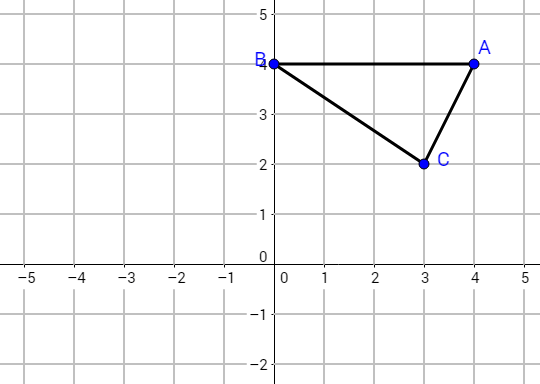
If the triangle is transformed following the rule (x,y)⊣(x,-y), what transformation is modeled?
a)
Dilation
b)
Reflection
c)
Translation
d)
Rotation
35.
Name the image of C(6, -4) under a rotation 90 degrees counterclockwise about the origin.
a)
C'(4, 6)
b)
C'(-4, -6)
c)
C'(6, 4)
d)
C'(-6, -4)
36.
Given C(2, 9), under which reflection is C'(-2, 9)?
a)
reflected in the x-axis
b)
reflected in the y-axis
c)
reflected in the line x = 2
d)
reflected in the line y = x
37.
Two objects that are the same shape but not the same size are _______.
a)
Congruent
b)
Vertical
c)
Similar
d)
Complementary 
38.
Find the value of x (to the nearest whole number)
a)
5
b)
7
c)
9
d)
11
39.
A slide is also called a _________.
a)
Translation
b)
Reflection
c)
Rotation
d)
Transformation
40.
A turn is also called a ___________.
a)
Translation
b)
Reflection
c)
Rotation
d)
Transformation
41.
Name the transformation.
a)
Translation
b)
Reflection
c)
Rotation
42.
Translation are always _______
a)
Congruent
b)
Bigger
c)
Smaller
d)
Rotated
43.
The image shows what type of transformation
a)
Rotation
b)
Translation
c)
Reflection
44.
What is this picture an example of? 
a)
An angle
b)
A cat vertex 
c)
Rotation 
45.
What transformation is happening to the red triangle to get to the blue triangle?
a)
Translation
b)
Rotation
c)
Reflection
46.
 Describe the Transformation
a)
Translation
b)
Rotation
c)
Reflection
47.
 Describe the Transformation
a)
Translation
b)
Rotation
c)
Reflection
48.
 Describe the Transformation
a)
Translation
b)
Rotation
c)
Reflection
49.
 Describe the Transformation
a)
Translation
b)
Rotation
c)
Reflection
50.
 Describe the Transformation
a)
Translation
b)
Rotation
c)
Reflection
51.
Reflection or Rotation
a)
Reflection
b)
Rotation
52.
Is this rotation or reflection symmetry?
a)
Rotation
b)
Reflection
c)
Translation
53.
Describe the Transformation
a)
Reflection
b)
Translation
c)
Rotation
54.
Describe the Transformation
a)
Translation
b)
Reflection
c)
Rotation
55.
Turning an Object
a)
Reflection
b)
Rotation
c)
Translation
56.
Describe the Translation
a)
Translation
b)
Reflection
c)
Rotation
57.
a)
Reflections
b)
Translations
c)
Reflections and Rotations
d)
Translations and Rotations
58.
Rotation or Reflection
a)
Rotation
b)
Reflection
c)
translation
59.
Translation are always _______
a)
Congruent
b)
Bigger
c)
Smaller
d)
Rotated
60.
When you translate, (x-4,y) will move _____.
a)
4 units right
b)
4 units left
c)
4 units up
d)
4 units down
61.
When you translate, (x,y+6) will move _____.
a)
6 units right
b)
6 units left
c)
6 units up
d)
6 units down
62.
Identify the transformation from ABC to A'B'C'.
a)
90o clockwise rotation
b)
90o counter clockwise rotation
c)
Reflection across the y-axis
d)
Reflection across the x-axis
63.
Identify the transformation from ABCD to A'B'C'D'.
a)
Translation
b)
Reflection across the y-axis
c)
Reflection across the x-axis
d)
90o counter clockwise Rotation
64.
Identify the transformation.
a)
Reflection across y-axis
b)
90 Rotation counter clockwise
c)
Translation 5 units left, 1 unit up.
d)
Translation 5 units right, 1 unit down
65.
Point (-5,2) is reflected over the y axis.  Where is the new point located?
a)
(5,2)
b)
(-5,-2)
c)
(-5,2)
d)
(5,-2)
66.
Point (7,2) is translated vertically 2 units and horizontally -5 units.  Where is the new point located?
a)
(9,-3)
b)
(2,4)
c)
(2,0)
d)
12,4)
67.
Triangle ABC is going to be translated. Where would  A' position be at, if the translation was be (x,y) --> (x+3, y-2)?
a)
(-1,3)
b)
(5,3)
c)
(5,8)
d)
(3,5)
68.
How many degrees was the figure rotated?
a)
90 degrees counterclockwise 
b)
180 degrees
c)
90 degrees clockwise
69.
If you were to rotate ABCD 180°  about the origin, what would the coordinate of A' be?
a)
(-5, 5)
b)
(-3, -5)
c)
(-5, 3)
d)
(-3, 3)
70.
The point that is to be transformed is called the:
a)
Pre-Image
b)
Image
c)
Post-Image
d)
Transformation
71.
What transformation is happening?
(x, y) ----> (x + 2, y - 3) 
a)
slide up 2, left 3
b)
slide right 2, up 3
c)
slide right 2, down 3
d)
slide left 3, right 2
72.
Reflect the point (2, -4) over the y-axis.
a)
(-4, 2)
b)
(-2, 4)
c)
(-2, -4)
d)
(2, 4)
73.
After being transformed the new point is called a(n):
a)
Pre-Image
b)
Post Image
c)
Transformed
d)
Image
74.
Reflect (6, -3) over the line x-axis.
a)
(6, 3)
b)
(-6, -3)
c)
(-3, 6)
d)
(3, -6)
75.
State the coordinate of the image of the given point B (-10,-6) under a dilation with center at the origin with the given scale factor k = 1/2.
a)
(5,3)
b)
(20,12)
c)
(-20,-12)
d)
(-5,-3)
76.
Choose the correct scale factor:
a)
2
b)
3
c)
1/3
d)
1/2
77.
What is the algebraic rule?
a)
A
b)
B
c)
C
d)
D
78.
What are the new dimensions?
a)
F
b)
G
c)
H
d)
J
79.
Which of the following scale factors will NOT produce an enlargement?
a)
1
b)
1.2
c)
34.5
d)
5/4
80.
What is the length of R'S'?
a)
11.7
b)
8.3
c)
5.4
d)
3
81.
An entire pre-image that is located in quadrant III is then rotated 90° clockwise about the origin.  In which quadrant will the image fall?
a)
Quadrant I
b)
Quadrant II
c)
Quadrant III
d)
Quadrant IV
82.
Triangle RST has vertices R(1, 1), S(1, 4), and   T(3, 1).  Graph the figure and its rotated image after a counterclockwise rotation of 180° about the origin. What are the coordinates of  Tʹ?
a)
(-3, -1)
b)
(-3,-2)
c)
(5,2)
d)
(5,4)
83.
Which algebraic rule will produce a translation that is 5 units to the right?
a)
(x, y)  --> (  x ,  y + 5)
b)
(x, y)  --> (  x-5 ,  y + 5)
c)
(x, y)  --> (  x-2 ,  y + 5)
d)
(x, y)  --> (  x+5 ,  y)
84.
A pre-image in quadrant II was rotated counterclockwise about the origin 360°.  Which of the following is NOT true about his transformation?
a)
The image will follow the rule    (x, y) --> (y, x).
b)
 The image will be back to its original position
c)
The image will follow the rule                 (x, y) --> (x, y).
d)
The image will be located in quadrant II.
85.
Triangle ABC is dilated about the origin to form A’B’C’.  If point A is located at ( 10, 12) and point A’ is located at  ( 2, 2.4)  then what scale factor was used to create this dilation?
a)
.2
b)
5
c)
.5
d)
2
86.
What Transformation is visible?
a)
Translation
b)
Rotation
c)
Reflection
d)
Dilation
87.
What Transformation is visible?
a)
Reflection
b)
Translation
c)
Dilation
d)
Rotation
88.
What Transformation is visible?
a)
Translation
b)
Rotation
c)
Dilation
d)
Reflection
89.
What Transformation is visible?
a)
Dilation
b)
Translation
c)
Reflection
d)
Rotation
90.
What Transformation is visible?
a)
Reflection
b)
Rotation
c)
Dilation
d)
Translation
91.
What Transformation is visible?
a)
Dilation
b)
Rotation
c)
Reflection
d)
Translation
92.
What Transformation is visible?
a)
Reflection
b)
Translation
c)
Rotation
d)
Dilation
93.
What Transformation is visible?
a)
Translation
b)
Reflection
c)
Rotation
d)
Dilation
94.
What Transformation is visible?
a)
Rotation
b)
Dilation
c)
Reflection
d)
Translation
95.
What Transformation is visible?
a)
Dilation
b)
Refection
c)
Translation
d)
Rotation
96.
What Transformation is visible?
a)
Dilation
b)
Translation
c)
Reflection
d)
Rotation
97.
Identify the transformation from ABCD to A'B'C'D'.
a)
Translation
b)
Reflection across the x-axis
c)
Reflection across the y-axis
d)
90o counter clockwise rotation
98.
Identify the transformation from ABC to A'B'C'.
a)
(x+8, y+4)
b)
(x-8, y-4)
c)
(x+4, y+8)
d)
(x-4, y-8)
99.
Identify the transformation from ABC to A'B'C'.
a)
90o clockwise rotation
b)
90o counter clockwise rotation
c)
Reflection across the y-axis
d)
Reflection across the x-axis
100.
Identify the transformation from ABC to A'B'C'.
a)
Translation
b)
90o clockwise rotation
c)
90o counterclockwise rotation
d)
Reflection across the x-axis
101.
Identify the transformation from ABCD to A'B'C'D'.
a)
Translation
b)
Reflection across the y-axis
c)
Reflection across the x-axis
d)
90o counter clockwise Rotation
102.
Identify the transformation from A to D.
a)
90o Clockwise Rotation
b)
180o Rotation
c)
270o Clockwise Rotation
d)
360o Rotation
103.
Which rule would dilate shows a scale factor of 4
a)
(x, y) → (y, x)
b)
(x, y) → (x + 4, y + 4)
c)
(x, y) → (x, -y)
d)
(x, y) → (4x, 4y)
104.
Which rule would result in a clockwise rotation of 90° about the origin?
a)
(x, y) → (y, x)
b)
(x, y) → (4x, 4y)
c)
(x, y) → (x, -y)
d)
(x, y) → (x + 4, y + 4)
105.
Which rule would result in a translation of 2 units left and 3 units up?
a)
(x, y) → (2x, 3y)
b)
(x, y) → (x - 2, y + 3)
c)
(x, y) → (-x, -y)
d)
(x, y) → (x + 2, y - 3)
106.
Identify the transformation from C to D.
a)
90o Clockwise Rotation
b)
180o Rotation
c)
270o Clockwise Rotation
d)
360o Rotation
107.

Identify the transformation from ABCD to A'B'C'D'.

a)

Translation

b)

Reflection across the x-axis

c)

Reflection across the y-axis

d)

90o counter clockwise rotation

108.
Identify the transformation from ABC to A'B'C'.
a)
90o clockwise rotation
b)
90o counter clockwise rotation
c)
Reflection across the y-axis
d)
Reflection across the x-axis
109.
How is Quadrilateral EFGH translated to E'F'G'H'?
a)
6 down
b)
6 down, 1 right
c)
6 down, 3 left
d)
8 down, 1 right
110.

How is the blue triangle rotated to the red triangle?

a)

90 clockwise

b)

90 counterclockwise

c)

180 clockwise

d)

180 counterclockwise

111.

Identify the transformation performed

a)

Translation

b)

Reflection

c)

Rotation

d)

Dilation

112.

Triangle A is rotated 90° clockwise with the origin as the center of rotation to create a new figure. Which triangle shows the new location?

a)

A

b)

B

c)

C

d)

D

113.

Identify the transformation performed

a)

Translation

b)

Reflection

c)

Rotation

d)

Dilation

114.
Triangle C is rotated 180° clockwise with the origin as the center of rotation to create a new figure. Which triangle shows the new location?
a)
A
b)
B
c)
C
d)
D
115.
If you were to rotate ABCD 90° counterclockwise about the origin, what would the coordinate of A' be?
a)
(-5, 5)
b)
(-3, 5)
c)
(-5, 3)
d)
(-3, 3)
116.

Determine where X' would be if you translated the figure -3 units to the horizontally and -9 units vertically.

a)

(-4, 4)

b)

(-10, 2)

c)

(-4, -5)

d)

(-1, 5)

117.
The point (8, 12) was dilated to become point (2, 3). What was the scale factor?
a)
½
b)
¼
c)
4
d)
2
118.

When you dilate the figure by a scale factor of 3, what is the location of B'?

a)

(12,0)

b)

(12,12)

c)

(4,3)

d)

(0,12)

119.

A reflection ____________________.

a)

turns a figure around a point.

b)

slides an object form one place to another.

c)

flips or mirrors an object across a line.

d)

changes the size of an object.

120.

A transformation that “turns” a figure about a fixed point is a _____________________.

a)

rotation

b)

translation

c)

reflection

d)

dilation

121.

Translated figures are always __________________.

a)

Congruent

b)

Bigger

c)

Smaller

d)

Rotated

122.

A type of transformation where a geometric figure slides horizontally, vertically, or both.

a)

dilation

b)

translation

c)

rotation

d)

reflection

123.
Determine how to translate triangle A'B'C' to triangle ABC.
a)
(x+2, y-5)
b)
(x+2, y-9)
c)
(x-2, y-9)
124.
Determine where X' would be if you translated X 3 units to the left and 9 units down.
a)
(-4, 4)
b)
(-10, 2)
c)
(-4, -5)
d)
(-1, 5)
125.
How was B translated to B' if B' is at (4, -2)?
a)
Translated 6 units down
b)
Translated 2 units to the left and 6 units down
c)
Translated 2 units to the right and 6 units down
d)
Translated 2 units to the right
126.
How is trapezoid ABCD translated to trapezoid A'B'C'D'?
a)
Translated 5 units down and 5 units to the right
b)
Translated 5 units down and 1 to the right
c)
Translated 8 units down and 5 units to the right
d)
Translated 5 units down and 4 units to the right
127.
Find K' if the figure is reflected across the x-axis
a)
(4, 1))
b)
(-1, -4)
c)
(1, -4)
d)
(1, 4)
128.
Which answer shows a reflection across the x-axis?
a)
d
b)
c
c)
b
d)
a
129.
∆QRS contains the points: Q(4, 2) R(5, 1) S(3,7). If the triangle is reflected across the y-axis, what will S' be?
a)
S'(3, 7)
b)
S'(-3, 7)
c)
S'(-3, -7)
d)
S'(3, 7)
130.
Which answer shows a reflection across the y-axis?
a)
a
b)
b
c)
c
d)
d
131.
How many degrees was the figure rotated?
a)
90 degrees counterclockwise 
b)
180 degrees
c)
90 degrees clockwise
132.
If you were to rotate ABCD 180°  about the origin, what would the coordinate of A' be?
a)
(-5, 5)
b)
(-3, -5)
c)
(-5, 3)
d)
(-3, 3)
133.
If you were to rotate ABCD 180° about the origin, what would the coordinates of B' be?
a)
(0, 0)
b)
(-6, -5)
c)
(-1, 3)
d)
(-6, 2)
134.
Rotate the point (-3,-4) around the origin 180 degrees. State the image of the point.
a)
(-4,-3)
b)
(-4,3)
c)
(4,-3)
d)
(3,4)
135.
Dilate the figure by a scale factor of 3 with the origin as the center of dilation. What are the coordinates of the image?
A(3,3) B(6,6) C(9,3)
a)
A'(9,9) B'(18,18) C'(27,9)
b)
A'(6,6) B'(9,9) C'(12,6)
c)
A'(0,0) B'(3,3) C'(6,0)
d)
A'(1,1) B'(2,2) C'(3,1)
136.
State the coordinate of the image of the given point B (-10,-6) under a dilation with center at the origin with the given scale factor k = 1/2.
a)
(5,3)
b)
(20,12)
c)
(-20,-12)
d)
(-5,-3)
137.
The point (8, 12) was dilated to become point (2, 3). What was the scale factor?
a)
½
b)
¼
c)
4
d)
2