wayground logo

Free Printable Worksheets

NEW

Font size

S
M
L
XL
Worksheets

Block 3: General Waves Properties

Total questions: 28

Worksheet time: 20mins
Name
Class
Date
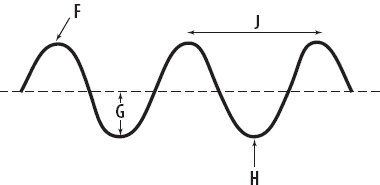
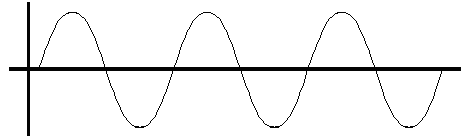
1.
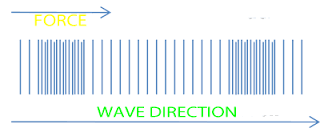
What type of wave is this?
a)
Longitudinal
b)
Transverse
2.
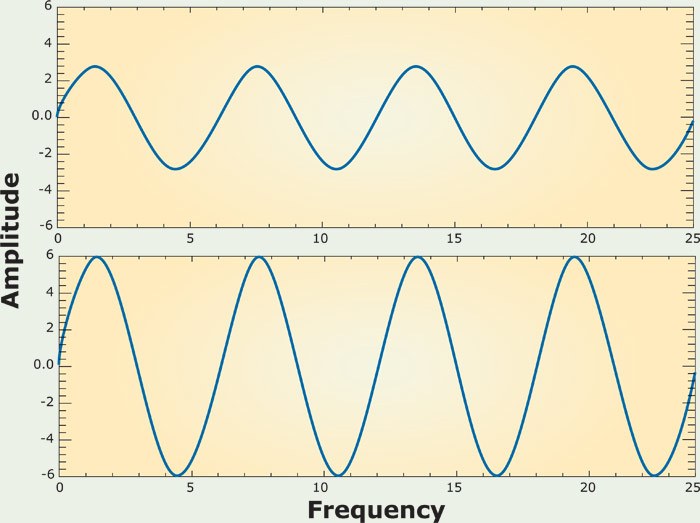
Which property of these waves differs?
a)
Frequency
b)
Wavelength
c)
Amplitude
d)
Pitch
3.
Which waves do NOT need a medium?
a)
Sound
b)
Ocean
c)
Seismic
d)
Light
4.
A high energy wave is considered to have a high 
a)
amplitude
b)
frequency
c)
wavelength
d)
period
5.
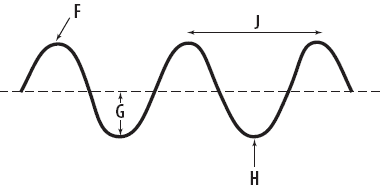
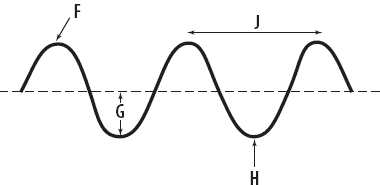
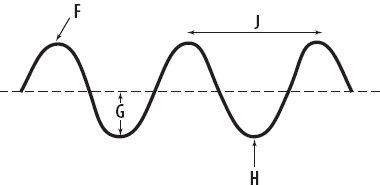
Which letter is a crest?
a)
F
b)
G
c)
H
d)
J
6.
What type of waves have compressions and rarefactions?
a)
longitudinal
b)
transverse
7.
Which letter is a trough?
a)
F
b)
G
c)
H
d)
J
8.
Which letter shows amplitude?
a)
F
b)
G
c)
H
d)
J
9.
Which letter identifies the wavelength?
a)
F
b)
G
c)
H
d)
J
10.
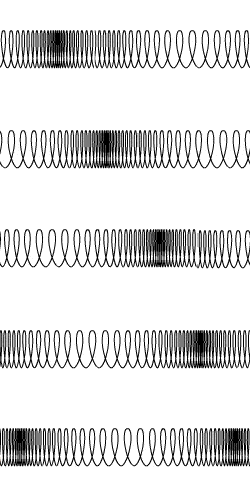
What type of wave is this?
a)
Longitudinal
b)
Transverse
11.
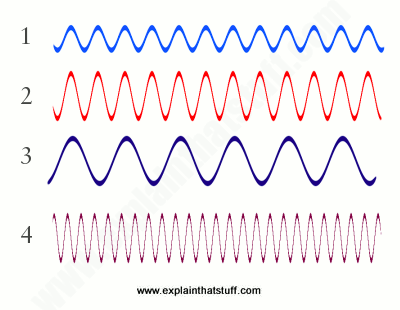
Which wave has the highest frequency?
a)
1
b)
2
c)
3
d)
4
12.
Frequency is
a)
Amount of time it takes for one wavelength
b)
How many wavelengths are completed in one second
c)
Distance between two crests or two troughs
d)
Amount of energy in a wave
13.
What is the material waves travel through?
a)
Period
b)
Frequency
c)
Medium
d)
Hertz
14.
Which part of a longitudinal wave is where particles are packed closely together?
a)
compression
b)
rarefaction
c)
crest 
d)
amplitude
15.
What do all waves transfer?
a)
Light
b)
Sound
c)
Heat
d)
Energy
16.
Frequency is measured in
a)
Newtons
b)
Joules
c)
Hertz
d)
Decibels
17.
Which is the correct equation for calculating the speed of a wave?
a)
T = 1/f
b)
Speed= Wavelength x Period
c)
Speed = Wavelength/Frequency
d)
Speed= Wavelength x Frequency
18.
A period is
a)
Amount of time it takes a wavelength to complete one cycle.
b)
How many wave lengths happen in a second.
c)
An indication of the amount of energy in a wave.
d)
The distance between two crests or two troughs.
19.
Sound travels best through
a)
solids
b)
liquids
c)
gases
d)
colloids
20.
These waves have the same
a)
amplitude
b)
frequency
c)
period 
d)
wavelength
21.
When a wave bends as it passes through at an angle from one medium to another.(example: pencil in a glass of water-)
a)
medium
b)
refraction
c)
reflection
d)
interference
22.

What is wavelength?

a)

total amount of time it takes a wave to move through one cycle

b)

distance between a point on a wave and the EXACT same point on the next wave

c)

number of crests and troughs a wave produces in one minute

d)

length of a series of waves traveling from a source

23.

What are mechanical waves?

a)

Waves that MUST HAVE a medium to travel

b)

Waves that need a mechanic to move because they've broken down

24.

Which type of waves do the particles vibrate perpendicular to the energy?

a)

surface

b)

transverse

c)

mechanical

d)

longitudinal

25.
When the frequency of a wave increases, what happens to the wavelength?
a)
The wavelength is not directly affected by the frequency of a wave.
b)
The wavelength increases.
c)
The wavelength decreases.
d)
More specific information is needed to form a conclusion about the wavelength.
26.

Light waves and water waves travel in what type of waves?

a)

Transverse waves

b)

Longitudinal waves

27.
The bouncing off of light rays from the surface of an object such as a mirror or other shiny surface is called:
a)
mirror
b)
laser
c)
reflection
d)
refraction
28.

As a wave passes through a medium, the particles that make up the medium...

a)

can consist of only liquids or gases

b)

do not transfer energy to one another

c)

become permanently displaced

d)

return to about the same position after the wave has passed