
 Worksheets
4 Stroke Electrical Systems
Total questions: 57
Worksheet time: 29mins
Which of the following is charged by the exciter coil in a capacitor discharge ignition system?
Capacitor
Primary Circuit
Secondary Circuit
Silicone controlled rectifier
When do breaker points open in a breaker point ignition system?
As primary voltage starts to build
Five to 10 degrees after top dead center
As primary voltage peaks
As primary windings start induction
What is the function of the condenser?
To regulate voltage to the points
To protect the secondary circuit
To minimize spark plug fouling
To protect the points by reducing arcing
Where does the ignition coil output voltage come from?
Coil primary resistance
The heat range
The coil itself
Combustion pressure
When does a magneto ignition system produce a spark?
When DC current flows from the primary to the secondary windings
When the primary circuit opens, inducing current into the secondary windings
When the points are at maximum open
When AC current flows from the secondary to the primary windings
What is the main function of a spark plug?
Regulating temperatures
Controlling the engine circuits
Charging the engine
Igniting the air/fuel mixture
Which of the following controls the spark plug heat range?
Spark plug gap
Length of the insulator tip
Diameter of the cone
Current flowing through the spark plug
Which of the following is visible on a hot spark plug?
A whiter insulator
A darker insulator
A long insulator tip
A short insulator tip
The lower the heat range number specified on the spark plug, the ____________.
Hotter the plug
Colder the plug
More resistance the spark plug offers
More energy the spark plug produces

What component is identified by the arrow?
Gasket
Terminal
Electrode
Insulator
Where is the alternator typically located on an engine?
On the cylinder head
On the engine block underneath the flywheel
On the piston
On the crankshaft below the engine
Which of the following is a function of the charging system?
Initiating the engine’s operation
Creating alternating current which is converted into direct current
Move the starter drive gear
Rotating the engine
What is the purpose of a stator?
To generate power for the engine’s electrical needs
To filter the air/fuel mixture for optimal electrical operation
To guide current flow
To guarantee ground connection
The battery should be at least __________ volts for the regulator to function.
3
4
5
6
A solenoid shift starting system utilizes which of the following?
Clutch
Pinwheel
Solenoid Cap
Shift Fork
For proper high-speed operation, the ignition spark should occur when?
At top dead center
Five degrees after top dead center
15 to 30 degrees before top dead center
40 to 50 degrees before top dead center
According to the presentation, advanced ignition timing could result in which of the following?
Detonation
Increased exhaust emissions
Incomplete combustion
Lower fuel output
A one-way electrical gate which allows electrical current to flow in one direction only correctly defines which of the following?
DC Current
AC Current
Solenoid
Diode
What is the difference between primary and secondary circuits?
The secondary circuit has more power than the primary circuit
The primary circuit generates the spark while the secondary circuit delivers the spark to the spark plug
The primary circuit is considered low voltage while the secondary circuit is considered high voltage
The secondary circuit does not utilize a spark plug, while the primary circuit does
In a capacitor discharge ignition system the ________________ is triggered, creating a path to ground through a coil.
Primary circuit
Silicone controlled rectifier (SCR)
Exciter coil
Capacitor
What is the meaning of a solid-state system?
The system remains at a constant temperature
The system produces an equal amount of power
The system has no heat range
The system has no moving parts

Which component is identified by the arrow?
Insulator
Washer
Terminal
Gasket
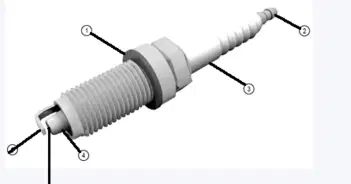
Which component is identified by #4?
Insulator tip
Washer
Terminal
Ground electrode
Larger horsepower engines require which of the following?
Spark plugs with a high heat range
Spark plugs with a low heat range
Spark plugs with a dropping heat range
Spark plugs with a secondary heat range
Which of the following is true about non-regulated charging systems?
They deliver a constant electrical output based on a constant engine speed
They use a voltage regulator to deliver a constant amount of electricity over varying engine speeds
Are not affected by an engines RPMs
Are most common when the primary equipment has additional components associated with it

Which of the following numbers identifies the location of a shift fork?
1
2
3
4
What is the purpose of an electrical ignition system?
To generate high voltage and send this to each spark plug in order to ignite the air/fuel mixture in the engine’s combustion chamber.
To increase the low voltage induced in the primary circuit to a high voltage in the secondary circuit, in order to be sent to the spark plug.
To start and stop the flow of current through the coil.
To create electrical energy needed for the ignition, starting and charging systems.
What is the purpose of an ignition coil?
To increase the low voltage induced in the primary circuit to a high voltage in the secondary circuit, in order to be sent to the spark plug.
To create electrical energy needed for the ignition, starting and charging systems.
To control the timing of the spark before the piston reaches top dead center.
To start and stop the flow of current through the coil.
What is the purpose of the condenser?
To control the current as it flows through the breaker points.
To control the flow of current.
To create electrical energy needed for the ignition, starting and charging systems.
To control the timing of the spark before the piston reaches top dead center.
What is the purpose of an ignition coil?
To increase the low voltage induced in the primary circuit to a high voltage in the secondary circuit, in order to be sent to the spark plug
To start and stop the flow of current through the coil.
To control the current as it flows through the breaker points
To control the timing of the spark before the piston reaches top dead center.
What is the purpose of primary and secondary windings?
To control the flow of current.
To create electrical energy needed for the ignition, starting and charging systems.
To control the timing of the spark before the piston reaches top dead center.
To start and stop the flow of current through the coil.
What is the purpose of magnets in a flywheel?
To create electrical energy needed for the ignition, starting and charging systems.
To control the timing of the spark before the piston reaches top dead center.
To control the flow of current.
To increase the low voltage induced in the primary circuit to a high voltage in the secondary circuit, in order to be sent to the spark plug.
What is the purpose of ignition timing control?
To control the timing of the spark before the piston reaches top dead center.
To create electrical energy needed for the ignition, starting and charging systems.
To control the flow of current.
To control the current as it flows through the breaker points.
Ignition Coil definition
electrical device used to increase the low voltage induced in the primary circuit to a high voltage in the secondary circuit, in order to be sent through the spark plug
delivers the spark to the spark plug
generate a spark for ignition
start and stop the flow of current through the coil
Provides efficient timing of the spark event before the piston reaches top dead center
Voltage
Ignition Timing Control
Condenser
Solid-state System
A one-way electrical gate which allows electrical current to flow in one direction only
Advanced ignition timing
Diode
Spark plug
Condenser
In a CDI system the ____ is charged by the axciter coil.
Silicone controlled rectifier
Primary circuit
Secondary circuit
Capacitor
Spark plug heat range is controlled by the:
diameter of the core
length of the insulator tip
current flowing through the spark plug
spark plug gap
In a breaker point ignition system, the breaker points open:
as primary voltage starts to build
as primary voltage peaks
to start induction in the primary windings
5-10 desgrees after TDC
The condenser:
regulates voltage to the points
protects the secondary circuit
protects the points by reducing arc
minimizes spark plug fouling
The ignition coil output voltage comes from:
the coil itself
combustion pressure and plug gap
the heat range of the spark plug
coil primary resistance
A magneto ignition system produces a spark when:
DC current flows from the primary to the secondary windings
AC current flows from the secondary to the primary windings
the primary circuit opens, inducing current in the secondary windings
the points are at maximum open
For proper high-speed operation, the ignition spark should occur:
at TDC
5 degrees after TDC
15-30 degrees before TDC
40-50 degrees before TDC
in a CDI system the ____ is triggered, creating a path to ground through a coil.
capacitor
silicone controlled rectifier
exciter coil
primary circuit
Large horsepower engines require spark plugs with which of the following?
Low heat range
High heat range
Carburetors adjusted too ___ will have increased levels of hydrocarbons (HC) and carbon monoxide (CO) in the ___ and will not be ___ compliant.
rich, exhaust, emission
A continuity test is used to determine which of the following?
Continuous electrical circuit (complete or closed circuit)
To verify the ignition system is working properly what tool should be used?
Spark tester
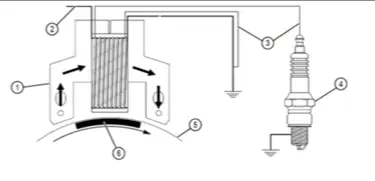
1
iron core
spark plug
flywheel
magnet
2
iron core
spark plug
primary circuit
magnet
3
secondary circuit
spark plug
primary circuit
magnet
4
secondary circuit
spark plug
primary circuit
magnet
5
secondary circuit
spark plug
primary circuit
flywheel
6
secondary circuit
spark plug
primary circuit
magnet
The ___ the ___ number specified on the spark plug, the ___ the plug.
lower, heat range, hotter
When assembling the Kohler® Command Pro CH 270, which of the following should be the first step when installing the ignition module?
Rotate the flywheel magnet away from the location where the ignition module will be installed
The carburetor _______ the fuel.
atomizes

