
 Worksheets
Enzymes Quizizz
Total questions: 10
Worksheet time: 8mins
Name
Class
Date
1.
The energy needed to get a reaction started is the
a)
Reaction Energy
b)
Activation Energy
2.
A substance that speeds up the rate of a chemical reaction is called
a)
a catalyst
b)
an element
3.
Enzymes are capable of increasing the rate of a chemical reaction within a living cell. Enzymes accomplish this through which of the following means?
a)
reducing the number of products
b)
reducing the activation energy
c)
increasing the temperature of the cell
d)
increasing the concentration of reactants
4.
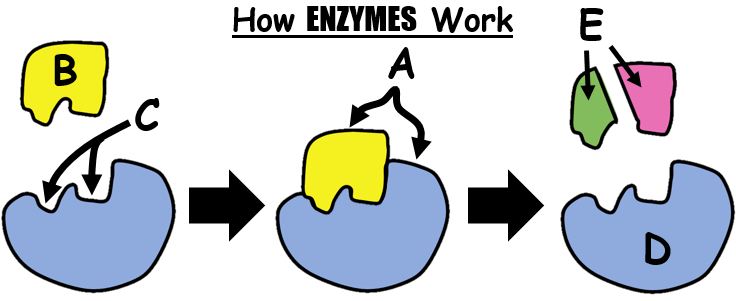
In the diagram, what is letter A?
a)
product
b)
substrate
c)
enzyme-substrate complex
d)
active site
5.
Enzymes provide a site where reactants called substrates can be brought together in an enzyme-catalyzed reaction. The site is called the
a)
enzyme substrate complex.
b)
reaction site.
c)
active site.
d)
lock and key.
6.
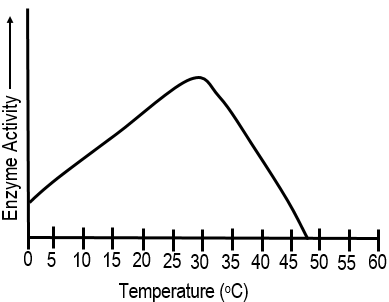
Based on the graph, what is the optimal temperature for this enzyme?
a)
15oC
b)
40oC
c)
30oC
d)
35oC
7.
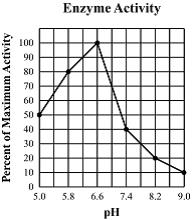
Which of the following conclusions can be drawn from this graph?
a)
The optimum pH of the enzyme is 6.6.
b)
The optimum pH of the enzyme is 5.8
c)
The enzyme’s activity increases as pH increases 5.0 to 9.0
d)
The enzyme’s activity is greater around pH of 8.0 .
8.
The part of the enzyme that the substrate bonds to is called the _____.
a)
active site
b)
activation energy
c)
bond site
d)
peptide bond
9.
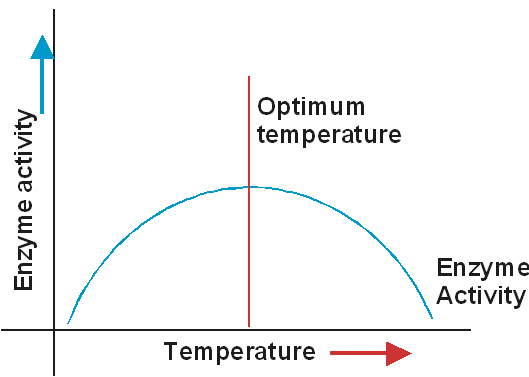
At high temperatures enzyme activity declines because of:
a)
Denaturation
b)
Decreased Kinetic Motion
c)
Increased H-Bonding
d)
Dissociation of Ionic Compounds
10.
Refers to a substance that slows or stops the normal catalytic function of an enzyme by binding it.
a)
Enzyme introduction
b)
Enzyme inhibition
c)
Enzyme Induction
d)
Enzyme ptoentiation
100 %

