
 Worksheets
HEAT: Heat and Temperature
Total questions: 13
Worksheet time: 8mins
How does heat transfer when you hold an ice cube in your hand?
from the cold ice cube to your warm hand
the cold ice cube makes your hand cold
from your warm hand to the cold ice cube
very carefully
Energy that transfers from one substance to another until the temperatures are equal is called...
Joe
temperature
MELTS
heat
Heat transfer is really neat. It always moves from..
hot to cold
cold to hot
big to little
stop singing

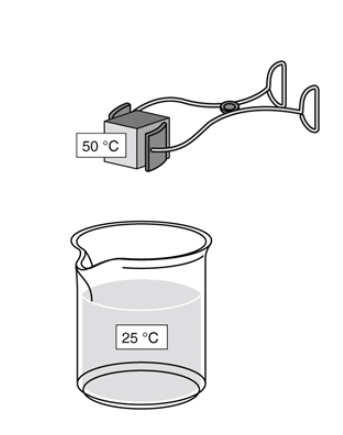
As part of a lab experiment, Tasha drops a metal cube into a beaker of water, as shown in the figure below.
After energy in the form of heat transfers between the substances, what is the final temperature of the water?
The final temperature is 25 °C because there is more water than metal.
The final temperature is 50 °C because the metal warms the water to the temperature of the metal.
The final temperature is between 25 °C and 50 °C because energy is transferred from the metal to the water.
The final temperature is between 25 °C and 50 °C because most of the thermal energy is lost to the air around the substances.
What does "c" stand for
heat
specific heat
calorimetry
constant
What does "Q" stand for
heat
specific heat
temperature
quality
A measure of how hot or cold something is; specifically a measure of how fast particles in an object are moving.
Thermometer
Temperature
Absolute Zero
Specific Heat

