wayground logo

Free Printable Worksheets

Font size

S
M
L
XL
Worksheets

IM3 Unit 1 Test Review

Total questions: 100

Worksheet time: 11hrs 59mins

Name
Class
Date
1.
Factor by using GCF:
8n3 + 2n2
a)
2n2(4n-1)
b)
2n2(4n + 1)
c)
n2(8n+2)
d)
3n(4n+1)
2.
Factor:
80x5-70x2-60x7
a)
2x2(80x3-70-60x6)
b)
10x2(80x4-70x-60x6)
c)
10x2(8x3-7-6x5)
d)
3x2(80x3-40-60x5)
3.
Factor:
24c5 - 12c3
a)
6(4c5 - 2c3)
b)
12c3(2c2)
c)
12c3(2c2 - 1)
d)
12c3(2c2 - 0)
4.

Factor completely


45xy + 15x3y + 10y

a)

5y (9xy + 3x2 + 2y)

b)

5xy (9 + 3x2 + 2)

c)

5x (9y + 3xy + 2)

d)

5y (9x + 3x3 + 2)

5.

Factor Completely


12abc + 18 ab2c - 6b

a)

6b (2abc + 3b - 1)

b)

6b ( 2ac + 3abc - 1)

c)

6b (2ac + 3abc)

d)

6abc (2 + b)

6.

What is the first question you ask yourself when factoring a polynomial?

a)

How many terms does it have?

b)

Is there a GCF?

c)

What strategy should I use?

d)

Why do I have to learn this?!?!?!

7.

9x2 - 49y2

a)

( 3x + 7y) (3x + 7y)

b)

( 3x - 7y) (3x + 7y)

c)

( 3x - 7y) (3x - 7y)

d)

Prime

8.
Factor 4y2 – 9.
a)
(2y + 3)(2y – 3)
b)
prime
c)
(2y + 3)(2y + 3)
d)
(2y – 3)(2y – 3)
9.

Factor completely.

121x2 - 49

a)

( 11x - 7 ) 2

b)

( 11x - 7 ) ( 11x - 7 )

c)

( 11x + 7 ) ( 11x - 7 )

d)

( 12x + 7 ) ( 12x - 7 )

10.

Factor completely.

49x2 + 16

a)

( 7x + 4 ) ( 7x - 4 )

b)

( 7x + 4 ) ( 7x + 4 )

c)

( 7x - 4 ) 2

d)

does not factor (SUM of squares)

11.
Factor: 8x3 - 1
a)
(2x - 1)(4x2 + 2x + 1)
b)
(2x + 1)(4x2 - 2x + 1)
c)
(2x - 1)(4x2 - 2x - 1)
d)
(2x + 1)(4x2 +2x + 1)
12.
Factor:  27x3 + 8
a)
(3x + 2)(9x2 - 6x + 4)
b)
(9x + 2)(3x2 + 18x + 4)
c)
(3x2+4)(9x + 2)
d)
(27x + 8)(x2 - 216x + 64)
13.
Complete the formula
a³-b³=
a)
(a-b)(a²+ab+b²)
b)
(a+b)(a²-ab+b²)
c)
(a-b)(a²-ab+b²)
d)
(a+b)(a²+ab+b²)
14.
Factor using differencesum/ of cubes.  (use your notes!)
a³ + b³
a)
(a-b)(a²+ab+b²)
b)
(a+b)(a²-ab+b²)
c)
(a-b)(a²-ab+b²)
d)
(a+b)(a²+ab+b²)
15.
x3 - 1000
a)
(x + 10)(x2 - 10x + 100)
b)
(x - 10)(x2 + 10x + 100)
c)
(x - 1)(x2 + 1x + 1)
d)
(x - 5)(x2 + 5x + 25)
16.
x- 400
a)
( x - 200) ( x + 200) 
b)
( x + 20) ( x + 20) 
c)
Prime
d)
( x - 20) ( x + 20) 
17.
64x3 + 1
a)
(4x - 3)(16x2 + 12x + 9)
b)
(3x - 1)(9x2 + 3x + 1)
c)
(2x - 1)(4x2 + 2x + 1)
d)
(4x + 1)(16x2 - 4x + 1)
18.
Factor:
 x² - 4x + 24
a)
prime
b)
(x + 6)(x - 4)
c)
(x - 8)(x - 3)
d)
(x - 12)(x - 2)
19.
Factor Completely:  3n² - 15n + 18
a)
(n - 2)(n - 3)
b)
3(n + 2)(n + 3)
c)
(3n - 9)(n - 2)
d)
3(n - 3)(n - 2)
20.
Factor Completely:  15t² - 27t - 6
a)
3(5t +1)(t - 2)
b)
(3t - 6)(5t + 1)
c)
3(5t - 1)(t + 2)
d)
(15t + 6)(1t - 6)
21.
Factor Completely:  6x² + 5x - 6
a)
6(x + 1)(x - 6)
b)
(6x + 6)(x - 1)
c)
(2x - 3)(3x + 2)
d)
(3x - 2)(2x + 3)
22.
Factor:  n- 2n + 1
a)
(n + 1)(n - 1)
b)
(n + 1)²
c)
prime
d)
(n - 1)²
23.
Factor Completely:  5v- 30v + 40
a)
(5v - 8)(v + 5)
b)
(5v + 5)(v - 8)
c)
5(v - 4)(v - 2)
d)
5(v + 8)(v - 5)
24.
Factor:
 2m² + 3m - 9
a)
2(m + 3)(m - 3)
b)
(2m - 3)²
c)
(m + 3)(2m - 3)
d)
(2m + 3)(m - 3)
25.
Factor:
 4h² - 17h + 4
a)
(2h - 2)²
b)
4(h + 4)(h + 1)
c)
(2h - 2)(2h + 2)
d)
(h - 4)(4h - 1)
26.
Factor Completely:  16b2 + 60b - 100
a)
(4b + 20)(4b - 5)
b)
(16b - 20)(b + 5)
c)
(4b + 10)(4b - 10)
d)
4(b + 5)(4b - 5)
27.

Factor the polynomial completely.

a)

A

b)

B

c)

C

d)

D

28.

Factor the polynomial completely.

a)

A

b)

B

c)

C

d)

D

29.

Factor the polynomial completely.

a)

A

b)

B

c)

C

d)

D

30.
What is the factored form of 5n³-10n²+3n-6
a)
(5n²+3)(n-2)
b)
(5n²-3)(n-2)
c)
(5n³+3)(n-2)
d)
10n(n²-6)
31.

What is the factored form of x³+7x²-2x-14

a)

(x²-2)(x-7)

b)

(x²+2)(x-7)

c)

(x²+2)(x+7)

d)

(x²-2)(x+7)

32.
What is the factored form of 4p³+8p²+3p+6
a)
(2p²+3)(p+2)
b)
(2p²+6)(p+4)
c)
(4p²+3)(p+2)
d)
(4p²+8p)(3p+6)
33.
Factor p- 3p2 - 16p + 48 
a)
p2 ( p - 3) (p - 3) 
b)
(p2 - 16) (p - 3)  
c)
(p + 4) (p - 4) (p - 3) 
34.
Factor x3 + 2x2 - 49x - 98 
a)
(x2 - 49) (x + 2) 
b)
(x2 - 49) (x + 2) (x + 2) 
c)
(x + 7) (x - 7) (x + 2) 
35.
30x3+15x2-18x-9
a)
(5x2-3)(6x+1)
b)
(5x2-3)(6x+3)
c)
3(5x2+3)(2x-1)
d)
3(5x2-3)(2x+1)
36.
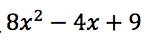
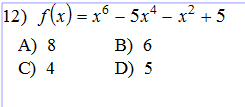
Classify the following polynomial
a)
quartic quadratic trinomial
b)
quartic polynomial
c)
quadratic trinomial
d)
quartic trinomial
37.
Classify the following polynomial
a)
Quintic Polynomial
b)
Quartic Polynomial
c)
polynomial
38.
Classify the following polynomial
a)
quadratic trinomial
b)
quartic polynomial
c)
quartic trinomial
39.
Classify the following polynomial
a)
quartic polynomial
b)
quadratic polynomial
c)
quartic trinomial
d)
quadratic trinomial
40.
Classify the following polynomial
a)
quartic quadratic trinomial
b)
quartic polynomial
c)
quadratic trinomial
d)
quartic trinomial
41.
Put in Standard Form.
12 - 3x3 - 10x - x2
a)
 - 3x3 - x2 - 10x + 12
b)
 3x3 - x2 + 10x + 12
c)
12 - 3x3 - 10x - x2
It is in Standard Form.
d)
12 - 10x - 3x3 - x2
42.
Which polynomial is written in standard form?
a)
-3x + 8x2 + 9x3 - 11
b)
9x3 + 8x- 3x - 11
c)
8x+ 9x3 -11 - 3x
d)
-11 - 3x + 8x2 + 9x3
43.
(3x2 + 6x - 1) + (4x2 + 5x + 9)
a)
-x2 + x - 10
b)
x2 - x + 10
c)
7x2 + 11x + 8
d)
7x2 + 11x + 10
44.
-x3(9x4 - 2x3 + 7)
a)
-9x12 + 2x9 - 7x3
b)
9x7 - 2x6 + 7x3
c)
-9x7 - 2x3 + 7
d)
-9x7 + 2x6 - 7x3
45.
Find the sum.
(3y2 + y3 - 5) + (4y2 -4y + 2y3 + 8)
a)
3y+ 7y- 4y + 3
b)
4y2 + 3y3 - y + 3
c)
-y4 + 2y-y - 4
d)
4y+ 3y-3y + 1
46.
Find the difference. 
(3- 2x + 2x2) - (4x -5 +3x2)
a)
x2 + 6x + 8
b)
2x+ 5x - 7
c)
-x2 -6x + 8
d)
-2x2 + 11x - 4
47.
Simplify the expression:
(3x4 - 4 - 5x2) - (1 - x2 + 2x3)
a)
3x4 - 2x3 - 4x2 - 5
b)
3x4 - 7x3 - 4x2 - 5
c)
3x4 - 7x3 - 4x2 - 4
d)
3x4 - 5x3 - 4x2 - 4
48.
Simplify the expression:
(p3 - 6p4 + 1) - (8p4 - 8p3 + 7)
a)
-14p4 + 9p3 - 6
b)
-14p4 + 9p3 + 6
c)
-14p4 + 9p3 - 1
d)
-15p4 + 9p3 + 6
49.
Find the sum.
(3y2 + y3 - 5) + (4y2 -4y + 2y3 + 8)
a)
3y+ 7y- 4y + 3
b)
4y2 + 3y3 - y + 3
c)
-y4 + 2y-y - 4
d)
4y+ 3y-3y + 1
50.
Simplify the expression:
(p3 - 6p4 + 1) - (8p4 - 8p3 + 7)
a)
-14p4 + 9p3 - 6
b)
-14p4 + 9p3 + 6
c)
-14p4 + 9p3 - 1
d)
-15p4 + 9p3 + 6
51.
(5x+1)(x+4)
a)
5x2 + 19x − 4
b)
5x2 + 21x + 4
c)
5x2 + 4
d)
5x2 − 19x − 4
52.
(4x+1)(5x−2)
a)
20x2 + 3x − 2
b)
20x2 − 11x + 5
c)
20x2 − 18x + 2
d)
20x2 − 3x − 2
53.
Simplify the expression.
-3x2( 7x- x + 4)
a)
-21x4 + 3x3 -12x2
b)
7x2 - x + 4 (-3x2)
c)
21x+ 3x+ 12x2
d)
-12x+ 3x-21x4
54.

-5x6(3x2 - 12x + 30)

a)

-15x8 + 60x7 - 150x6

b)

15x8 - 60x7 - 150x6

c)

8x6 - 17x + 35

d)

-8x6 + 17x - 35x2

55.
(5x+2)(x2-3x+6)
a)
5x3 - 17x2 +24x +12
b)
5x3 + 17x2 - 24x +12
c)
5x3 - 13x2 + 24x +12
d)
5x3 +13x2 - 24x - 12
56.
(x-3)(x2+2x+7)
a)
x3-x2+x-21
b)
x3+5x+13x-21
c)
x3-3x2+7x-21
d)
x2+2x-3
57.

What is the perimeter of the rectangle?

a)

x²+8x-5

b)

2x²+16x-10

c)

2x²+10x-8

d)

6x-2

58.

What is the area of the rectangle?

a)

x²+8x-5

b)

3x3+14x2+17x+4

c)

3x3+14x2-17x+4

d)

6x-2

59.
Is this division problem worked correctly?
a)
This is correct!
b)
This is incorrect!
60.
a)
This is correct
b)
This is incorrect
61.

Divide

a)

2x3 + 3x + (7/x-4)

b)

2x2 + 3x + 8 + (7/x-4)

c)

2x2 + 3x + 8

d)

2x2 - x + 10 + (6/x-4)

62.
a)
A
b)
B
c)
C
d)
D
63.
a)
A
b)
B
c)
C
d)
D
64.
if f(x) = x3+8x+24, then find f(-2) using synthetic division.
a)
12
b)
8
c)
0
d)
-6
65.
x3-3x2-10x+24 ÷ x+3
a)
x2-7x+5
b)
x-8
c)
x2-6x+8
d)
x+9
66.
Use synthetic division:
(2x3 - 5x - 7) ÷ (x - 2)
a)
2x3 - 4x2 + 3x - 13
b)
2x3 + 4x2 +3x - 1
c)
2x2 - 4x + 3 - 13/x-2
d)
2x2 + 4x + 3 - 1/x-2
67.
Use synthetic division:
(2x3 - 5x - 7) ÷ (x - 2)
a)
2x3 - 4x2 + 3x - 13
b)
2x3 + 4x2 +3x - 1
c)
2x2 - 4x + 3 - 13/x-2
d)
2x2 + 4x + 3 - 1/x-2
68.
            Is (x-2) a factor of             f(x)= x3-8x2+14x-4?
a)
Yes, (x-2) is a factor. There is a remainder.
b)
No, (x-2) is  not a factor. The remainder is zero.
c)
Yes, (x-2) is a factor. The remainder is zero.
d)
No, (x-2) is  not a factor. There is a remainder. 
69.
What does it mean to be a factor of a number?
a)
Divides evenly with a remainder of zero.
b)
Divides unevenly with a remainder of 1.
70.
If you are missing an exponent in your polynomial you must put a zero as a coefficient place holder for that exponent
a)
True
b)
False
71.

What is the proper way to write the answer for the following problem?

a)

2x3-x2-25x+12

b)

2x4-x3-25x2-12x+0

c)

2x3-x2-25x-12

d)

2x4-x3-25x2-12x-0

72.

Cam divided (x4 + 3x2 - 4x - 2) by factor of (x-2) using synthetic division. His work is shown above. Which best describes his mistake?

a)

Cam wrote the remainder incorrectly.

b)

Cam did not use a zero place holder for the x3 term.

c)

Cam added instead of subtracting the rows.

d)

Cam should have used -2 as his division since the factor was x-2.

73.
What should be the order of the polynomial coefficients if
(3x - 4x3 + 6x4 + 1) / (x + 3)
a)
3   0   -4   6   1
b)
6   -4   3   1   0
c)
6   -4   0   3   1
d)
-6   4   0   -3   -1
74.
Which of the following is a COMPLETE  list of all possible Rational Zeros?
f(x) = x3 + 2x2 - 6x + 8
a)
±1, ±8
b)
±1, ±2, ±4, ±8
c)
±1, ±2, ±4
d)
1, 2, 4, 8
75.
Which of the following is a COMPLETE  list of all possible Rational Zeros?
f(x) = 3x3 + 2x2 - 6x + 7
a)
±1, ±7, ±1/3, ±7/3
b)
±1, 7
c)
±1, ±3, ±7, ±7/3
d)
±1, ±3, ±7, ±1/3, ±7/3
76.
Which of the following is a COMPLETE  list of all possible Rational Zeros?
f(x) = 2x3 + 5x2 - 9x + 5
a)
±1, ±5, ±1/2, ±5/2
b)
±1, ±2, ±5, ±1/2, ±5/2
c)
±1, ±5
d)
±1, ±2, ±5, ±1/2, ±5/2, ±2/5
77.
Solve by using Rational Root Theorem: 
2x3 - 11x2 + 12x + 9 = 0
a)
-1, 1, 3
b)
-1, 3/2, 3 
c)
-1/2, 3, 3
d)
-1/2, 1, 3
78.
            Is (x-2) a factor of             f(x)= x3-8x2+14x-4?
a)
Yes, (x-2) is a factor. There is a remainder.
b)
No, (x-2) is  not a factor. The remainder is zero.
c)
Yes, (x-2) is a factor. The remainder is zero.
d)
No, (x-2) is  not a factor. There is a remainder. 
79.
Solve by using Rational Root Theorem: 
x3 + 3x2 - 6x - 8 = 0
a)
 -4, -1, 2
b)
-4, -1, ±√2
c)
1, 2, 4
d)
4,-1,√2
80.
How many zeros does the following function have?
f(x)= x5 - 3x3 + x
a)
8
b)
9
c)
5
d)
3
81.
Use the Fundamental Theorem of Algebra to state the number of zeros/solutions/roots of the polynomial. 
a)
A
b)
B
c)
C
d)
D
82.
How many solutions does the polynomial f(x)=3x4 + 5x2 - 6x have?
a)
4
b)
2
c)
3
d)
5
83.
What is the proper way to write the answer for the following problem? 
a)
2x3-x2-25x-12
b)
2x4-x3-25x2-12x+0
84.

Write the polynomial in standard form given the following zeros. x = -2, 1, 4

a)

f(x) = (x+2)(x-1)(x-4)

b)

f(x) =x3 - 3x2 - 6x + 8

c)

f(x) = x3 + 8

d)

f(x) = x3 - 3x2 + 8

85.

Write the polynomial with the given zeros

a)

A

b)

B

c)

C

d)

D

86.

f(x)=(x+4)(x-3)(x-2)

List the zeros for this function.

a)

x = -4, x = 3, x = -2

b)

x = -4, x = 3, x = 2

c)

x = -4, x = -3, x = 2

d)

x = 4, x = 3, x = 2

87.

x2 + 12x + 32 = 0

a)

x = -4, 8

b)

x = 4, 8

c)

x = -4, -8

d)

x = 0, 12

88.

Solve x2 + x – 72 = 0.

a)

x = -8

b)

x = -8 or x = 9

c)

x = 8 or x = -9

d)

x = 9

89.
What is the first step in solving 
(x + 2)(x - 3) = 0      ?
a)
Plug in zero for x
b)
Solve for x
c)
FOIL
d)
Set each binomial factor equal to zero
90.
How many zeros does the polynomial function
 P(x) = 3x4+4x-8 have?
a)
1
b)
2
c)
3
d)
4
91.
If p(x) = 9x4- 45x+ 37x2 + x +2, use synthetic substitution to find p(2).
a)
p(2) = 656
b)
p(2) = 652
c)
p(2) = -64
d)
p(2) = -368
92.
How many zeros do you expect the polynomial function
 P(x) = 3x3+4x-8 to have?
a)
1
b)
2
c)
3
d)
4
93.

Solve 10x3 - 40x2 + 40x = 0.

a)

x= 0 and x = 2

b)

x = 0

c)

x = 2

d)

x = -2, x = 0, and x = 2

94.

Find the zeros of the function f(x) = 4x4 - 8x2 + 4.

a)

x = -1 and x = 1

b)

x = 1

c)

x = -1

d)

no solution

95.

Find all real solutions of x3 - 5x2 - 2x + 24 = 0.

a)

x = -2, x = 3, and x = 4

b)

x = -2 and x = 4

c)

x = 3 and x = 4

d)

x = -2

96.

Write the polynomial in standard form given the following zeros. x = -2, 1, 4

a)

f(x) = (x+2)(x-1)(x-4)

b)

f(x) =x3 - 3x2 - 6x + 8

c)

f(x) = x3 + 8

d)

f(x) = x3 - 3x2 + 8

97.
Write a polynomial function of least degree with integral coefficients that has the given zeros.
a)
A
b)
B
c)
C
d)
D
98.

Find the zeros of the polynomial function: f(x)= (x-3)(x+2)2(x-5)

a)

x= 3,2,5

b)

x= 3, -2, 5

c)

x= -3, 2, -5

d)

x= -2, -3, -5

99.

Write a polynomial in factored form with zeros at x = 1, x = -1 x = 0

a)

(x - 1)(x + 1)

b)

x(x - 1)(x + 1)

c)

x2(x - 1)(x + 1)

d)

x(x - 1)(x - 1)

100.
How many total roots/zeros are there in the polynomial.   
a)
A
b)
B
c)
C
d)
D