
 Worksheets
P4 Electric Circuits
Total questions: 22
Worksheet time: 11mins
What does an ammeter measure?
Coulombs
Current
Charge
Amperes
What is resistance the measure of?
How easily charge can flow
How hot a wire is
How easily charge can be counted
How many particles are in a wire
Where in a circuit is an ammeter added?
In parallel
In series
Why is a voltmeter added in parallel?
To measure the energy transferred before the component
To measure the energy transferred after the component
To measure the energy transferred to a component
To measure the energy wasted by a component
What is charge measured in?
Electrons
Current
Ohms
Coulombs
How many joules are in 1 kJ?
10
100
1000
10,000
Complete the equation: ................ = potential difference / resistance
Charge
Current
Resistance
Coulomb
Complete the equation: Charge = ................ x ..............
Time, Current
Current , Voltage
Resistance, Voltage
Current , Time
Complete the equation: .............. = energy transferred / potential difference
Current
Time
Charge
Resistance

What is this circuit component?
Fixed resistor
Variable resistor
Thermistor
LDR

Calculate the charge and give the unit when a current of 0.15 A flow around the circuit for 20 seconds.
133.33 C
1.5 C
0.0075 C
3 C

Calculate the voltage across the 8Ω resistor.
4 V
16 V
9 V
4.5 V

Why must parts of a circuit be properly connected before the bulb can light up?
To ensure that the bulb can light up.
To ensure that the battery can produce light in a closed circuit.
To ensure that electric current can flow through the closed circuit.

Look at the circuits in the diagram. In which circuit will the bulb be brighter?
Circuit A
Circuit B
Both circuits, the bulbs will have the same brightness.

Look at the circuits in the diagram. In which circuit will the bulb be brighter?
Circuit C
Circuit D
Both circuits, the bulbs will have the same brightness.

Look at the circuits in the diagram. In which circuit will the bulb be brighter?
Circuit A
Circuit B
Both circuits, the bulbs will have the same brightness.


Based on the graph, which of the following would be true regarding the relationship of voltage and current?
As voltage increases, current decreases.
Voltage will not affect current.
As voltage decreases, current increases.
As voltage increases, current also increases.
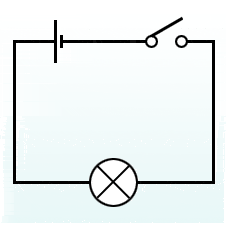
What does a voltmeter measure?
potential difference
resistance
charge
current

