wayground logo

Free Printable Worksheets

NEW

Font size

S
M
L
XL
Worksheets

Coastal Erosion Quiz

Total questions: 30

Worksheet time: 16mins

Name
Class
Date
1.
What is Erosion?
a)
When waves lose energy and leave sediments / sand along a coast.
b)
The wearing away of land, removal of beach rocks/sand by water or wind.
c)
An area of land that smells different to other places.
d)
An area that has a lot of wind.
2.
Which of these coastal landforms is created by erosion?
a)
Cave
b)
Tombolo
c)
Beach
d)
Spit
3.
What type of landform are the 12 Apostles?
a)
Wave cut platform
b)
Arch
c)
Stack
d)
Cave
4.
What is the first stage of a stack forming from a head land?
a)
Cracks erode to form a cave.
b)
Hydraulic action creates small cracks in the headland/cliff face.
c)
The cave becomes wider and deeper.
d)
The waves cut through the cave and form an arch.
5.
What is the most advanced stage of erosion of a headland?
a)
Cracks erode further to create a cave.
b)
The roof of an arch becomes too heavy and collapses.
c)
The cave becomes wider and deeper.
d)
The waves cut through the cave and form an arch.
6.
What is the erosional process in which rocks are pushed by waves up against the headland, eroding the cliff face further?
a)
Hydraulic action.
b)
Abrasion.
c)
Attrition.
d)
Solution.
7.
What is swash?
a)
Water that runs back into the ocean.
b)
Water that falls forward and moves up the shore.
c)
Tug of war between the drag of the wind and pull of gravity.
d)
Swirling of water in an area.
8.
What is backwash?
a)
Water that runs back into the ocean.
b)
Water that falls forward and moves up the shore.
c)
Tug of war between the drag of the wind and pull of gravity.
d)
Swirling of water in an area.
9.
What are destructive waves?
a)
Waves that are tall and frequent, crashing into shoreline, digging out chunks.
b)
Long and low waves, beginning far out in the sea, with a smooth gentle landing.
c)
The circular movement caused by wind and gravity fighting.
d)
When people wave their hand to aggresively destroy things.
10.
What are constructive waves?
a)
Waves that are tall and frequent, crashing into shoreline, digging out chunks.
b)
Long and low waves, beginning far out in the sea, with a smooth gentle landing.
c)
The circular movement caused by wind and gravity fighting.
d)
When people wave their hand to aggresively destroy things.
11.
What am I? I start far out to sea and land on the shore smoothly and gently.
a)
A deconstructive wave.
b)
A constructive wave.
c)
A pirate.
12.
What am I? I have a very strong backwash which removes material from the beach.
a)
A deconstructive wave.
b)
A constructive wave.
c)
The local council.
13.

What is erosion?

a)

The movement of sediment

b)

The breaking of sediment

c)

The dropping of sediment

14.

Identify the landform type.

a)

Sea Stack

b)

Sea Stump

c)

Arch

d)

Bay

15.
What is this
a)
Sea cave
b)
Sea stack
c)
Sea arch
d)
Headland
16.
What is this?
a)
Beach
b)
Sea cave
c)
Headland
d)
Barrier Island
17.
What is this landform?
a)
mountain
b)
glacier
c)
bay
d)
canyon
18.

Letter B is called a ____.

a)

Sea Cave

b)

Sea Island

c)

Sea Arch

d)

Sea Stack

19.
Which feature cannot be seen in this image?
a)
Stump
b)
Arch
c)
Cliff
d)
Cave
20.
The type of erosion that occurs when pebbles bang together
a)
Abrasion
b)
Attrition
c)
Hydraulic action
d)
Solution
21.
This is a
a)
Headland
b)
Stack
c)
Arch
d)
Bay
22.

What is this type of wave?

a)

Constructive wave

b)

Destructive wave

23.

What is this type of wave?

a)

Coast building - constructive

b)

Coast destroying - destructive

24.

This coastline was created due to...

a)

Erosion

b)

Deposition

c)

Using your phone in class

d)

Both

25.

What does the term Fetch refer to?

a)

The shape of a headland

b)

The distance a wave travels before it reaches land

c)

The movement of sediment within an ecosystem

d)

The time it takes for erosion to occur

26.

What is Hydraulic action?

a)

The weight and impact of water against the coastline which cause cracks/caves to form.

b)

The way a coastal feature transitions into a new feature

c)

The time it takes for erosion to occur

d)

The way a wave moves up the beach and interacts with the coastline.

27.

Abrasion occurs when?

a)

Little rocks get picked up by the waves and smashed on to the cliffs

b)

Small rocks are smashed against each other, making smaller rocks.

c)

Chemicals in the sea water dissolve the rocks

d)

At low tide when animals enter the coastal environment.

28.

Corrosion occurs when?

a)

Little rocks get picked up by the waves and smashed on to the cliffs

b)

Small rocks are smashed against each other, making smaller rocks.

c)

Chemicals in the sea water dissolve the rocks

d)

At low tide when animals enter the coastal environment.

29.

Attrition occurs when?

a)

Little rocks get picked up by the waves and smashed on to the cliffs

b)

Small rocks are smashed against each other, making smaller rocks.

c)

Chemicals in the sea water dissolve the rocks

d)

At low tide when animals enter the coastal environment.

30.

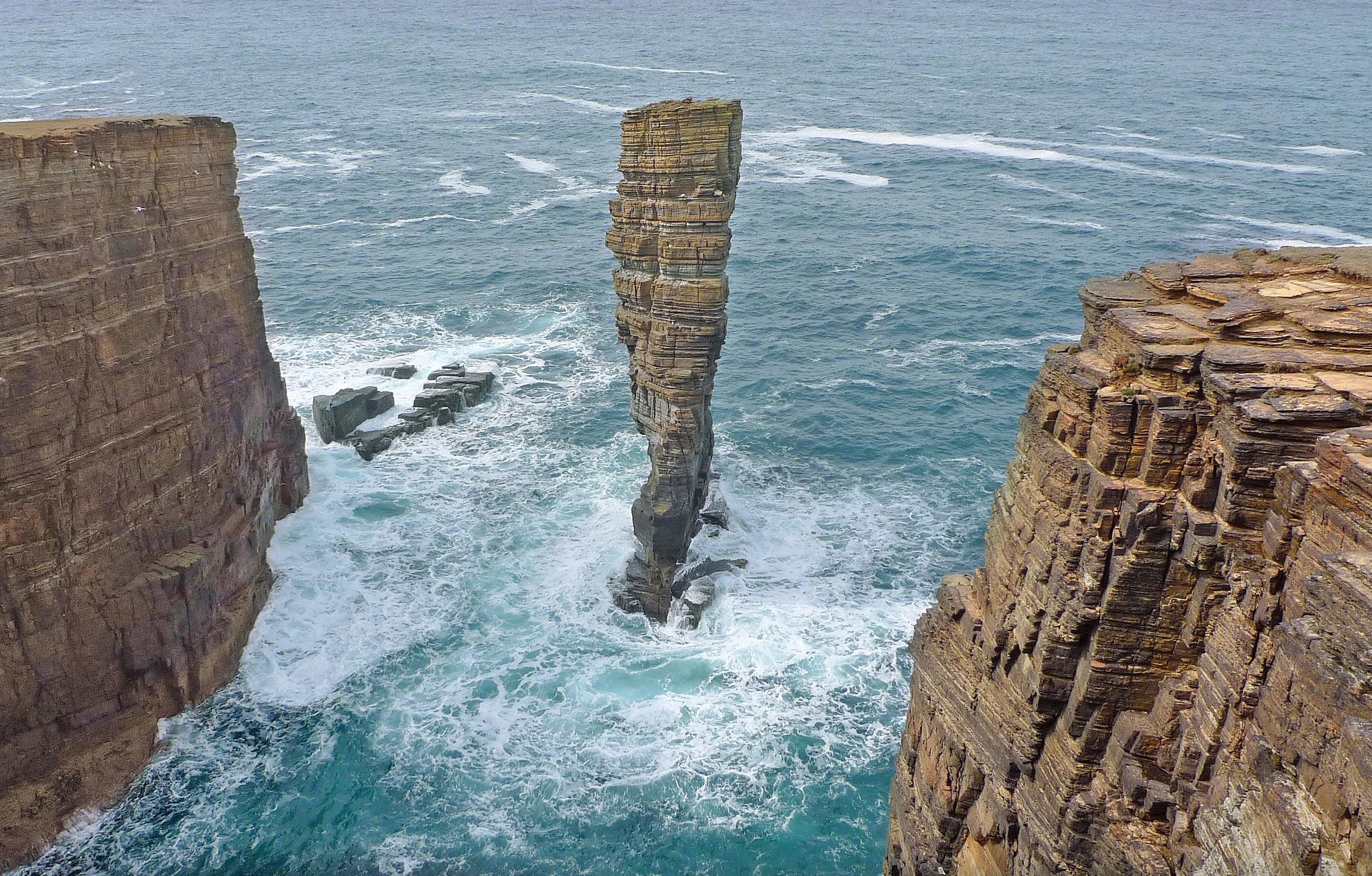
What Coastal Erosion feature is shown here?

a)

Blowhole

b)

Stack

c)

Arch

d)

Cliff