
NEW
Font size
 Worksheets
Platyhelminthes
Total questions: 30
Worksheet time: 33mins

True or False: This a flatworm
True
False

This animal is in the Phlyum ___.
Mollusk
Poriferan
Arthropod
Platyhelminthes
What is the common name for all Platyhelminthes?
roundworms
flatworms
segmented worms
parasitic worms
Class Trematoda includes which animals?
earthworms
flukes
tapeworms
planarians
Class Cestoda includes which animals?
earthworms
flukes
tapeworms
planarians
Class Turbellaria includes which animals?
earthworms
flukes
tapeworms
planarians
What is the most common location for parasitic flatworm eggs?
muscle tissue
stomach/intestines (digestive system)
feces (poop)
epidermis
What is the most common intermediate host of most flukes?
snails
fish
humans
livestock
Which of the following best describes the body cavity of a flatworm?
acoelomate
pseudocoelomate
true coelomate
diploblastic
Which of the following would be the least likely habitat of a flatworm?
desert
wetland
ocean
inside a host
Which of the following is NOT a characteristic of flatworms?
bilaterally symmetrical
cephalized
complete digestion
dorsoventrally flattened
What is the purpose of flatworm tegument?
it makes them better hunters
it covers parasitic flatworms
its a hard protective covering
it aids in movement
How are parasitic flatworms different from predatory flatworms?
they are acoelomates
they lack eyespots
they are hermaphroditic
they lay eggs
What do Platyhelminthes have that Poriferians and /or Cnidarians don't?
simple brains
multiple hearts
mesoglea tissue
pores
Which process best describes planarian asexual reproduction?
hermaphroditic
fusion/gamete combination
parasitic
fission/regeneration

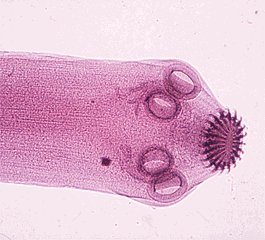
Which of the 3 types of flatworms we talked about are not parasites?
planarians
flukes
tapeworms
Schistosomas
Why are Platyhelminthes flat?
the type of respiratory system they contain
because they have no respiratory system and they respire by diffusion across skin
the placement of their mouth 2/3 of the way down their ventral surface
They are acoelomates with bilateral symmetry
Concentration of nerves and other sensory organs on the anterior (front) end of the body is called____
acoelmate
bilateral symmetry
cephalization
protandry



