
NEW
Font size
S
M
L
XL
 Worksheets
IB Biology Chapter 5 Review: Evolution
Total questions: 20
Worksheet time: 38mins
Name
Class
Date
1.

Genetic variation can arise from a random change in the DNA of a gene. The change is called a(n)
a)
mutation
b)
gene flow
c)
gene pool
d)
allele
2.
Which statement best describes the process of evolution?
a)
Populations can survive in different locations on earth
b)
Environmental conditions limit the number of species on Earth
c)
Populations grow when resources are abundant
d)
The traits of a species can change over time
3.
Darwin theorized that individuals having an advantage due to their traits or abilities will be more likely to survive and reproduce. This theory is known as
a)
evolution
b)
speciation
c)
adaptation
d)
natural selection
4.
Darwin's book was called On the Origin of
a)
individuals
b)
natural selection
c)
species
d)
evolution
5.
What factor must be in place for natural selection to occur?
a)
struggle for existence (overproduction)
b)
genetically identical individuals
c)
random mating
d)
no immigration or emigration
6.

Which scientist stated that things like war, famine and disease help to keep the worlds population in check.
a)
Darwin
b)
Lamarck
c)
Malthus
7.
Natural selection can also be referred to as:
a)
Survival of the weakest
b)
Survival
c)
Survival of the fittest
d)
Artificial selection
8.
When did Charles Darwin live?
a)
1600s
b)
1700s
c)
1800s
d)
1900s
9.
This scientist stated that by using or not using a certain body part, organisms could change in their lifetime and that the trait gained would be passed down to their offspring.
a)
James Hutton
b)
Charles Lyell
c)
Jean-Baptiste Lamarck
d)
Thomas Malthus
10.

Who was the naturalist that traveled the world to study plants and animals?
a)
Albert Einstein
b)
Charles Darwin
c)
Charles Barkley
d)
Isaac Newton
11.
What characteristic did Darwin observe about the finches on the Galapagos Islands?
a)
Their feathers
b)
Genotypes
c)
Their beaks
d)
Their body sizes
12.
Genetic differences between organisms of the same species
a)
Variation
b)
Adaptation
c)
Behavior
d)
Environment
13.
The struggle for existence against other members of an organisms species is
a)
Competition
b)
Natural Selection
c)
gene flow
d)
genetic drift
14.
Darwin's expedition was called the Voyage of the _________.
a)
Titanic
b)
Beagle
15.
Remains of ancient organisms are called
a)
Extinctions
b)
Fossils
c)
Mutations
d)
Variations
16.

If an organism has a vestigial structure, that structure likely once had a function in a(n)
a)
close relative
b)
early ancestor
c)
unrelated organism
d)
embryological stage
17.

the hind leg bones in a whale are examples of
a)
homologous structures
b)
analogous structures
c)
fossils
d)
vestigals
18.
What is the term for a feature that allows an organism to survive better in its environemtn?
a)
variation
b)
adaptation
c)
homologous structure
d)
vestigial structure
19.
What is the study of organisms at the early stages of development?
a)
DNA studies
b)
embryology
c)
extinction
d)
fossil record
20.
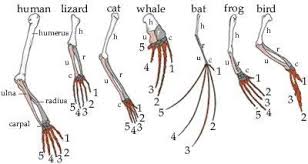
What is this an example of?
a)
vestigial structures
b)
embryology
c)
homologous structures
d)
fossil record
Reset

