
 Worksheets
8.11ABC Review
Total questions: 50
Worksheet time: 50mins
An organism that can make its own food
decomposer
producer
consumer
Small consumers that are hunted and eaten by larger consumers
producer
prey
predator
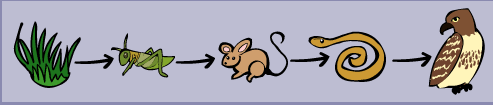
Explain the flow of energy in this food chain (who passes energy to who).
The hawk gives energy to the snake. The snake gives energy to the mouse. The mouse gives energy to the grasshopper who gives energy to the grass.
The mouse gives energy to the hawk. The snake gives energy to the grasshopper. The grass gives energy to the snake.
The grass gives energy to the grasshopper. The grasshopper gives energy to the mouse. The mouse gives energy to the snake who gives energy to the hawk.
Chameleons can change color to match the color of the surroundings. If a chameleon was born with a mutation that prevented it from being able to change color, why would it be unlikely to pass on its trait?
The gene would mutate before it passed on.
The trait would be recessive, so it would not be passed on.
The chameleon would be unlikely to survive and pass the trait.
The chameleon would have to find another chameleon with the same trait.
How does natural selection lead to evolution?
Stronger offspring kill weaker members of the species.
Individuals that are better adapted to their environment survive and reproduce.
Overproduction provides food for stronger member of the species.
Environmental changes kill weaker members of the species.
A company purchased a large forest and cut the trees for lumber. Sunlight which had not reached the forest floor before was now very bright on the bare ground. Holly ferns began to grow rapidly because of increased access to light and moisture.Which population of organisms would be in direct competition with the Holly ferns for the same resources?
Spotted owls
Squirrels
Hawks
Wildflowers
Plants need sunlight to perform photosynthesis. In the tropical rainforest, the survival of a plant depends upon its ability to adapt in order to reach sunlight.
Which of the following is an example of one such adaptation?
Vines that wrap around a tree
Thin, shallow roots that run across the forest floor
Numerous small leaves on one stem
Colorful petals

Which organisms are in competition for the same food source?
Fox and owl
Spider and fly
Rabbit and mouse
Deer and owl
In Austin, Texas, a well-known salamander inhabits the waters of the spring outflows of Barton Springs. This is the perfect habitat for the Barton Springs salamander since it thrives in fresh and pure continuous flowing water. They may inhabit underground or surface environments. They have been observed in water, under and among rocks and gravel, as well as within plants and algae. They consume small aquatic organisms.
What is the most likely way that humans could have a damaging impact on the Barton Springs salamander?
Polluting the water
Floating down the river
Adding new water vegetation
Adding new crustaceans
Fossils of tropical plants and animals can be found buried in limestone rock in the North Texas area. These plants and animals are no longer found in this region.What is the most likely cause of the disappearance of these tropical plants and animals?
Earthquakes and volcanoes destroyed all the tropical plants and animals.
Tropical animals ate all the tropical plants and everything died out.
Air pollution and acid rain killed off all the tropical plants and animals.
The climate in that area is different today than when tropical plants and animals lived there.


Why might it be helpful for a species to have a lot of variations?
They can't be seen by predators
If the environment changes, they might be better able to adapt
It is helpful in asexual reproduction
They don't recognize each other
Why is carbon dioxide important for plants?
Carbon dioxide gives plants their green color.
Plants can release carbon dioxide into the air.
Plants use carbon dioxide to make their own food.
Carbon dioxide lets plants absorb their roots.
Ecosystem change for many different reasons. Which of the following is a natural cause of changes in an ecosystem?
Farming
Housebuilding
Hurricanes
Pollution

why is only about 10% of the energy available within 1 trophic level transferred to organisms at the next trophic level
energy organisms consume is used for life processes
energy is used during respiration, movement, reproduction, heat loss
Only part of the energy that is stored in one trophic level of an energy pyramid is passed on to the next level
all of the above

Which of the following is the best definition for Short Term Environmental changes?
Short-term environmental changes tend to not affect the environment and the organisms living in it since it happens rather quickly.
Short-term environmental changes do not have a significant effect on the environment.
Short-term environmental changes, like droughts, floods, and fires do not give populations time to adapt to the change and force them to move or become extinct. The changes happen rather quickly and there is no time for adaptations to occur which can lead to massive die-off.
Short-term environmental changes, like pollution, deforestation, and ice age give populations time to adapt to the change and force them to move or become extinct.
Which of the following is the best definition for Long-term environmental changes?
Long-term environmental changes tend to not affect the environment and the organisms living in it since it happens rather quickly.
Long-term environmental changes do not have a significant effect on the environment.
Long-term environmental changes, like droughts, floods, and fires do not give populations time to adapt to the change and force them to move or become extinct. The changes happen rather quickly and there is no time for adaptations to occur which can lead to massive die-off.
Long-term environmental changes, like pollution, deforestation, and ice age are much more gradual and allow populations to adapt. Overtime, organisms that are affected by these changes have a chance to survive as they can develop adaptations that will help them cope with the change.


Scientists are studying the effects of climate change on the Baltic Sea. Some scientists predict that if current trends continue, the Baltic Sea will become less salty, and it will contain less dissolved oxygen. As a result of these changes, the Baltic Sea will have less biodiversity.
Which statement best explains why biodiversity of the Baltic Sea could decrease if these changes occur?
Fewer types of plants and animals are found in warm water than in cool water.
Plants and animals adapted for living in saltwater will grow more slowly in water that has less salt.
Plants and animals adapated for living in saltier conditions will not be able to survive and reproduce.
Animals adapted for living in warm water will eat all the plants and animals adapted for living in cool water.

How do the oceans contribute to the amount of Oxygen in the Earth's atmosphere?
Fish in the ocean produce oxygen.
Phytoplankton in the ocean produce oxygen through the process of respiration.
Phytoplankton in the ocean produce oxygen through the process of phtosynthesis.
There is no oxygen production in the ocean.



