
Font size
 Worksheets
TOPIC 3
Total questions: 20
Worksheet time: 18mins
Pergerakan bahan-bahan terlarut daripada rantau berkepekatan tinggi ke rantau yang berkepekatan rendah adalah dikenali sebagai
resapan
hemolisis
plasmolisis
osmosis
Pergerakan molekul air daripada larutan hipotonik ke larutan hipertonik melalui membran separa telap dikenali sebagai
resapan
pengangkutan pasif
osmosis
pengangkutan aktif
Tekanan yang dikumuhkan pada bahagian dalaman dinding sel oleh sap sel dikenali sebagai
tekanan turgor
tekanan sel
tekanan osmosis
tekanan hidrostatik
Sel-sel darah merah yang berpecah disebabkan oleh protoplasma dibebaskan ke persekitaran dikenali sebagai
krenasi
plasmolisis
fagositosis
hemolisis
Krenasi adalah proses dimana saiz sel-sel menurun disebabkan oleh kehilangan
glukosa
sitoplasma
air
protoplasma
Radas ringkas yang digunakan untuk menunjukkan proses osmosis adalah
pengosmokawalaturan
atmometer
osmometer
osmoreseptor
Antara proses di dalam tumbuhan berikut, yang manakah tidak memerlukan tenaga?
Pertumbuhan tiub debunga
Penyerapan garam mineral
Meiosis
Resapan air
Membran yang membenarkan laluan molekul-molekul kecil tetapi tidak kepada molekul-molekul besar adalah dikatakan
telap
separa telap
poros
semi-poros
Antara sampel air berikut, yang manakah adalah paling hipotonik?
Air sungai
Air hujan
Air perigi
Air suling
Larutan yang boleh menyebabkab suatu sel mengembang atau mengalami hemolisis ialah
larutan beralkali
larutan berasid
larutan hipertonik
larutan hipotonik
Sekiranya Paramecium air tawar diletakkan di dalam larutan hipotonik, vakuol mengecut akan
mengalami peningkatan dalam saiz
mengecut dengan kadar sangat pantas
mengecut dengan perlahan
merembeskan bahan kumuh
Pengangkutan asid amino merentasi membran plasma dengan bantuan protein pembawa dikenali sebagai
osmosis
resapan berbantu
resapan ringkas
pengangkutan aktif
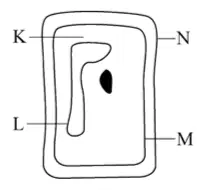
Diagram shows the structure of a cell.
Which of the following structures are semi-permeable membranes?
A. K and L only
B. L and M only
C. M and N only
D. L and N only
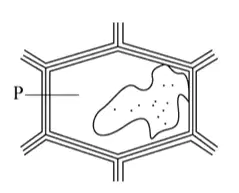
The diagram shows the condition of a plant cell immersed in 30% sucrose solution for an hour.
What is contained in P?
A. water
B. cytoplasm
C. sucrose solution
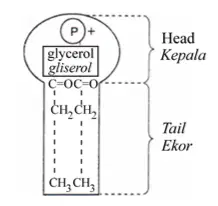
Diagram shows a phospholipid molecule.
The tail end of the molecule allows easy passage of molecules that are
A. hydrophobic
B. hydrophilic
C. charges
D. small
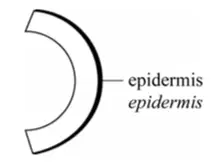
Diagram shows a plant strip immersed in solution X for 30 minutes.
What is solution X?
A. Sucrose solution 5%
B. Sucrose solution 30%
C. Salt solution 1%
D. Distilled water

Diagram shows an experiment to show the movement of water across a membrane.
At the end of experiment, the level of water in the glass tube did not increase because (choose two correct answer)
A. Glucose solution diffuse out from Visking tubing.
B. water diffuse into Visking tubing
C. water diffuse out from Visking tubing
D. glucose solution remain inside Visking tubing

Diagram shows stem strips of a plant that has been immersed into solution of different concentrations.
Which of the following shows the correct sequence about the concentration of solution from isotonic, hypotonic and hypertonic order compared to cell sap?
P, Q, R
Q, R, P
Q, P, R
R, P, Q

A
B
C
D

A
B
C
D

