Worksheets
Forces Quiz Review
Total questions: 40
Worksheet time: 1hrs 6mins
When two forces are acting in the same direction . . .
Each force cancels the other out
The stronger force overcomes the weaker force
Forces are added together
You calculate the average force to figure out the net force
Whenever an object is moving, there is always this force opposing the motion:
inertia
momentum
friction
applied force
The force exerted by ropes and chains is called
tension
normal
elastic
mechanical
In a force diagram, or free-body diagram, the size/length of the arrow tells you this about the force:
relative strength
relative distance
relative direction
Paired forces are
in opposite directions
always equal
not possible
added together
When determining the NET force on an object you should (TWO correct answers)
subtract forces in opposite directions
add forces in the same direction
divide by velocity
multiply by acceleration
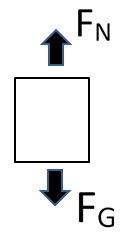
Which of the following is true about this free-body diagram?
the forces are are balanced
the object is free-falling
the object is moving upward
the forces are unbalanced
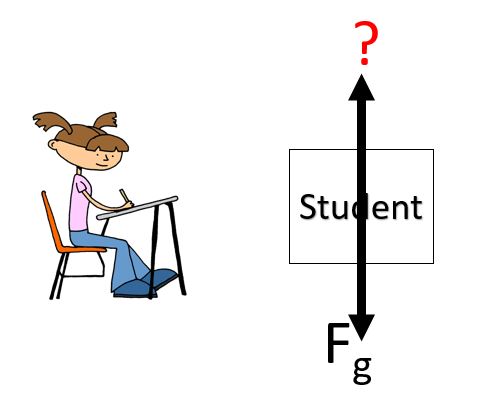
The force that keeps objects on top of surfaces instead of letting them sink into the surface is known as:
normal
abnormal
static
inertia
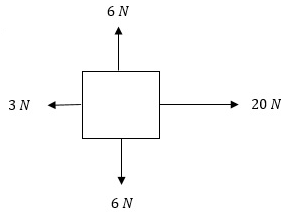
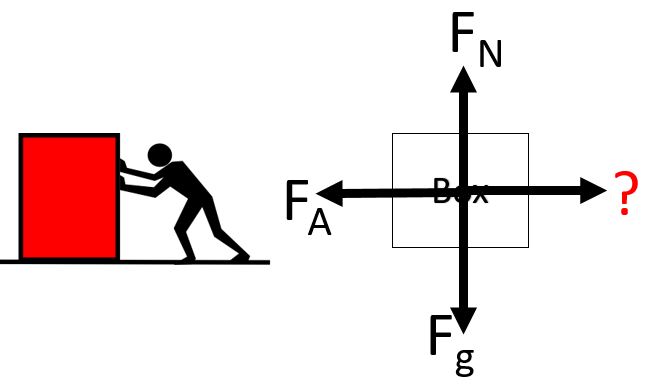
What is the NET FORCE of this diagram?
17 N, right
17 N, left
23 N, right
12 N, up

What forces are on a leopard laying on a log?
Fg & Fapp
Fb & Fg
Fg & FN
Ff & FN
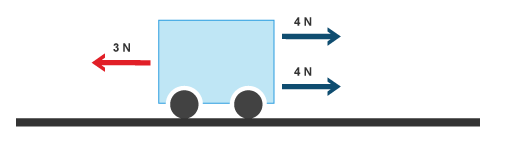
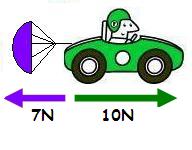

In a force diagram, or free-body diagram, the pointy-end of the arrow tells you this about the force:
relative strength
relative distance
relative direction
When determining the NET force on an object you should (TWO correct answers)
subtract forces in opposite directions
add forces in the same direction
divide by velocity
multiply by acceleration


What force overcomes gravity in a fluid to cause an object to float?
applied force
antigravity force
normal force
bouyant force

What force is always present when an object is close to the earth's mass?
Applied Force
Normal Force
Frictional Force
Gravitational force

Which freebody diagram best represents a desk being pushed across the classroom floor?


Which freebody diagram best represents a bookbag resting on the classroom floor?


Which law states that the acceleration of an object depends on the force exerted on it and its mass?
1st Law
2nd Law
3rd Law
Which law states that for every action there is an equal and opposite reaction?
1st Law
2nd Law
3rd Law
Which activity would BEST demonstrate Newton's law of Inertia?
A plate sits on a table top.
A lady pushes a grocery cart.
A child jumps on a trampoline.
A boy swings a baseball bat.
When there is an INCREASE in MASS of an object you will have a DECREASE in ______________.
friction
acceleration
force
gravity
Mary is riding in a car when the driver suddenly slams on the brakes. Mary is jerked forward out of her seat. This is an example of which law of motion?
2nd Law
1st Law
3rd Law
A jellyfish swims through the water by pulling in water and then pushing the water back out in the opposite direction. This is an example of which law of motion?
1st Law
2nd Law
3rd Law
Ted is playing with a yoyo outside. When he pushes the yoyo downward it returns back to him with the same force. Which law is this an example of?
1st Law
2nd Law
3rd Law


An 18 Wheeler with a mass of 5000 kg is traveling at 20 m/s², what is the force it applies when it crashes into a wall? (F = M x A)
100 N
1000 N
10,000 N
100,000 N
What is the acceleration of a baseball if it hits a bat with a force of 40 N and has a mass of 2 kg? (F/M = A)
10 m/s2
20 m/s2
80 m/s2
.5 m/s2