
 Worksheets
Unit II: Southwestern Asia and Northern Africa (2026-2027)
Total questions: 47
Worksheet time: 2mins

Which letter Represents the Mediterranean Sea?
A
B
C
D
E

The region represented by the letter D is know by what name?
Northern Africa
Turkey
Persia
The Iberian Peninsula
The Arabian Peninsula
Which letter Represents the Red Sea?
B
C
E
E
F
Which letter Represents the Arabian Sea?
B
C
E
E
F

The waterway marked by the letter E is known by what name?
The Mediterranean Sea
The Red Sea
The Persian Gulf
The Arabian Sea

What is the climate of the region that is circled on the map?
Mediterranean
Tropical
Desert
Rain Forest
Which TWO physical features are located entirely within the circled region on the map? (Select TWO answers)
Mediterranean Sea
Red Sea
Iberian Peninsula
Black Sea
Arabian Peninsula

The Umayyads were responsible for the spread of Islamic teachings. What language did they spread as a result?
Punjab
Hindi
Mandarin
Arabic

When did Islam extend outside of the Arabian Peninsula?
During Muhammad's' military Conquests of Western Asia
When Muhammad fled to Medinah and became the accepted ruler.
After Muhammad's death under the caliphs and Umayyads
Through Muhammad leading caravans on trading expeditions
What are the two primary ways that the Islamic faith spread?
Exploration
Trade
Libraries
Missionaries
Military Conquests
After Muhammad began preaching about a new faith to the people of Mecca, the people became angry. What happened next?
Muhammad was visited by an angel who told him there were many gods.
Muhammad leads an army to take over Constantinople.
Muhammad took his followers to Jerusalem and established this city as the holy city of Islam.
Muhammad and his followers leave for Medina where he becomes the accepted ruler.
Which of the following helped trade expand in the Islamic Empires?
The Empire split into many separate kingdoms.
Freedom of religion was practiced within the Arab Empire
The Arabic language became the language of trade.
The religions divided into two different branches/sects.
The Arabic language has a special status in Islam. Why?
It is the language of the Qu'ran and is believed by Muslims to be the language used by an angel when communicating with Muhammad.
It is a language that is only spoken on the Arabian Peninsula and cannot be used by non-Muslims.
It is the language of all three major world religions and is the most widely spoken language in the world today.
It became the language of trade and is still the language of business in modern society.

Which of the following describes FASTING?
belief in one god
praying 5 times per day
not eating from sunrise to sunset
giving a portion of your income to the poor

Which of the following describe PILGRIMAGE?
giving a portion of your income to the poor
not eating from sunrise to sunset
belief in one god (monotheistic)
a journey for religious reasons

A moral code and set of customs based on the words and deeds of Muhammad is called which of the following?
The Qu'ran
Shari'ah Law Code
The Five Pillars
The Sunnah
Which of the following are the primary teachings/texts/guidelines for the Islamic faith. (Pick Three)
Hajj
Qu'ran
Sunnah
Hijrah
Five Pillars
Which of the following is an example of Islamic architecture? (pick two)


Which of the following maps represents the area that Islam extended to during Muhammad's lifetime?


Which two cultural elements were spread (diffused) as a result of the Umayyads Military Expansion of the Islamic Empire? (PICK TWO)
Buddhist Teachings
Arabic Languae
Hindu Language
Islamic Faith/Muslim Relgion
Polytheistic Religions

Which two elements are often found In Islamic architecture?
Collums
Domes
Statues
Mosaics
Minarets

The Taj Mahal and Dome of the Rock are both examples of architecture from which civilization?
Ancient Rome
Ming Dynasty
Islamic Empires
Egyptian Kingdoms

The map illustrates that which group controlled most of the trade routes during the early medieval period?
European Sailors
African Caravans
Indian Traders
Arab Merchants

Which of the following explain how and why the Islamic Empires controlled trade during the early medieval period?
Most of the trade routes ran through the Indian Ocean .
The Arab/Muslim Empires created most of the goods that were exported along these trade routes.
Muslim armies controlled all of the trade routes for Europe, Asia, and Africa.
The trade routes from all three continent had to pass through territories that were part of the Islamic/Muslim Empires.

Which of the following were accomplishments of Al-Razi: (Pick THREE)
made advancements in Chemistry and medicine
discovered algebra and the Indian-Arabic
Identified substances and placed them into 6 categories
wrote the first book on small-pox
improved the atrolabe and named stars

Which group primarily (mainly) helped spread Islam further into the African continent to areas such as West Africa?
Islamic Soldiers
Arab Merchants
Muslim Scholars
African Kings
"In West Africa, as was the case in Southeast Asia, it was traders who introduced Islam, and many rulers accepted it first, followed by others." This passage shows that which group played a key role in the spread Islam to Western Africa?
Islamic Soldiers
Arab Merchants
Muslim Scholars
African Kings

Which Islamic Empire was a threat to the Byzantine Empire in the 1450s?
Mogul Empire
Ottoman Empire
Persian Empire
Abbasid Empire

Who was responsible for defeating the Byzantine Empire?
Muhammad
Abu Bakar
Mehmed II
Al Razi IV

What city did Mehmed II conquer?
Mecca/Makkah
Cordoba
Constantinople
Rome
What did the Ottoman Empire change the name of Constantinople to after the defeat of the Byzantine Empire?
Turkey
Persia
Istanbul
Cordoba

Which of the following summarizes contributions made by Islamic/Muslim Scholars?
Islamic Scholars borrowed heavily from the Chinese and Europeans.
Muslim Scholars made contributions that spread throughout the world.
Islamic Scholars made no contributions in the areas of medicine, science or mathematics.
Muslim Scholars spread their ideas to the new world through exploration.

How did the Arabic language spread to areas such as Spain, Northern Africa, Western Africa, and parts of Western Asia? (PICK THREE)
Trade
Books
Military Conquest
Cultural Diffusion
Exploration

Which of the following were contributions made to science and mathematics by Muslim/Islamic Scholars? (PICK THREE)
Invented new ways to solve mathematical problems called algebra.
Created calculus to solve higher level problems
Spread the Indian Arabic numbers to Europeans
Created the compass to help sailors navigate the ocean.
Became interested in chemistry and began to label things as vegetable, animal, and mineral.
Which of the following are examples of Islamic artwork? (PICK TWO)


Which of the following can often be found in Islamic art?
Images of Muhammad
Geometric Designs
Animal Patterns
Images from the Qur'an
Muhammad spread Islam throughout the Arabian Peninsula, Islamic Empire Extends to North Africa and Spain, Muslim teachings spread to West Africa through trade, ______________________________ _____________________________: What comes next?
The Umayyads extend the Islamic Empire to North America and spread Islam to this region.
The Abbasids attack Mecca and make it the capital of the Islamic Empire.
The Ottoman Turks conquer the Byzantine empire and take control of Constantinople under Mehmed II.
The first Caliphs spread the Islamic faith to South East Asia and make it part of the Islamic Empire.
Which of the following words first this definition: To grow or develop in a healthy way; to thrive
conquer
decline
flourish
diffuse
"In the year 21, Umar directed Sa'da-AnsAri at the head of a great army against the Greeks…Umar came into a place called al-Himar-a which he destroyed putting its inhabitants to the sword." This quote is an example of which of the following answer choices:
Islam was diffused through trade and commerce.
Islam was diffused through military conquests.
The Arabic language has a special status in the Islamic Faith
Muhammad and his followers left Mecca for Medina when Mecca became too dangerous

The map shows which of the following:
How the Islamic faith was spread through military conquests
The route that Muhammad and his followers took from Mecca to Medina.
How trade networks helped lead to the spread of Islam through trade.
The route that Muhammad took to spread his new religion of Islam

Which empire was responsible for the Fall of Constantinople?
The Umayyad Empire
The Abbasid Dynasty
The Persian Empire
The Ottoman Turks

Which of the following was an effect that the Muslim Arab trade network had on culture?
Muslim Arab Merchants helped to spread Catholic Christianity throughout Northern Africa and Southwestern Asia
Muslim trade networks led to ethnic group from East Asia emigrating to Western Europe.
Muslim Arab Merchants helped spread the Latin language throughout the known world.
Muslim trade networks led to the different cultural ideas being shared from different areas around the known world.

Which of the flowing were contributions that Islamic/Muslim scholars made to the area of Medicine? (Select TWO answers)
Islamic/Muslim doctors were required to receive medical training and pass a test to practice medicine.
Islamic/Muslim doctors invented the microscope to be able to see the bacteria that causes diseases
Islamic/Muslim doctors conducted research in order to be able to diagnose diseases based on symptoms.
Islamic/Muslim doctors read Chinese medical texts to learn how to transplant organs.
Islamic/Muslim doctors conducted experiments in order to create the world's first antibiotics to treat diseases.
Which of the following statements is true about the first followers of the Islamic faith system?
They were nomadic merchants from South Africa
They were explorers from Western Europe
They were people located on the Arabian Peninsula
They were Christian Missionaries from Italy
Based on what you know about the way's the Islam spread, which of the following groups would have been responsible for the diffusion of Islam to Western Africa?
Jesuit Missionaries
Muslim Merchants
Chinese Explorers
European Knights
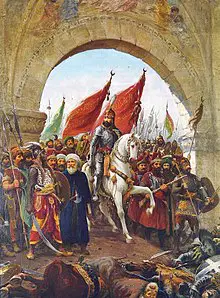
Mehmed II conquered Constantinople. Which of the following would have been a result/effect of his actions?
Trade increased between Asia and Europe.
He created Istanbul which become the holiest city of the Islamic faith.
The center for trade moved from the Arabian Peninsula to East Asia.
The Ottoman Turks established their Empire as the dominant power in the region.
"Increased costs, political and religious tensions, and instability
resulted in an increased importance on finding new ways to access Asian luxury goods. There was a renewed
focus on the discovery of trade routes outside the reaches of the Islamic world. Necessity resulted in an Age
of Exploration for European nations with undiscovered lands soon to be found."
What major impact is this passage describing?
Religious wars resulted in a decline in the Ottoman Empire leading to a decrease in trade.
European Kingdoms looking for new trade routes to get goods from Asia.
Islamic Empires cut off trade with outside regions as a result of continued conflicts.
East Asian kingdoms refused to trade with Europe as a result of religious conflict.

